The RAM Crisis Is Real - But Not Where Everyone Thinks
Everyone is screaming about a “RAM shortage.” The data says something more interesting: there isn’t one crisis. There are four. And only some of them are physics.

Let’s start with the number that broke people’s brains.
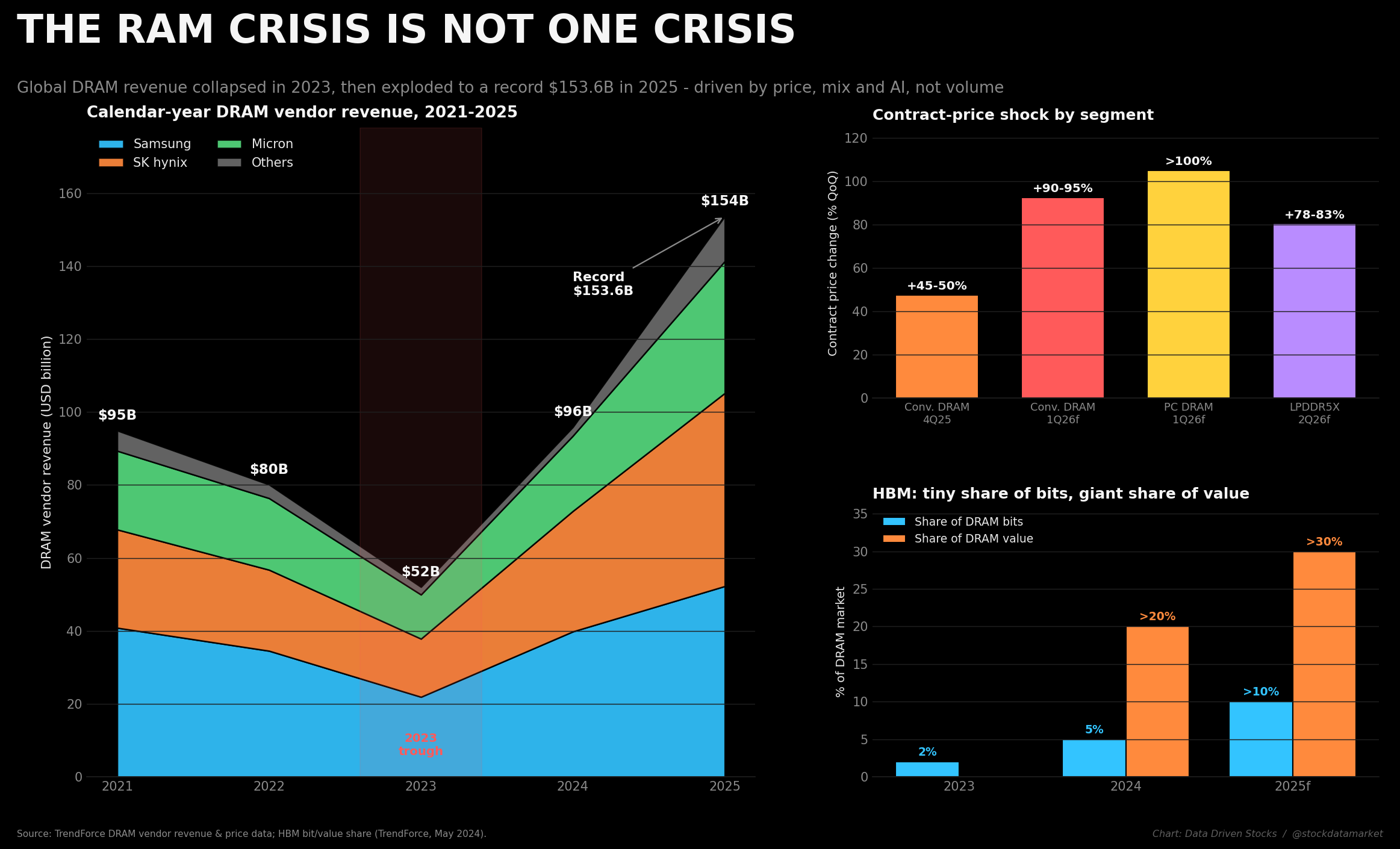
In the fourth quarter of 2025, the global DRAM industry pulled in $53.58 billion in revenue, up 29.4% in a single quarter. Conventional DRAM contract prices jumped 45-50% quarter over quarter. Then TrendForce looked at the first quarter of 2026 and forecast conventional DRAM prices rising another 90-95%, with PC DRAM going up by more than 100% and server DRAM around 90%. A 32GB DDR5 server module that Samsung sold for roughly $149 in September 2025 was going for about $239 by November. That is not a typo, and it is not normal cyclicality. That is a market that lost its mind in about six months.
So naturally the internet did what the internet does. Half of it decided this was an organic, AI-driven supply shock that nobody could have prevented. The other half decided it was a stitch-up, a quiet cartel jacking up prices while pretending the wafers ran out. Both camps are partly right, and both are mostly wrong, because they are arguing about “the RAM market” as if it were one thing.
It isn’t. So let’s actually go through it.
The shape of the cycle
Memory is the most violent cyclical business in tech, and the last five years are a clean demonstration. TrendForce vendor revenue puts the global DRAM market at roughly $94.9 billion in 2021, then $80.1 billion in 2022 as the bubble deflated, then a brutal $52.0 billion trough in 2023. That was the year memory makers were quite literally selling chips below cash cost and praying. Then it snapped back to $95.9 billion in 2024 and detonated to $153.6 billion in 2025.
One honest caveat on those annual figures, because precision matters here. They are sums of TrendForce’s quarterly vendor-revenue tables, and different trackers slice the market differently. Yole Group puts 2025 DRAM closer to $129 billion, while TrendForce’s own full-year market estimate runs as high as $165.7 billion. The shape of the cycle is identical no matter whose number you use - the collapse and the explosion are the same. Only the altitude changes.
Look at it by quarter and it’s even more dramatic. The industry bottomed at about $9.7 billion in the first quarter of 2023. By the fourth quarter of 2025 it was running at $53.6 billion. That’s a 5.5x climb off the floor in eleven quarters, and the steepest part happened in the back half of 2025.

Here’s the thing that matters, though. The 2025 surge was not a volume story. Bit shipments grew, sure, but the explosion in revenue came from price and from mix - selling more of the expensive stuff and charging far more for the rest. Samsung’s fourth-quarter revenue climbed about 43% quarter over quarter, but its bit shipments only grew in the low single digits. The money came from average selling prices going up roughly 40%. Hold onto that. It’s the whole argument.
The companies, one by one
The DRAM business is an oligopoly, full stop. Three companies - Samsung, SK hynix and Micron - own the overwhelming majority of it, with a tail of Taiwanese and Chinese makers picking up scraps. When three firms control a market, “the market” and “what those three firms decide to do” become almost the same sentence. So let’s look at what each of them actually did.
SK hynix is the cleanest illustration of the new regime, because it leaned hardest into HBM and got paid for it. Full-year 2025 revenue hit 97.1 trillion won, up 47% year over year, with operating profit of 47.2 trillion won. Then the first quarter of 2026 happened: 52.6 trillion won of revenue, a 72% operating margin, and a net margin of 77%. Read that again. A memory company posted a 72% operating margin, which is fatter than Nvidia’s, fatter than TSMC’s. SK hynix generated more operating profit in that single quarter than it did in all of 2024. And crucially, it has already sold out its entire 2026 output of DRAM, NAND and HBM. The chairman has openly warned that wafer shortages could run until 2030. When your customers have pre-bought the whole year and you still can’t make enough, you have pricing power that borders on the absurd.
Samsung is the giant that briefly lost the crown and took it back. Its broad Memory sales (which lump DRAM together with NAND) went from 72.6 trillion won in 2021 down to 44.1 trillion in the 2023 trough, then back up to 84.5 trillion in 2024 and 104.1 trillion in 2025. On the DRAM-specific scoreboard, Samsung regained the number-one spot in the fourth quarter of 2025 with $19.30 billion of revenue and a 36% market share, having ceded ground to SK hynix during the HBM scramble. In the first quarter of 2026 its semiconductor division alone booked 81.7 trillion won of revenue and 53.7 trillion won of operating profit. Samsung is also the company Korean media quote as saying it would “minimize oversupply risk” - more on that loaded phrase later.
Micron is the most useful of the three because it’s American, files real audited numbers with the SEC, and tells you more than the Koreans do. Its DRAM revenue ran $20.0 billion in fiscal 2021, $22.4 billion in 2022, then collapsed to $11.0 billion in the 2023 down-cycle, recovered to $17.6 billion in 2024, and ripped to $28.6 billion in fiscal 2025. By its fiscal second quarter of 2026 the company was posting a 74.4% GAAP gross margin and guiding the next quarter to about $33.5 billion of revenue at an 81% gross margin. Eighty-one percent gross margin. On memory chips. The thing that was selling below cost two years earlier.
Then there’s the tail, and it matters more than it looks. Nanya in Taiwan saw fourth-quarter 2025 revenue jump 54.7% quarter over quarter as it hoovered up demand that the big three abandoned. China’s CXMT has been the single most aggressive capacity-builder in the industry, ramping legacy and mid-tier DRAM precisely because the leaders walked away from it. This is the pressure-release valve, and it’s a real one - but it cannot replace advanced server or HBM capacity, and it can’t do it fast.
Now the part nobody separates: the RAM types
This is where the “is it one crisis” question falls apart, because DDR4, DDR5, HBM and the LPDDR mobile family are behaving like four completely different markets.

DDR4 is the legacy crisis, and it’s the most obviously engineered one. This is old memory. The big three want out of it so they can put those mature wafers toward higher-value products. So they announced end-of-life timelines and cut output. The problem is that a huge chunk of the real economy - industrial gear, cars, networking equipment, medical devices, cheap PCs, older servers - still needs DDR4 and cannot just switch. Cut the supply of something with stubborn demand and the price goes vertical. Server DDR4 contracts rose 18-23% in the second quarter of 2025, and consumer DDR4 was forecast up 85-90% by the third quarter. At points in the cycle, an 8GB DDR4 chip was selling for more than its DDR5 equivalent, which is economically insane and tells you everything. Even Micron firing up older Fab 6 capacity for DDR4 isn’t expected to fix it quickly.
HBM is the physical bottleneck, and it’s the one closest to genuine, unavoidable scarcity. High-bandwidth memory is the stacked stuff that sits next to AI accelerators. It sells for several times the price of conventional DRAM - roughly five times the price of DDR5 - and it’s brutally hard to make. It chews up advanced DRAM dies, through-silicon-via interconnects, stacking and back-end packaging capacity, all of which are constrained and slow to expand. And here’s the chart that explains the whole industry’s behavior: HBM was about 2% of DRAM bit capacity in 2023, 5% in 2024, and was set to exceed 10% in 2025. But by value it went from over 20% of the DRAM market in 2024 to potentially over 30% in 2025. Tiny share of the bits. Huge share of the money. If you’re a supplier, you’d be negligent not to throw every wafer you can at it.
DDR5 is the allocation crisis. This one is real but more nuanced. AI and cloud demand started in HBM, then spilled outward into high-capacity server modules and general-purpose servers, then into PC allocation. Contracts went berserk - that 90-95% conventional-DRAM forecast for early 2026 is mostly a DDR5 story. But it is not uniformly broken everywhere, which is the single most important nuance in this entire saga, and we’ll get to the China data point in a second.
The LPDDR mobile family is the spillover crisis. Here’s a detail that kills the lazy narrative. In mid-2025, LPDDR5X - the modern mobile memory in good phones - was actually relatively healthy, forecast up only 10-15% in the third quarter. The real mobile bottleneck back then was LPDDR4X, the older stuff, up 38-43%, because cheap and mid-range phone chips still needed it while suppliers were fleeing it. So mobile’s pain started in the legacy product, exactly like DDR4. Then it spread. By the first quarter of 2026 both LPDDR4X and LPDDR5X were forecast up around 90%, and the second-quarter 2026 forecast had LPDDR4X up 70-75% and LPDDR5X up 78-83%. The crisis didn’t start everywhere. It migrated.

So what actually caused this?
The honest answer has three layers, and you need all three.
Layer one is a genuine demand shock. AI is not a meme here. The build-out went from training a handful of giant models to running inference everywhere, and that pushed cloud providers to expand not just AI servers but general-purpose servers too. Yole Group pegged the total memory market at around $170 billion in 2024 and nearly $200 billion in 2025, with HBM roughly doubling to about $34 billion. Goldman Sachs widened its estimate of the 2026 DRAM supply gap from 3.3% to 4.9%. When the gap between what the world wants and what exists is measured in single-digit percentages of a market this size, prices don’t drift. They snap.
Layer two is product-mix displacement. This is the quiet killer. Every wafer a supplier commits to HBM or premium server DDR5 is a wafer not making cheap DDR4 or LPDDR4X. The shortage in the boring products is partly a side effect of the boom in the exciting ones. The factory floor is finite.
Layer three is supplier discipline, and this is where “engineered” stops being a conspiracy word and becomes a description. The producers are spending - TrendForce sees DRAM capex rising from $53.7 billion in 2025 to $61.3 billion in 2026, up 14%. But that money is going into process upgrades, hybrid bonding, through-silicon vias, HBM and high-value products, not into cheap commodity wafer expansion. That is precisely how you get rising investment and zero short-term relief at the same time. Korean reporting has Samsung and SK hynix controlling about 70% of the DRAM market, with Samsung reportedly able to fill only around 70% of its DRAM orders and openly stating it would minimize oversupply risk. Suppliers also moved to shorter contracts so they could keep repricing upward. None of these moves are illegal. All of them tighten the market and fatten margins.

Okay, but is it artificial?
This is the question everyone actually wants answered, so let’s be disciplined about it instead of vibing.
First, the strongest evidence that it is not purely a manufactured panic: early 2025 wasn’t a crisis at all. In the first quarter of 2025, DRAM revenue actually fell 5.5% quarter over quarter to about $27 billion, with conventional prices still sliding. If this were a coordinated price-fixing scheme switched on at will, you’d expect it to start earlier and cleaner. It didn’t. The shock built through the back half of 2025 as AI demand genuinely overran supply.
Second, the cleanest anti-panic data point: in May 2026, retail and secondary-market DDR5 in China corrected by around 25-30% off its highs. Cue the “see, it was all fake” takes. Except TrendForce framed this correctly - that spot and secondary channel is only about 1-5% of the total DRAM market. A small, overheated resale channel cooling off does not refute a contract-market shortage where the actual volume trades. It’s a real counter-signal, but it’s a small one.
Third, the history is genuinely ugly, which is why skepticism is rational. DRAM makers were fined by US and EU authorities for price-fixing in the 2000s and 2010, and China opened a probe into Samsung, SK hynix and Micron in 2018 after an earlier price spike. So the suspicion isn’t paranoid. But - and this matters - a US appeals court in 2022 looked at the kind of behavior we’re describing here, parallel capex cuts and price signaling, and treated it as more consistent with “conscious parallelism” (everyone rationally reading the same market) than with a proven illegal conspiracy. That’s the legal line, and the current public evidence doesn’t cross it. You can have an oligopoly that behaves with iron discipline, reads each other’s moves perfectly, and never sends a single incriminating email. From the outside it looks identical to a cartel. It just isn’t provable as one.
So the fair verdict is uncomfortable for both camps. It is not fake. It is not a proven cartel. It is a real demand shock, plus a real mix displacement, plus very real and very rational supplier discipline that amplifies the squeeze. Real and engineered at the same time.
A quick word on the “$/GB”
I wanted to post $/GB of DRAM memory. But I quickly found out it’s quite impossible. Samsung reports broad Memory sales that fold DRAM and NAND together. SK hynix reports total company revenue. Even Micron, the most transparent, gives you audited DRAM revenue and qualitative bit-shipment and pricing commentary, but not the exact gigabytes shipped by product mix. So the most you can honestly build is an index, not an audited price per gigabyte.

That index tells a clean story anyway. Using Micron’s own disclosed revenue and its language about bit and price movements, the implied revenue per bit roughly halved into the 2023 trough and then climbed back hard through 2025. And the cycle from 2022 may repeat in 2026 (making 2026 another 2022 for the DRAM industry).
What this means if you actually buy or build things
For consumers and PC builders, the pain is real and probably not over soon. Module prices have already moved, and with contract forecasts where they are, that flows through to retail. If you’ve been putting off a memory upgrade, the cheap window is behind you for a while.
For the device makers - phone brands, server builders, anyone with memory on their bill of materials - this is a margin event. The cost is getting passed down the chain, and 2026 products are being priced around it.
For investors, the uncomfortable truth is that the memory makers have rarely looked better and rarely looked more dangerous at the same time. Margins like SK hynix’s 72% don’t last forever in a commodity business - they never have. The bull case is that AI has structurally changed the demand floor and that supply discipline holds. The bear case is the oldest one in this industry: every memory supercycle ends when the capacity that’s being built today finally lands and the same three companies flood the market to grab share. This isn’t investment advice, and I’m not your financial advisor - but anyone who’s watched this sector knows the cycle has a back half.
The shortage is real. The prices are real. The margins are very real. Just don’t let anyone tell you it’s a simple story. It’s four markets, three companies, and a whole lot of rational behavior that happens to look like a conspiracy if you squint. And it may end just as quickly as it began. Remember DRAM market is highly cyclical.
Sources
TrendForce, “Price Rally Drives 4Q25 DRAM Revenue Up 29.4%; Samsung Regains No. 1 Market Share” - https://www.trendforce.com/presscenter/news/20260226-12937.html
TrendForce, “Memory Price Outlook for 1Q26 Sharply Upgraded” - https://www.trendforce.com/presscenter/news/20260202-12911.html
TrendForce, “Mobile DRAM Contract Prices Continue Rising in 2Q26” - https://www.trendforce.com/presscenter/news/20260514-13044.html
TrendForce, “Tightening of LPDDR4X Supply Drives Up Prices” - https://www.trendforce.com/presscenter/news/20250717-12647.html
TrendForce, “Rising Demand and EOL Plans Drive Strong DDR4 Contract Price Hikes in 2Q25” - https://www.trendforce.com/presscenter/news/20250605-12608.html
TrendForce, “DDR4, LPDDR4 Supply Sharply Contracts; Structural Shortage in 2H25” (Taiwan) - https://www.trendforce.com.tw/presscenter/news/20250811-12665.html
TrendForce, “DRAM Revenue Drops 5.5% in the First Quarter of 2025” - https://www.trendforce.com/presscenter/news/20250603-12603.html
TrendForce, “HBM Prices to Increase by 5-10% in 2025, Accounting for Over 30% of Total DRAM Value” - https://www.trendforce.com/presscenter/news/20240506-12125.html
TrendForce, “Memory Industry to Maintain Cautious CapEx in 2026” - https://www.trendforce.com/presscenter/news/20251113-12780.html
TrendForce, “Unpacking the DDR5 Price Correction in China” - https://www.trendforce.com/news/2026/05/20/news-unpacking-the-ddr5-price-correction-in-china-true-market-shift-or-short-term-fluctuation/
TrendForce, “Micron Fab 6 Starts LPDDR4 and DDR4 Production, but DDR4 Shortage Is Expected to Persist” - https://www.trendforce.com/presscenter/news/20260526-13116.html
TrendForce DRAM research category (vendor revenue tables) - https://www.trendforce.com/research/category/Semiconductors/DRAM
Micron Technology, FY2025 Form 10-K - https://www.sec.gov/Archives/edgar/data/723125/000072312525000028/mu-20250828.htm
Micron Technology, Fiscal Q2 2026 results - https://investors.micron.com/news-releases/news-release-details/micron-technology-inc-reports-results-second-quarter-fiscal-2026
Samsung Electronics, First Quarter 2026 Results - https://news.samsung.com/global/samsung-electronics-announces-first-quarter-2026-results
Samsung Electronics, 4Q25 earnings presentation - https://images.samsung.com/is/content/samsung/assets/global/ir/docs/2025_4Q_conference_eng.pdf
SK hynix, FY25 financial results - https://news.skhynix.com/sk-hynix-announces-fy25-financial-results/
SK hynix, 1Q26 financial results - https://www.prnewswire.com/news-releases/sk-hynix-announces-1q26-financial-results-302750959.html
Reuters, “Samsung hikes memory chip prices by up to 60% as shortage worsens” - https://www.reuters.com/world/china/samsung-hikes-memory-chip-prices-by-up-60-shortage-worsens-sources-say-2025-11-14/
Reuters, “SK hynix says it has sold out all 2026 output” - https://www.reuters.com/technology/sk-hynix-says-it-has-sold-out-all-2026-output-shares-jump-2025-10-29/
Reuters, “The AI frenzy is driving a new global supply chain crisis” - https://www.reuters.com/world/china/ai-frenzy-is-driving-new-global-supply-chain-crisis-2025-12-03/
Yole Group, “Memory market surges beyond expectations: almost $200 billion in 2025 driven by HBM & AI” - https://www.yolegroup.com/press-release/memory-market-surges-beyond-expectations-almost-200-billion-in-2025-driven-by-hbm-ai/
Counterpoint Research, Global DRAM and HBM market share - https://counterpointresearch.com/en/insights/global-dram-and-hbm-market-share
The Korea Economic Daily (Hankyung), DRAM supply discipline reporting - https://www.hankyung.com/article/2025120168881
US Department of Justice, DRAM antitrust enforcement (2005) - https://www.justice.gov/archive/atr/public/press_releases/2005/209571.htm
European Commission, DRAM cartel decision (2010) - https://ec.europa.eu/commission/presscorner/detail/en/ip_10_586
US Court of Appeals for the Ninth Circuit, DRAM antitrust opinion (2022) - https://cdn.ca9.uscourts.gov/datastore/opinions/2022/03/31/20-16862.pdf