The Internet Stopped Being Human: How Bots and AI Quietly Took Over Social Media
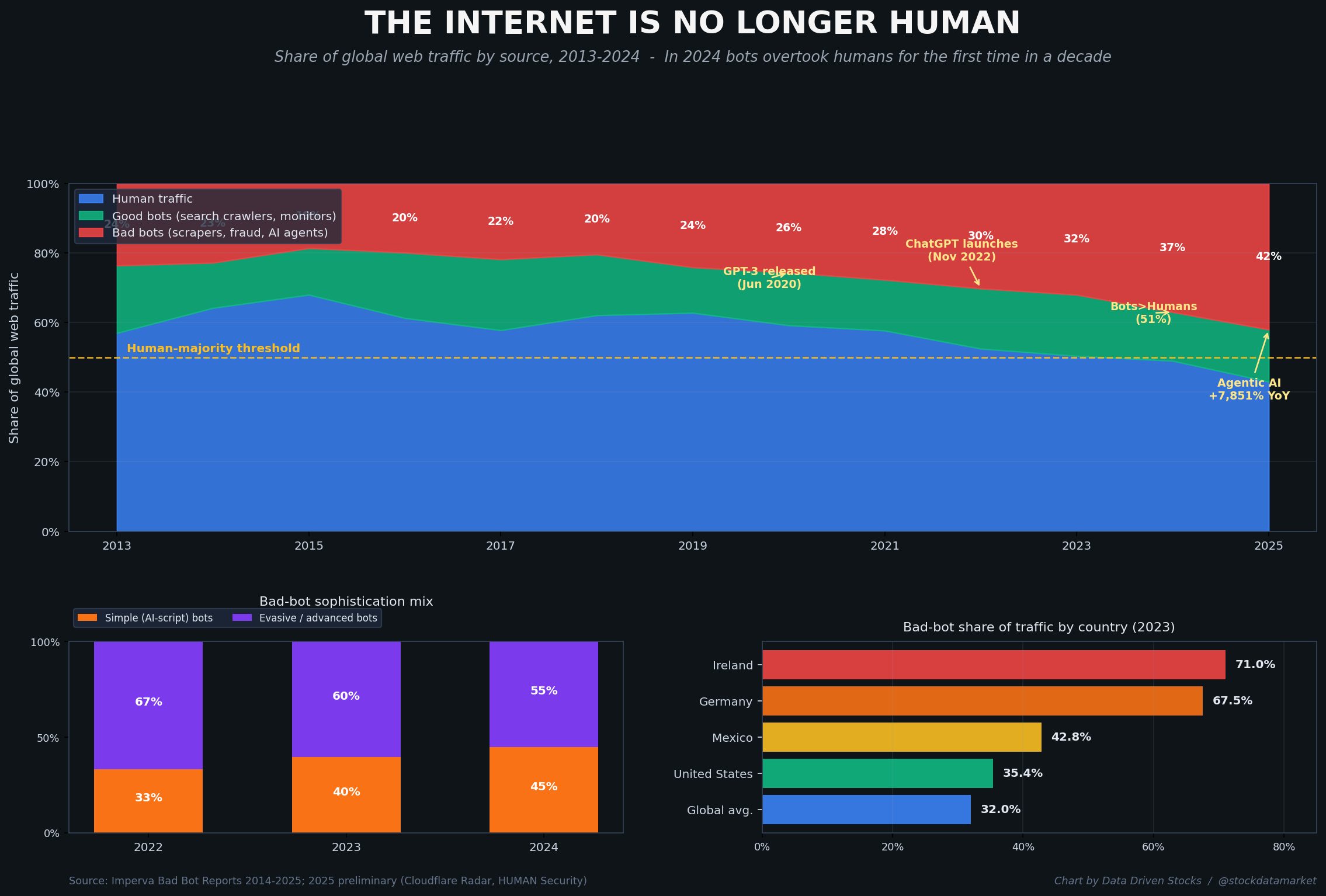
For the first time in a decade, more than half of all web traffic in 2024 came from machines, not people.

For the first time in a decade, more than half of all web traffic in 2024 came from machines, not people. That used to be the headline. By the end of 2025, automated traffic was growing eight times faster than human traffic, and a new category nobody was tracking two years ago - agentic AI - had grown 7,851% in twelve months. The “dead internet” stopped being a meme and started being a measurement, then started being a structural fact.
The pre-LLM era: spam at industrial scale
Before ChatGPT, “bot” mostly meant something cheap and dumb. Twitter said in 2013 that fewer than 5% of its accounts were fake, roughly 20 million at the time. Academic teams kept finding numbers two to three times higher. The gap was the entire story: the platforms had a financial reason to undercount and the researchers had a methodology that company PR could not.
What was hard to argue with was the enforcement. In May and June 2018 alone, Twitter suspended about 70 million accounts. TikTok, in its first transparency report, removed 9.5 million spam accounts in the second half of 2020 and blocked 173 million automated signup attempts. These were not AI agents. They were credential-stuffers, scrapers, follower farms and crypto spammers - the boring industrial backbone of social manipulation.

The 5% question
Nothing illustrates the credibility gap better than the Musk-Twitter fight of 2022. Twitter kept saying “fewer than 5%.” Musk countered with “at least 20%.” Both sides were arguing about a number that, technically, nobody could verify from the outside. Three years later the question is still unsettled. In October 2025, X’s head of product Nikita Bier publicly stated that 80% of crypto content on the platform was bots and announced a purge of 1.7 million reply bots in a single sweep. By February 2026, X was rolling out “human-only interaction” rules. Meta’s transparency reports kept hovering near 4%, which on a 3.54 billion user base still works out to roughly 142 million fake profiles.

What 2025 actually looked like
The 2025 numbers are where the story changes shape. Cloudflare, which sees roughly a fifth of global web traffic, reported in its 2025 Year in Review that non-AI bots generated 50% of HTML page requests, seven percentage points above human traffic, and that AI crawlers had overtaken traditional search engine crawlers as the largest crawler category. HUMAN Security’s 2026 State of AI Traffic Report, published in March 2026, found that automated traffic grew 23.5% in 2025 against 3.1% growth for humans - an 8x divergence in a single year. Median scraping attack rates approached 20% of all traffic. Account takeover attempts quadrupled. Akamai measured AI bot activity surging 300% across 2025. DataDome counted 7.9 billion AI agent requests in just January and February 2026.
The most striking number is agentic AI traffic, the kind generated by autonomous AI agents that browse, fill forms, and complete transactions on their own. HUMAN Security clocked it at +7,851% year-over-year. OpenAI bots accounted for roughly 69% of all observed AI-driven traffic, Meta-ExternalAgent 16%, and Anthropic 11%. On the malicious side, Imperva attributed 54% of GenAI-enabled attacks to ByteSpider Bot alone, with AppleBot at 26%, ClaudeBot at 13%, and ChatGPT User Bot at 6%.

The platforms cannot keep up
The 2025 enforcement numbers are stark. Meta actioned roughly 687 million fake accounts in Q2 2025 alone. X suspended an estimated 800 million accounts across full-year 2024 - more than its entire active user count. LinkedIn removed 83.7 million fake accounts in the first half of 2025, with 97% caught by automated defenses. TikTok removed 118.6 million fake accounts in Q3 2025 and wiped 4.3 billion fake likes and follows in Q1. YouTube removed 5.3 billion comments in 2024, a 47% jump year-over-year. Reddit deletes about 100,000 bot accounts per day; in March 2026 it launched a human verification system using passkeys and government ID after co-founder Alexis Ohanian warned the internet was becoming a “bot wasteland.”
The content side is where it gets uncomfortable. A peer-reviewed ACL 2025 study analyzing 2.4 million posts found AI attribution rates surged from 1.77% to 37.03% on Medium and from 2.06% to 38.95% on Quora between January 2022 and October 2024. A USC team led by Emilio Ferrara found that roughly 12.33% of images about the 2024 U.S. election on X were AI-generated, and just 10% of accounts spread 80% of them - many of them X Premium subscribers behaving like bots. NewsGuard, as of March 2026, was tracking 3,006 AI content farm sites across 16 languages, with 300 to 500 new ones appearing every month.
Regulators finally bite
Governments noticed late but started moving in 2025. The EU fined X €120 million in December 2025 under the Digital Services Act for deceptive blue-checkmark design and insufficient transparency - the first big DSA penalty against a major platform. The UK’s Ofcom opened formal Online Safety Act investigations into X and an AI companion chatbot service. The US FTC issued Section 6(b) orders to seven companies including Meta, OpenAI, Snapchat, X and Google about AI chatbot safety practices for minors. NATO StratCom published a new report in April 2026 titled “Beyond Spam Bots: The Rise of AI-Powered Disinformation Machines” documenting that roughly 7.9% of tracked interactions across ten platforms now show statistical signs of coordination, with Kremlin-aligned messaging appearing roughly twice as often as pro-Western counterparts. None of these will catch a Russian troll farm. All of them will reshape how legitimate platforms label, watermark and moderate AI content.
So what does this mean for the feed in front of you
Three things are true at once. First, the share of automated web traffic crossed 50% in 2024 and Cloudflare’s CEO Matthew Prince told an SXSW audience in March 2026 that the human-bot crossover is now a permanent structural fact, with bots set to durably exceed humans by 2027. Second, the share of that automation that is adaptive - that learns, writes, replies, evades, completes transactions - was effectively zero in 2021 and grew nearly 80x in 2025 alone. Third, the platforms’ own numbers and the independent numbers still disagree by a factor of two to four, and the 2026 Imperva Bad Bot Report, expected within days of this article, will likely confirm 2025’s bad-bot share cleared 40%.
The honest summary is the uncomfortable one. The social internet you scroll is no longer a place where humans occasionally meet bots. It is a place where bots occasionally meet humans, and the bots are now writing the conversations the algorithm shows you.
Sources
Imperva / Thales, 2025 Bad Bot Report: How AI is Supercharging the Bot Threat, https://www.imperva.com/blog/2025-imperva-bad-bot-report-how-ai-is-supercharging-the-bot-threat/
HUMAN Security, 2026 State of AI Traffic & Cyberthreat Benchmark Report, March 2026, https://www.humansecurity.com/learn/blog/ai-traffic-growth-2025-key-findings/
Cloudflare, 2025 Radar Year in Review, December 2025, https://blog.cloudflare.com/radar-2025-year-in-review/
Akamai, Online Fraud and Abuse 2025: AI Is in the Driver’s Seat, https://www.akamai.com/blog/security-research/online-fraud-abuse-2025-ai-drivers-seat
DataDome, 2025 Global Bot Security Report, https://datadome.co/press/datadome-report-finds-most-organizations-flying-blind-as-agentic-traffic-surges/
Yang & Menczer, Anatomy of an AI-Powered Malicious Social Botnet, arXiv:2307.16336, Indiana University Observatory on Social Media, 2023.
Sun et al., Are We in the AI-Generated Text World Already?, ACL 2025, arXiv:2412.18148.
Ferrara et al., From Pixels to Polls: AI-Generated Images on X during the 2024 U.S. Election, arXiv:2502.11248, ACM Hypertext 2025.
NewsGuard, AI Tracking Center, https://www.newsguardtech.com/special-reports/ai-tracking-center/
NATO StratCom Centre of Excellence, Virtual Manipulation Brief 2025, https://stratcomcoe.org/publications/virtual-manipulation-brief-2025-from-war-and-fear-to-confusion-and-uncertainty/320
Pew Research Center, Teens, Social Media and AI Chatbots 2025, December 2025, https://www.pewresearch.org/internet/2025/12/09/teens-social-media-and-ai-chatbots-2025/
Meta, Community Standards Enforcement Reports 2024-2025, https://transparency.meta.com/reports/community-standards-enforcement/
TikTok, Community Guidelines Enforcement Reports Q1-Q3 2025, https://www.tiktok.com/transparency/
European Commission, DSA enforcement action against X, December 2025.