The Helium Choke Point Behind AI Chips
A balloon gas, two countries, one Gulf strait, and the most advanced supply chain on Earth

Here is a number that should not be allowed to matter as much as it does. The entire world produced about 190 million cubic meters of helium in 2025. That is the whole planet, every gas field, every refinery, every cylinder. It sounds like a lot until you put it next to oil, where the world burns through roughly 100 million barrels in a single day.
Helium is small. Tiny, even. And that is exactly why it can break things quietly.
Because while nobody was paying attention, helium quietly wedged itself into the one industry the entire global economy is currently betting its future on: semiconductors. Not as a headline input like silicon or copper, but as a utility. The gas that keeps the lights on. The thing nobody notices until it is gone.
In March 2026, it almost went gone. So let us walk through it properly, because this is one of those stories where the small print is the whole story.
What helium actually is, and why it is a hostage
Most people meet helium at a kid’s birthday party. The semiconductor industry meets it at the bottom of a cryogenic tank at minus 269 degrees Celsius, which is about as cold as anything gets in this universe.
Here is the part that makes helium weird as a commodity. You cannot really go drill for it on purpose. Almost all commercial helium is a byproduct of natural gas processing. It builds up over geological time as radioactive elements decay deep underground, gets trapped in the same reservoirs as natural gas, and the only economical way to capture it is to skim it off while you are already processing that gas at industrial scale. If the gas plant stops, the helium stops. There is no separate helium spigot to open.
That single fact is the root of everything that follows. Helium supply is welded to natural gas infrastructure, which means helium inherits all of natural gas’s geography and all of its geopolitics, whether it wants to or not.
It also has almost no understudy. The U.S. Geological Survey is blunt about this: for the genuinely cold applications, the ones below minus 429 degrees Fahrenheit, nothing substitutes for helium. You can swap argon into welding and hydrogen into balloons, but when you need to move heat around at the edge of physics, helium is the only actor who shows up.
Supply recovered. The buffer did not come back.
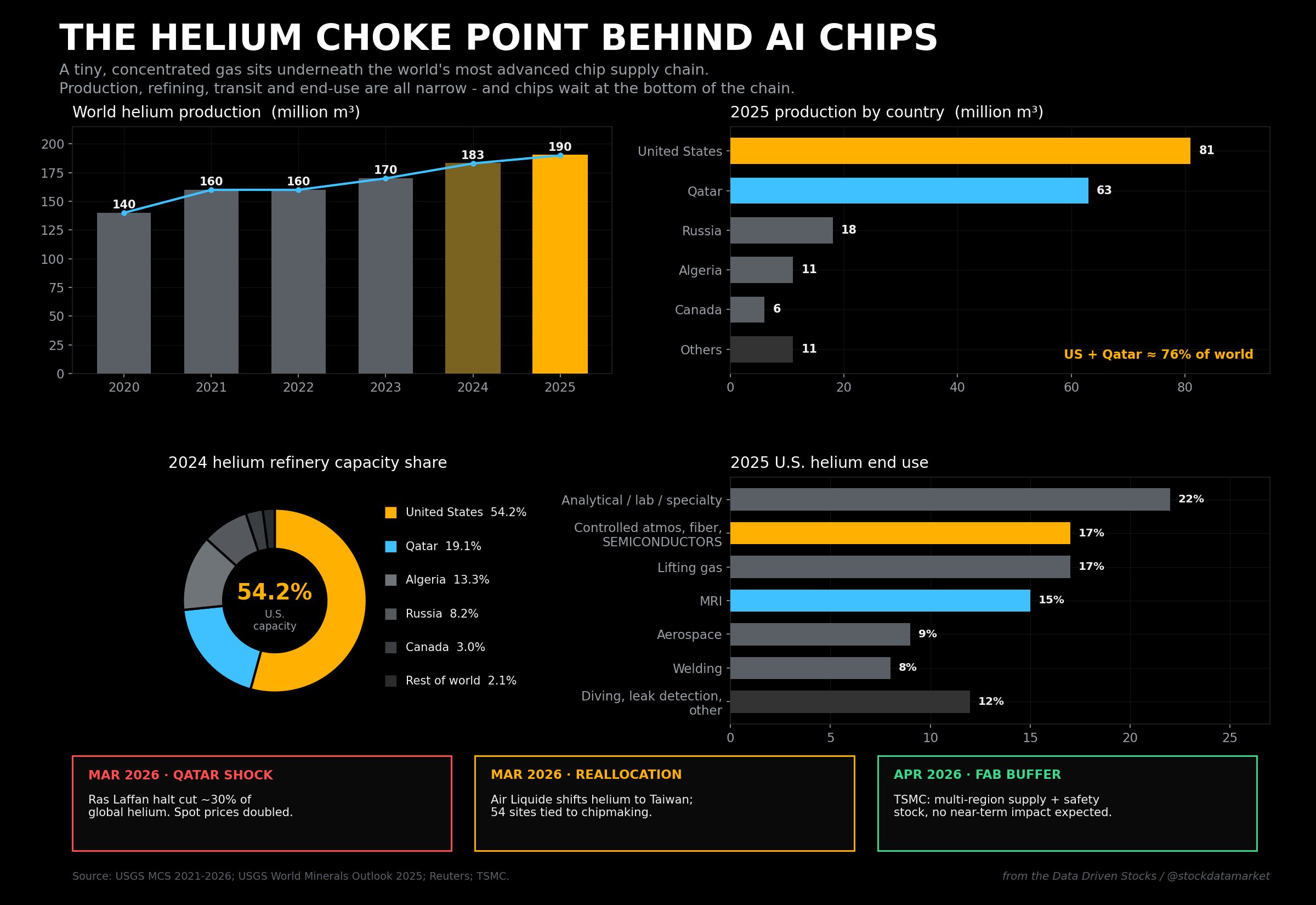
The good news first. Helium supply did recover from its pandemic low. Output bottomed at around 140 million cubic meters in 2020, clawed back to 160 in 2021 and 2022, hit 170 in 2023, and the latest official figures put 2024 at a revised 183 and 2025 at an estimated 190.
So the chart goes up and to the right, and you would be forgiven for thinking the helium scare of a few years ago was over.

The problem is what is not on that chart: the cushion. The United States used to sit on a giant federal helium reserve, a literal underground stockpile near Amarillo, Texas, that acted as the global shock absorber whenever a producer hiccupped. That system was sold off, with the assets transferred in 2024, and by 2025 the official government stockpile is listed as none. The training wheels came off right as the bike started going faster.
You can see the market still flinching in the price. The official U.S. Grade-A base price sat at $210 per thousand cubic feet in 2020 and 2021, then ran to $310 in 2022 and all the way to $390 in 2023 and 2024 before easing back to $330 in 2025. Remember, that is the posted base price, before transport, before surcharges, before the emergency premiums that show up when buyers are panicking. The market recovered in volume but it never forgot what scarcity felt like.
Two countries. Most of the helium.
Now we get to the part that turns a supply story into a risk story.
Of that 190 million cubic meters in 2025, the United States produced about 81 and Qatar about 63. Add those two together and you are at roughly 76 percent of the entire world’s helium coming from just two countries. Russia is a distant third at 18, hobbled by sanctions and chronic underperformance at its Amur plant. Then Algeria at 11, Canada at 6, China and Poland at 3 each, and South Africa rounding out the list at less than half a million.
This is not a diversified market. This is two suppliers and a rounding error.

And here is the kicker. Production concentration is only half the picture, because raw extraction is not the same as refined, liquid, ready-to-ship helium. Only a slice of what comes out of the ground ever gets purified to Grade-A. The real chokepoint is refining capacity, and that is even more lopsided than production.
In the USGS capacity outlook, the United States alone holds 54.2 percent of the world’s helium refinery capacity. Qatar is second at 19.1, then Algeria at 13.3, Russia at 8.2, Canada at 3.0, and everyone else combined at 2.1. So the supply chain has a concentration problem on top of a concentration problem. Geology is narrow, and the machines that turn geology into a usable product are narrower still.
[INSERT IMAGE: 05_refinery.png]

The whole chain, in one picture
Before we go anywhere near a chip, it helps to see the full pipeline laid out, because the mistake everyone makes is assuming the risk lives in one place. It does not. The fragility is spread across the whole chain, and the chain only gets narrower as you move along it. A vast amount of natural gas goes in at one end; a trace of refined, liquid helium comes out the other; and a chip fab is the very last thing standing in line.
[INSERT IMAGE: schema_supply_chain.png]

Walk it from left to right. It starts in a gas field, where helium is barely a rounding error in the gas stream, around 0.04 percent in Qatar’s case. It gets purified at a refinery, and that refining capacity is wildly concentrated. It then has to move as a cryogenic liquid in specialized containers that must be cycled back for refill, in a market so small there is almost no spare storage to lean on. Then it hits the layer that matters most in a crisis: the middlemen.
Air Liquide, Linde, Air Products, and Iwatani are the gatekeepers. When supply gets tight, they do not hold an auction. They ration, and they ration in a brutal little hierarchy. The highest-priority uses like medical MRI and rocketry get essentially everything they need, semiconductor fabs come next, and the low-value stuff at the bottom, the welding and diving and party balloons, absorbs the deep cuts. When helium gets scarce, the balloon is the shock absorber so the MRI scanner does not have to be.
Here is the part worth holding onto, because it is the difference between a scare and a catastrophe. When Qatar went offline in 2026, the thing that actually kept the fabs running was not new production, because you cannot conjure new helium overnight. It was this supplier layer reshuffling existing volumes across regions, combined with the inventory the fabs had already stockpiled. The majors are the shock absorber, and the fab’s own safety stock is the seatbelt. Both are real, and both are finite. They buy weeks to months, not years. If a Gulf outage ever runs long enough to drain them, the squeeze stops being about price and starts being about whether the gas physically exists where the wafer is.
That is the chain. Now look at the single most exposed link in it.
The part of the chain everyone forgot: the Strait of Hormuz
Here is where the story stops being about chemistry and starts being about a 33-kilometer-wide stretch of seawater between Iran and Oman.
Qatar produces a third of the world’s helium. But Qatar is also a peninsula sticking into the Persian Gulf, and almost everything it exports by sea has to thread the same needle: the Strait of Hormuz. At its narrowest the strait is only about 20 miles across, with shipping lanes a couple of miles wide in each direction. It is the only maritime exit from the Gulf, and it is the single most concentrated energy chokepoint on the planet.

The scale is genuinely hard to overstate. Roughly 20 million barrels of oil a day moved through Hormuz in 2024, which is about a fifth of everything the world consumes and more than a quarter of all seaborne oil trade. On the gas side, around 20 percent of global LNG trade transits the strait, and almost all of it is Qatari. Qatar shipped well over 112 billion cubic meters of LNG in 2025, and the overwhelming majority of it left through Hormuz, because there is essentially no other way out. Only Saudi Arabia and the UAE have pipelines that can route some crude around the strait. Qatar has nothing comparable, and crucially, helium has no overland option at all. You cannot truck liquid helium across a continent in any meaningful volume. It exits through the Gulf, or it does not move.
And here is the subtle point that most coverage gets wrong. The 2026 helium crisis was not, primarily, a Hormuz-is-closed story. It was worse and more specific than that. The damage was upstream, at the plant itself. Helium does not get produced if the LNG processing is shut, full stop. So even with ships able to sail, if Ras Laffan is offline, the helium simply is not being made.
That is why, when Air Liquide’s CEO was asked about relief, he pointed not at the shipping lane but at the plant. In his framing, restarting the Ras Laffan LNG complex would bring faster relief than reopening Hormuz. The chokepoint matters. But the chokepoint plus the plant outage together is what made 2026 a genuine scare.
So why does a chip fab care about a cryogenic gas?
Now the semiconductor piece, and this is where you have to resist the easy headline. USGS does not say semiconductors alone consume 17 percent of U.S. helium. It says controlled atmospheres, fiber optics, and semiconductors together make up a combined 17 percent bucket. That is still one of the largest end-use categories in the country, and it puts chip-adjacent demand right near the top of the table, but it is a bucket, not a clean fab-only number.
[INSERT IMAGE: 06_enduse.png]
Caption: USGS reports controlled atmospheres, fiber optics, and semiconductors as a combined 17 percent U.S. helium end-use bucket in 2025. Note that lifting gas, the balloon use, is a minority. Source: USGS Mineral Commodity Summaries 2026.
Helium is also not the only rare gas the fab leans on. Krypton, xenon, neon, and argon all show up in chipmaking, and by some measures they are even more chip-heavy than helium. Around two-thirds of U.S. krypton use is semiconductor-related, with xenon at 36 percent and neon at 32 percent. Helium is one instrument in a whole rare-gas orchestra.
[INSERT IMAGE: 07_raregas.png]
Caption: Semiconductor and electronics exposure runs across the rare-gas family, with krypton and xenon especially chip-heavy in the USGS end-use split. Category definitions differ by gas, and helium’s 17 percent is a combined bucket. Source: USGS Mineral Commodity Summaries 2026.
But the reason helium specifically is hard to replace comes down to one job it does extremely well: moving heat. Inside an etch or deposition tool, the wafer sits clamped to an electrostatic chuck while a plasma blasts away at its surface. That plasma dumps heat into the wafer, and if the temperature drifts or goes uneven, your yield and your feature precision go with it. So the tool flows helium into a microscopic gap behind the wafer, where it conducts that heat down into the cooled chuck. The gas never becomes part of the chip. It just keeps the wafer from cooking unevenly.

This is the part chip-watchers miss. The risk is not really the price of the gas. Lam Research, which builds this equipment, frames it as a throughput problem: practical replacements move heat away more slowly, so if you swap helium out, your cooling steps lengthen and your tool runs slower. A fab’s entire economic model is uptime and throughput. Anything that quietly slows the line is a much bigger deal than a line item on the gas bill. Helium is buying speed and stability, and that is what is genuinely hard to substitute.
The 2026 shock, in real time
Everything above was the theory. In March 2026, the market got the live-fire exercise.
On March 2, QatarEnergy halted production at its Ras Laffan complex after the facility was caught up in regional conflict, and on March 4 it declared force majeure. Because helium is a byproduct, the helium stopped with the gas. By most industry estimates the outage knocked out around 30 percent of global helium supply in one stroke. The market, which has no deep spot exchange and barely any storage, did exactly what you would expect.

By March 12, Reuters was reporting that helium spot prices had doubled since the crisis began, citing helium consultant Phil Kornbluth. And here is that rationing hierarchy we flagged earlier, made concrete: in Kornbluth’s read, the highest-priority uses like medical MRI and rocketry would likely still get essentially all the helium they needed, semiconductor manufacturers might get around 95 percent, and the low-priority stuff at the bottom, the welding and the diving and yes, the party balloons, would absorb the deep cuts. When the gas gets scarce, the balloon is the shock absorber so the MRI scanner does not have to be.
Then the geography did its thing. Air Liquide said on March 25 that it expected a short-term shortage and would start reallocating helium from other regions into Taiwan, where it runs dozens of facilities tied to the chip industry. By March 31, Reuters reported that South Korea’s chipmakers, Samsung and SK Hynix, were sitting on roughly four to six months of inventory and buying up mostly U.S.-origin helium to plug the gap. Korea was uniquely exposed here, having sourced something like 64.7 percent of its 2025 helium imports from Qatar.
Why the fabs did not fall over
So did the AI buildout grind to a halt? No. And the reason is worth understanding, because it is the difference between a scare and a catastrophe.
The leading fabs were not standing there naked. When TSMC reported earnings on April 16, it was notably calm: it said it sources specialty chemicals and gases, including helium and hydrogen, from multiple suppliers across different regions, that it holds safety stock, and that it did not expect a near-term material supply impact, though it did warn that some gas and chemical prices would likely rise. That is the playbook. Multi-region sourcing, safety stock, and priority allocation from the gas majors who would much rather keep a fab running than a balloon vendor happy.
By late April, Air Liquide was pointing at the only thing that actually fixes the problem: a restart of Ras Laffan. The company also noted it can hold more than a year of helium supply in underground storage in Germany, which is the kind of buffer the United States used to have and gave up. Helium is only about 3 percent of Air Liquide’s sales, but it is strategically central to healthcare and electronics, which is exactly why it gets defended out of proportion to its revenue.
The honest read is this. The system bent and did not break. But it bent because of inventory and reallocation, and inventory and reallocation are measured in months. They are a bridge, not a foundation. If a Gulf outage ever runs long enough to drain those buffers, the squeeze stops being about price and starts being about whether the gas physically exists where the wafer is.
The forward problem: 190 today, 322 tomorrow
And that is before you account for where demand is heading.
The market-research firm IDTechEx, in work reported by Reuters, projected that global helium demand could exceed 322 million cubic meters by 2035, with demand from the semiconductor industry specifically rising something like five-fold over the decade. Put that next to 2025’s official production of 190 and the arithmetic gets uncomfortable. Even if supply just holds flat, you are staring at a gap of well over a hundred million cubic meters, with chips doing most of the pushing.

Treat that 2035 number for what it is, a forecast rather than a measured fact. New supply is coming, from Russia’s Amur ramp if it ever behaves, from new projects in Canada, the United States, and elsewhere, and from better recycling. But the demand curve is being bent upward by the single most capital-intensive build-out in modern industrial history, and the supply curve depends on natural gas economics, a few refineries, and a Gulf shipping lane.
The bottom line
Strip away the chemistry and the geopolitics and you are left with a very clean thesis. AI needs leading-edge wafers. Leading-edge wafers need process stability. Process stability needs specialty gases and precise cooling. And helium, the gas doing a lot of that cooling, depends on natural-gas-linked extraction, a tiny set of refineries, a single Gulf strait, and a handful of industrial-gas majors who quietly decide who gets supply when things go wrong.
The fab does not need balloons. It needs uptime. And uptime, it turns out, runs partly through a 20-mile-wide gap of water between Iran and Oman, and through a plant in Qatar that the whole world hopes keeps running. For a gas most people only associate with squeaky voices, that is a remarkable amount of the future to be resting on.
Watch the small print. It is usually where the real risk lives.
Sources
U.S. Geological Survey, Mineral Commodity Summaries 2026, Helium and Rare Gases. https://pubs.usgs.gov/periodicals/mcs2026/mcs2026-helium.pdf
U.S. Geological Survey, Mineral Commodity Summaries 2021-2025, Helium chapters (production, price, stockpile, and end-use history). https://pubs.usgs.gov/periodicals/mcs2025/mcs2025-helium.pdf
U.S. Geological Survey, World Minerals Outlook 2025 (helium refinery capacity shares). https://pubs.usgs.gov/sir/2025/5021/Version%201.0/sir20255021.pdf
QatarEnergy LNG, Ras Laffan Helium operations (Helium 1 and Helium 2 capacity and offtake). https://www.qatarenergylng.qa/english/Operations/Ras-Laffan-Helium
Reuters, “Helium prices soar as Qatar LNG halt exposes fragile supply chain,” March 12, 2026. https://www.reuters.com/business/energy/helium-prices-soar-qatar-lng-halt-exposes-fragile-supply-chain-2026-03-12/
Reuters, “Air Liquide executive will allocate helium volume from other places,” March 25, 2026. https://www.reuters.com/world/china/air-liquide-executive-will-allocate-helium-volume-other-places-world-2026-03-25/
Reuters, “Helium stocks of South Korea’s chipmakers to last until June, sources say,” March 31, 2026. https://www.reuters.com/business/energy/helium-stocks-south-koreas-chipmakers-last-until-june-sources-say-2026-03-31/
Reuters, “Air Liquide says Qatar’s Ras Laffan restart would bring quickest helium supply relief,” April 28, 2026. https://www.reuters.com/business/energy/air-liquide-posts-slight-q1-revenue-miss-2026-04-28/
TSMC, First Quarter 2026 Earnings Conference Transcript (helium/hydrogen multi-source supply and safety stock). https://investor.tsmc.com/english
Reuters, “Helium demand to double by 2035, tracking chip production boom, report says” (IDTechEx), September 9, 2024. https://www.reuters.com/business/energy/helium-demand-double-by-2035-tracking-chip-production-boom-report-says-2024-09-09/
U.S. Energy Information Administration, World Oil Transit Chokepoints / Strait of Hormuz analysis. https://www.eia.gov/international/content/analysis/special_topics/World_Oil_Transit_Chokepoints/
International Energy Agency, Strait of Hormuz (oil and LNG transit). https://www.iea.org/about/oil-security-and-emergency-response/strait-of-hormuz
Lam Research, “Using Less Helium Is Good Business.” https://newsroom.lamresearch.com/Using-Less-Helium-Is-Good-Business
HORIBA, GR-511F wafer backside cooling system specification. https://www.horiba.com/int/semiconductor/products/detail/action/show/Product/gr-511f-1-5987/
CSMANTECH / Qorvo, “Characterization of Electrostatic Chuck (ESC) Performance.” https://csmantech.org/wp-content/uploads/2023/09/15.3.2022-Characterization-of-Electrostatic-Chuck-ESC-Performance.pdf