
The Forever Chokehold: What a Multi-Year Iran Blockade of the Strait of Hormuz Means for U.S. and EU Inflation Through 2030
“Just like the crisis after Russia’s full-scale invasion of Ukraine. Different conflict. Same European divisions; same dilemmas over energy.” - March 2026 European energy crisis.

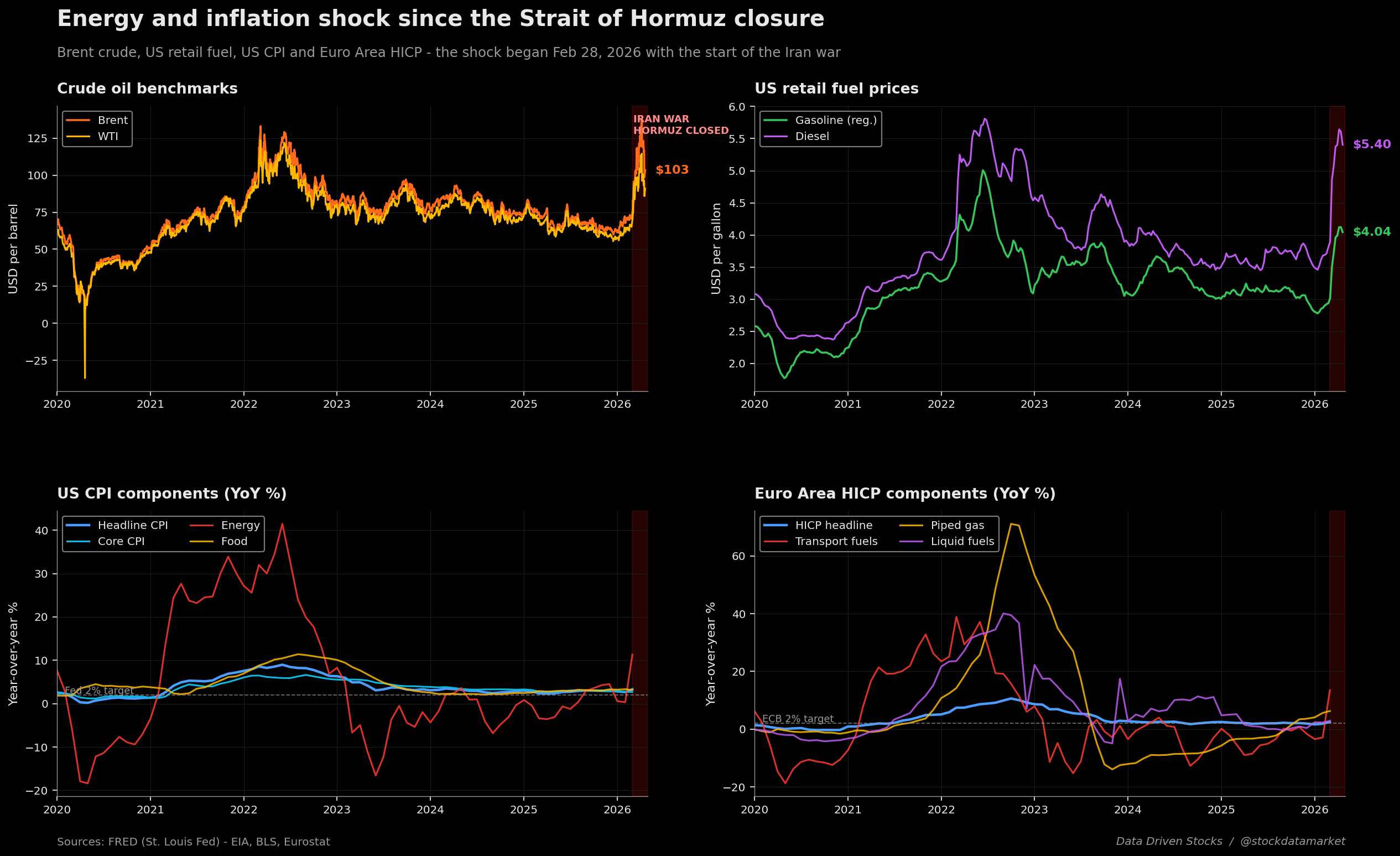
Two months ago, Eurozone inflation was about to slide back below the European Central Bank’s 2% target, U.S. gasoline was the cheapest it had been since 2021, and the consensus among forecasters was that the disinflation story was basically finished. As of this weekend, regular U.S. gasoline averages $4.04 per gallon - up 38% in eight weeks. Brent crude touched $138 on April 7 and is still trading above $100. Euro Area HICP fuel and lubricants jumped 13.5% in a single month. The Iranian president told the Pakistani prime minister this weekend that the Strait of Hormuz “will not return to its previous state under any circumstances,” and the IRGC continues to enforce a closure that began on February 28.
The interesting question is no longer whether this is a real shock. The interesting question is what happens to inflation if the closure is not measured in weeks, but in years. Anthropic’s policy of treating present-day facts as live information matters here, because the natural reflex - “this is just another oil spike, it will pass” - is wrong. The official scenario work that exists publicly already concedes that a multi-month closure is a serious shock, and a multi-year closure would be a regime change in inflation dynamics on both sides of the Atlantic. The data from FRED, BLS, Eurostat, the EIA, the ECB, the IMF and the Oxford Institute for Energy Studies all converge on the same point: the longer this lasts, the less it looks like an energy story and the more it looks like a generalised inflation story.
This piece walks through the geography, the arithmetic, and then the inflation transmission - and finishes with the question every long-horizon investor and policy-watcher is now asking: what does the world actually look like if Hormuz remains effectively closed for the next several years?
The 21-mile chokepoint
The Strait of Hormuz is a corridor barely 21 miles wide at its narrowest. About 20 million barrels per day of crude and condensate normally pass through it - roughly one-fifth of global oil consumption and around 25% of seaborne oil trade. It also handles around 20% of global LNG trade, almost all of which originates in Qatar’s North Field and the United Arab Emirates. As of late April 2026 it is, in the words of UNCTAD, “practically closed,” and the IEA has called the resulting disruption the largest in the history of the global oil market.

The thing that makes Hormuz uniquely dangerous is that the alternatives are tiny. The Saudi East-West Pipeline can move about 1.6 million barrels per day to the Red Sea. The UAE’s Abu Dhabi Crude Oil Pipeline can move about 1.0 million barrels per day to Fujairah, outside the strait. That is 2.6 million barrels per day combined - against roughly 20 million barrels per day of normal flow. Iraq, Kuwait, Qatar, and Bahrain have no comparable bypass at all. For LNG, there are no alternatives whatsoever; Qatar and the UAE simply cannot ship a meaningful share of their exports through any other route.

The numerical implication is uncomfortable. A short closure is something the global system can absorb through stock draws, OPEC+ spare capacity, and demand destruction. A multi-month closure starts running into hard physical limits. A year-long closure - the kind the Oxford Institute for Energy Studies modeled in March 2026 - means global LNG export capacity does not return to pre-crisis levels until late 2028, because U.S. expansions need to come online to backfill the Gulf shortfall. There is no technological fix for that. Pipelines and LNG trains take years to build; the world has the world it has.
Oil prices: the scenario fan, in one chart
Public scenario work from the EIA, the ECB, and the Oxford Institute for Energy Studies - the most credible institutions modelling this in real time - lines up surprisingly well, even though they use different models and assumptions. What they disagree on is duration, and that disagreement is the entire forecast. Below is what each of those scenarios implies for Brent crude through 2030, with the historical Brent price plotted in white for context.

Even the EIA’s optimistic baseline puts Brent at $115 in Q2 2026 before fading. The ECB’s adverse scenario - 40% of Hormuz oil and LNG flows disrupted through Q3 2026 - keeps Brent close to $120 and TTF gas near €87/MWh. The ECB’s severe scenario - 60% disruption with damage to energy infrastructure - puts Brent around $145 and gas above €100/MWh, with normalisation only starting in Q1 2027. The OIES “one year shutdown” scenario keeps Brent averaging $150 for the rest of 2026 and not falling below $100 until 2029. And if the closure simply extends past 2027 - the kind of multi-year scenario the Iranian president is now openly threatening - Brent stays above $100 well into the next decade, because there is no alternative supply path that can be built within that horizon.
The World Bank’s pre-2026 disruption scenarios reach almost identical numbers from a completely different methodology: a “medium” disruption of 3 to 5 million barrels per day initially lifts oil to $109-$121, and a “large” disruption of 6 to 8 million barrels per day initially lifts it to $140-$157. The fact that an institutional baseline, an ECB stress test, an Oxford modelling exercise, and a World Bank scenario all converge on roughly the same numbers is what gives the forecast credibility.
The shock at the pump
For most readers, the abstract barrel-of-oil number doesn’t matter. What matters is the price on the gas-station sign. The U.S. story so far is straightforward and ugly.

The EIA’s rule of thumb is that a $1 per barrel change in crude translates to about 2.4 cents per gallon at the pump, and that crude is roughly half the retail gasoline price. That means a sustained $40 per barrel premium over a no-war path - which is roughly where we are today versus February - implies about $0.96 per gallon of additional pump-price pressure from crude alone, before refinery margins, distribution costs, and taxes. A sustained $50 premium implies about $1.20. The actual Mar-Apr move in U.S. retail gasoline (about +$1.10) is right inside that range, which is reassuring on the model side and disturbing on the consumer side.
The American consumer is now living the Brent price - not the WTI price - because gasoline is priced in internationally connected refined product markets. Even though the United States imports very little crude through Hormuz directly (the EIA estimates Persian Gulf crude was about 2% of U.S. petroleum-liquids consumption in 2024), U.S. drivers feel the same global benchmark shock as everyone else. The protection that exists - U.S. shale, the SPR, refining capacity - softens the absolute level but does not insulate the change.
How the shock reaches inflation - and why Europe is hit twice
A crude oil shock and a fuel-price shock are not the same thing as an inflation shock. Inflation is about the general price level, and the question is how much of an oil-and-gas price increase migrates into the prices of food, services, goods, wages, and rents. The mechanics are different on the two sides of the Atlantic, and the structural difference is what makes Europe more vulnerable in the long run.

In the United States, the relevant CPI weights are gasoline at 2.9%, electricity at 2.5%, utility piped gas at 0.8%, and total energy at 6.4%. The BLS reported that gasoline accounted for about three-quarters of the monthly increase in March 2026 headline CPI. Federal Reserve research suggests a 10% real oil-price increase raises U.S. headline CPI by about 0.15 percentage point in year one and core CPI by about 0.06 percentage point, with second-round effects building over roughly eight quarters. The implication is that a sustained oil shock is a slow-burn inflation problem in the United States - mostly visible in the energy line for the first six months, then quietly bleeding into food, freight, and services as logistics costs rise.
In the Eurozone, the energy block is only 9% of the HICP basket - structurally smaller than in the U.S. - but the second-round risk is much larger because the LNG channel is real. Qatar and the UAE supply about 20% of global LNG, mostly to Asia, but in a cut-off Europe has to compete in a tighter global market for the marginal cargo. That moves the Dutch TTF benchmark, then European wholesale electricity (where gas is the marginal price-setter), then industrial input costs (especially fertiliser, where the Gulf supplies roughly 30% of global ammonia and 50% of urea), and finally food and manufactured goods. The ECB explicitly says energy-supply shocks pass through more strongly when inflation is already high, and that gas-price shocks have persistence up to 12 months. The fuel-tax structure also matters: IMF research finds taxes are about 60% of EU pump prices versus less than 20% in the U.S., which damps percentage pass-through but does not stop the shock from reaching the broader basket via electricity, fertiliser, and food.
The actual data already shows the difference. In March 2026, U.S. CPI energy jumped 10.9% in a single month, while Eurozone HICP fuels and lubricants jumped 13.5% and HICP liquid fuels by even more. Eurozone headline HICP rose to 2.5% on the flash estimate, with energy doing the work. The European story is starting where the American one is - in the energy line - but it has further to travel.
What the ECB scenarios actually say
This is where the scenario fan gets serious. The ECB’s March 2026 staff projections published three explicit paths: a baseline that assumes the war fades; an adverse scenario in which 40% of Hormuz oil and LNG flows are disrupted through Q3 2026; and a severe scenario in which 60% of flows are disrupted, infrastructure is damaged, and supply only normalises in Q1 2027.

Numerically: the ECB baseline already lifts 2026 HICP to 2.6% (from 1.9% pre-war). The adverse scenario peaks above 3.5% in 2026 and stays above target into 2027. The severe scenario adds 1.8 percentage points of inflation in 2026, 2.8 percentage points in 2027, and 0.7 percentage points in 2028 above baseline - meaning HICP around 4.4% in 2026 and 4.8% in 2027. The shape of that profile is what matters. The peak is in 2027, not 2026, which is the textbook signature of a shock that has migrated from energy into wages, services, and core. That is a regime change, not a spike. A multi-year closure pushes the trajectory higher and longer, with HICP staying above 5% well into 2028.
The ECB is now explicit that its standard models underestimate how large energy shocks propagate through the broader economy, and it has recalibrated to sit between normal elasticities and the elasticities that were actually observed during the 2021-2022 inflation surge. That recalibration is the most important sentence in the entire ECB document. It is the central bank acknowledging, in writing, that the linear oil-to-CPI mappings most analysts still use are wrong for a shock of this size.
The British case is even worse, because of the country’s dependence on imported gas and its faster wage-price feedback loop. Coverage of the energy crisis suggests UK inflation could breach 5% in 2026, and OECD analysis already flags the UK as the worst-hit major economy in the immediate scenarios.
The Fed’s quieter problem
The U.S. story is less dramatic, but more contested. The Federal Reserve’s models, including the FRBUS-type DSGE work, suggest a sustained $40-$50 per barrel premium contributes between roughly 0.5 and 0.8 percentage point directly to U.S. headline CPI through gasoline alone, before second-round effects on food, freight, and services. With gasoline at a 2.9% CPI weight and a 25% year-over-year increase plausible for a sustained shock, the direct contribution to headline CPI is in the order of 0.7 percentage point. The full energy block (6.4% weight) under a 12.5% year-over-year increase contributed about 0.8 percentage point in March, before any indirect effects.
Indirect effects are where the controversy is. Fed research suggests oil passes through to U.S. core inflation only via the common, economy-wide component of inflation - small but statistically significant and long-lasting. FAO work attributes 47% of recent U.S. food-price inflation to agricultural and energy commodity moves, including indirect macro effects. IMF gasoline-shock research finds that in advanced economies, seven of twelve CPI components respond significantly to gasoline shocks. None of those individual numbers is dramatic in isolation; the issue is that they all push the same way over a sustained closure.
Markets are starting to price this. The 10-year breakeven inflation rate sat around 2.30% in mid-February. By April 24, 2026, it was at 2.42%, despite Fed officials publicly dismissing this as a temporary supply shock. The 5-year breakeven is moving in tandem. That is small in absolute terms, but it is exactly the direction the Fed least wants - and it is happening before any of the second-round food, freight, or services effects have shown up in CPI.
The U.S. inflation problem in a multi-year scenario is therefore not a 2022-style spike. It is a 2-3 year period in which headline CPI runs in the 3.5%-5% range, core CPI runs in the 3%-4% range, and the Fed has to choose between higher rates that stress an already-cooling economy and tolerating an extended deviation from its 2% target that risks de-anchoring inflation expectations. That is a genuinely uncomfortable choice. It is also the choice that Lagarde is more publicly preparing for in Frankfurt; Powell has been more equivocal.
Iran’s calculus, and why this could last
The standard counterargument to a multi-year scenario is that Iran cannot afford to sustain the closure - that its own oil revenues depend on Hormuz, that China would not allow it, and that the U.S. Navy would force the strait open. Each of these arguments is weaker than it was three months ago.
Iran’s economy is in freefall already. The IMF forecasts a 6.1% GDP contraction in 2026 and 68.9% inflation, with the rial down to roughly 1.32 million per dollar. More than 90% of Iran’s annual trade passes through the strait, which means the U.S. blockade of Iranian ports has already cut its oil revenues regardless of whether Iran cooperates with reopening Hormuz. From Tehran’s perspective, the cost of keeping the strait closed is therefore lower than it appears, because the punishment is already happening. The marginal economic cost of closing the strait for one more month is small relative to the leverage it provides in any negotiation.
China is in a contradictory position. It is the world’s largest oil importer, with about half of its over-11-million-barrel-per-day import bill from the Middle East. It has every incentive to want Hormuz open. But Beijing also buys roughly 90% of Iran’s oil exports, has a strategic interest in keeping Tehran financially viable, and has its own energy-security imperatives that cut against any direct military pressure on Iran. Chinese-flagged vessels appear to be among the few still transiting the strait, suggesting Beijing may be carving out a protected corridor rather than forcing a general reopening. President Xi’s call with Crown Prince Mohammed bin Salman on April 21 emphasised the importance of keeping the strait open “in the common interest of regional countries,” which is diplomatic language for “we are not going to do anything kinetic about it.”
The U.S. military option exists, but it is not the option it was in 2019 or 2020. Iran has had years to mine the strait, harden coastal anti-ship-missile sites, and develop drone-and-fast-boat tactics that make naval clearance slow and costly. A 50-country conference hosted by the United Kingdom on April 22-23 was discussing how to reopen the strait - which is itself a signal that there is no quick military solution. Australia has said it stands ready to act if its government decides; Canada has condemned Iran’s actions; the U.S. has demanded NATO and Chinese help. The fact that all of this is necessary is the answer.
The base case, in other words, is no longer that this resolves quickly. The base case is that Iran retains effective control of access to the strait for an extended period - measured in quarters, possibly in years - while a slow, partial, contested reopening proceeds in fits and starts. That is exactly the scenario in which the inflation models start to break down, because the second-round effects have time to accumulate.
The bottom line
A short Hormuz closure is a fuel shock. A multi-month closure is a broad inflation shock. A multi-year closure is a regime change in inflation dynamics, especially in Europe, where the LNG channel and the gas-power pricing mechanism amplify the original oil shock into a generalised price-level shock that takes years to unwind.
For U.S. inflation, the realistic scenario in a sustained closure is headline CPI in the 3.5-5% range and core CPI in the 3-4% range for the next 18-24 months, with a Fed that has to choose between rate hikes into a slowing economy and tolerating an extended deviation from target. For European inflation, the realistic scenario is HICP between 4% and 6% in 2026-2027, with the peak in 2027 rather than 2026, and an ECB that has explicitly acknowledged it will hike even in a temporary overshoot if expectations look like de-anchoring. For UK inflation, the modal forecast is already above 5%.
Markets are doing some of the work here. Brent above $100, gasoline above $4, breakevens drifting up, European industrial chemical and steel surcharges of up to 30% - these are the early prices of a world that no longer assumes Hormuz reopens quickly. The under-priced outcome is the multi-year tail. The Iranian president saying the strait will not return to its previous state under any circumstances is not just rhetoric; it is the public version of a domestic political reality in Tehran where the ability to close the strait is now the country’s main remaining piece of strategic leverage against a U.S. that is publicly committed to its blockade of Iranian ports until “a deal is signed.”
If that standoff lasts, the inflation arithmetic does not look like 2008. It does not even look like 2022. It looks like an extended, structurally higher inflation environment in the United States and a genuine second energy crisis in Europe - one that the ECB has already publicly modeled, and that the Fed is quietly modelling but not yet publicly conceding. The clock on disinflation has been reset. The data already say that. The question is whether the duration assumption gets reset too.
Sources & further reading
UNCTAD, “Strait of Hormuz Disruptions: Growth and financial implications,” 2026 - https://unctad.org/
International Energy Agency (IEA), commentary on the largest supply disruption in the history of the global oil market, March 2026 - https://www.iea.org/
U.S. Energy Information Administration (EIA), Short-Term Energy Outlook, April 2026 - https://www.eia.gov/outlooks/steo/
EIA, Hormuz chokepoint analysis - https://www.eia.gov/international/analysis/special-topics/World_Oil_Transit_Chokepoints
EIA, Weekly Retail Gasoline and Diesel Prices - https://www.eia.gov/petroleum/gasdiesel/
European Central Bank, “ECB staff macroeconomic projections for the euro area, March 2026” - https://www.ecb.europa.eu/press/projections/html/ecb.projections202603_ecbstaff~ebe291cd3d.en.html
European Central Bank, Economic Bulletin Issue 2 / 2026 - https://www.ecb.europa.eu/pub/pdf/ecbu/eb202602.en.pdf
Oxford Institute for Energy Studies, “Modelling the Impact of the Strait of Hormuz Closure on Global Gas Flows and Prices,” March 2026 - https://www.oxfordenergy.org/publications/modelling-the-impact-of-the-strait-of-hormuz-closure-on-global-gas-flows-and-prices/
Oxford Institute for Energy Studies, “The Iran War and Disruption to LNG Supply from the Persian Gulf,” March 2026 - https://www.oxfordenergy.org/publications/the-iran-war-and-disruption-to-lng-supply-from-the-persian-gulf/
International Monetary Fund, “Cuts global growth forecast during Hormuz blockade,” April 2026 (Al Jazeera coverage of WEO update) - https://www.aljazeera.com/economy/2026/4/14/imf-cuts-global-growth-forecast-during-hormuz-blockade
IMF Working Paper 2021/271, “The Distributional Implications of the Impact of Fuel Price Increases on Inflation” - https://www.imf.org/en/Publications/WP/
IMF Working Paper 2025/091, “The Energy Origins of the Global Inflation Surge” - https://www.imf.org/en/Publications/WP/
Bureau of Labor Statistics, CPI Relative Importance tables and CPI release, March 2026 - https://www.bls.gov/cpi/
Eurostat, HICP releases, March 2026 - https://ec.europa.eu/eurostat/web/hicp
Federal Reserve Board, FEDS notes on oil-price pass-through to advanced foreign economies and the U.S. - https://www.federalreserve.gov/econres/feds/
Atlas Institute for International Affairs, “The Strait that Moves the Market: The 2026 Strait of Hormuz Crisis and the Anatomy of a Global Energy Shock,” March 2026 - https://atlasinstitute.org/the-strait-that-moves-the-market-the-2026-strait-of-hormuz-crisis-and-the-anatomy-of-a-global-energy-shock/
Baker Institute for Public Policy, March 2026 commentary on Hormuz closure - https://www.bakerinstitute.org/
Bloomberg, “Iran War: How High Could Oil Prices Get with Strait of Hormuz Closure?” - https://www.bloomberg.com/graphics/2026-iran-war-hormuz-closure-oil-shock/
CNN Business, “Oil prices increase after Iran doubles down on Strait of Hormuz closure,” April 26, 2026 - https://www.cnn.com/2026/04/26/business/oil-prices-stock-futures-iran-war
Euronews, “Eurozone inflation jumps to 2.5% amid Iran war: Will the ECB hike rates?” - https://www.euronews.com/business/2026/03/31/eurozone-inflation-jumps-to-25-amid-iran-war-will-the-ecb-hike-rates
CNBC, “ECB ready to hike rates even if expected inflation surge is short-lived, Lagarde says,” March 2026 - https://www.cnbc.com/2026/03/25/ecb-rate-hikes-inflation-forecasts-christine-lagarde-iran-war.html
CNBC, “Iran’s economy in charts: Hyperinflation and depreciating rial,” April 23, 2026 - https://www.cnbc.com/2026/04/23/iran-economy-war-charts-rial-oil-strait-hormuz-blockade.html
Lloyd’s List, “Brief Gulf shutdown manageable, but year-long closure would upend global LNG flows, says think tank,” April 1, 2026 - https://www.lloydslist.com/
NBC News, “Oil prices jump amid renewed tensions over the Strait of Hormuz,” April 2026 - https://www.nbcnews.com/business/markets/oil-prices-jump-renewed-tensions-strait-hormuz-rcna340901
Wikipedia, “2026 Strait of Hormuz crisis” - https://en.wikipedia.org/wiki/2026_Strait_of_Hormuz_crisis
Wikipedia, “Economic impact of the 2026 Iran war” - https://en.wikipedia.org/wiki/Economic_impact_of_the_2026_Iran_war
San Francisco Federal Reserve, CPI Inflation Contributions data - https://www.frbsf.org/
World Bank, Commodity Markets Outlook, October 2023 (oil disruption scenarios) - https://www.worldbank.org/en/research/commodity-markets
All raw price and inflation data downloaded from FRED (Federal Reserve Bank of St. Louis), https://fred.stlouisfed.org/
Charts and analysis by Data Driven Stocks / @stockdatamarket. Data: FRED, EIA, BLS, Eurostat. Last updated: April 27, 2026.


Hey check DMs