The Fed Just Blinked - In the Other Direction. Inside the June 17 FOMC Meeting
We had FOMC meeting with Kevin Warsh - and what's next ?

Probably you just woke up or just coming back from work and wonder why did market tank, wondering whether the Fed just did something. And the interesting part is not what it did with the rate - it left that alone - but what it admitted about where rates are heading next.
Here is the one-sentence version. On June 17, 2026, the Federal Reserve held its benchmark rate steady at 3.50% to 3.75% for the fourth straight meeting, but its fresh set of projections did something the Fed almost never does mid-cycle: it erased the rate cut it had been promising and replaced it with the quiet expectation of a hike. Six months ago this was a central bank gently easing into a soft landing. Today it is a central bank with its hands on the brake, watching an oil-driven inflation wave decide its next move.
This was also the first meeting run by a brand-new chairman, and that matters more than usual, because he rewrote how the Fed talks. So let us walk through it properly - the decision, the projections that turned hawkish, the inflation problem underneath it all, and the geopolitical shock that started the whole chain reaction.
A new chair, a shorter statement, and a missing promise
The meeting belonged to Kevin Warsh, who took the oath as the 17th chair of the Federal Reserve on May 22 after one of the narrowest confirmation votes in the institution’s modern history. He inherited the job from Jerome Powell, who, in an unusual move not seen in roughly eighty years, chose to stay on as a governor rather than leave the building - keeping his vote on the rate-setting committee while promising to stay out of the spotlight. President Trump had pushed hard for a chair who would cut rates faster. What he got, at least on day one, was a chair boxed in by an inflation number he cannot control.
The decision itself was unanimous, 12 to 0, to keep the target range exactly where it had been since December. No drama there - markets had priced a hold at roughly 97% odds going in. The drama was in the language. Warsh tore up the usual script. The statement came out noticeably shorter, and he said so plainly, describing it as a bit shorter, a bit simpler, and stripped of older language. Most strikingly, he removed forward guidance altogether - the standard sentences the Fed has used for years to hint at what comes next. In his telling, that kind of guidance was not well-suited to the moment. He also announced five internal task forces to review how the Fed communicates, how it runs its balance sheet, how it uses data, how it thinks about productivity and jobs in an age of AI, and what is actually driving inflation.
If you trade on Fed signals, this is a real change. A Fed that tells you less about its reaction function is a Fed whose every data point now carries more weight. Expect sharper market reactions to each inflation and jobs report from here, precisely because the central bank has stopped handing out a roadmap.
The dot plot did the talking instead
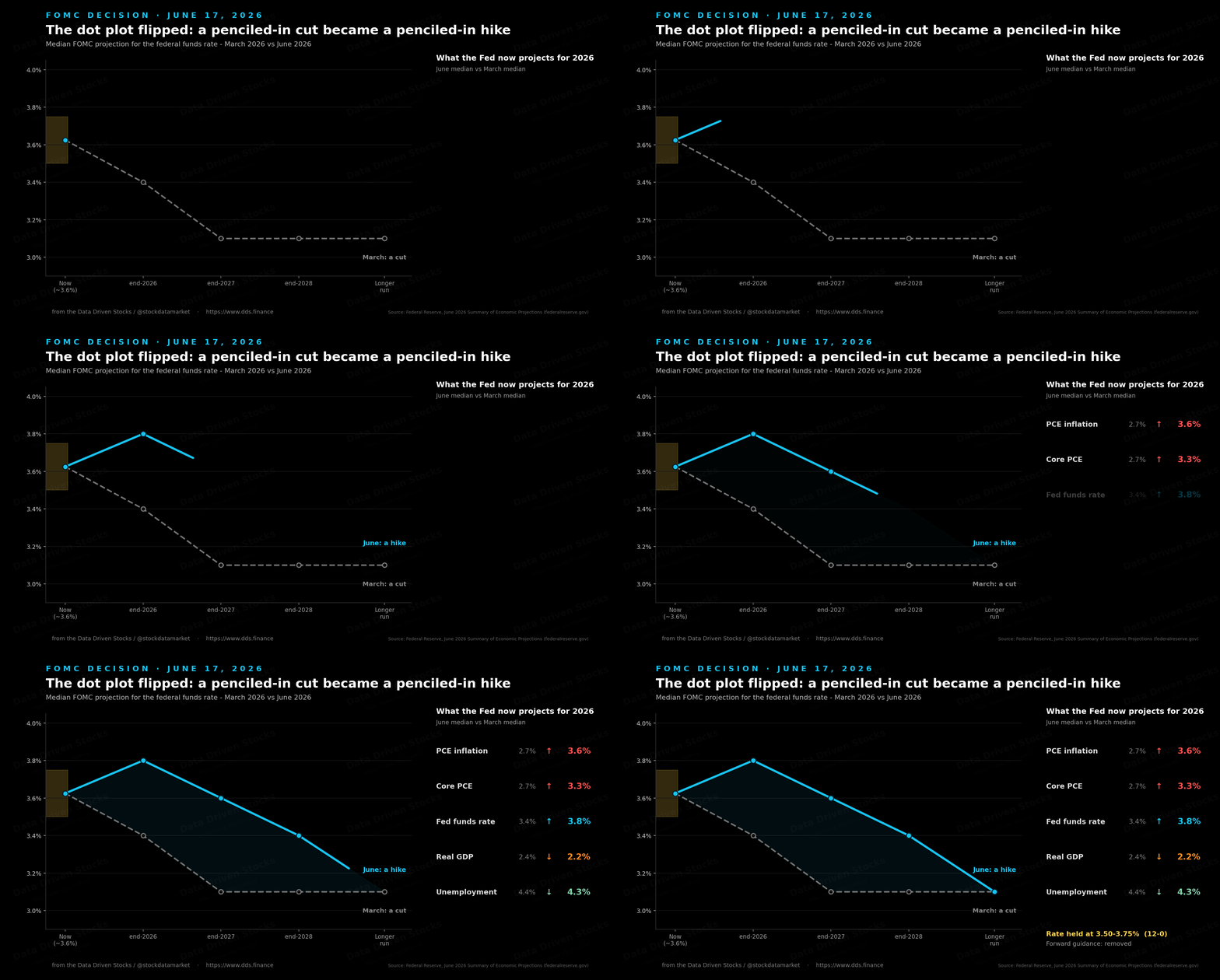
With the words stripped back, the numbers had to speak - and they spoke loudly. The Fed’s Summary of Economic Projections, the famous dot plot, is where each official marks down where they think rates should go. In March, the median official saw the federal funds rate ending 2026 at 3.4%, which meant one quarter-point cut this year. By June, that median had climbed to 3.8%. Since the rate sits around 3.6% today, a 3.8% projection is not a cut deferred - it is a hike penciled in.
The internal split tells the story even better. Of the eighteen officials who submitted projections, eight saw no change for the rest of the year, just one still saw a cut, and nine - half the committee - now expect at least one hike before year-end, with six of them seeing two. Three months earlier, the typical official had been forecasting a cut. That is a genuine turn, not a nuance. And notice the count: eighteen dots, not the usual nineteen. Warsh declined to submit one of his own, consistent with his skepticism of forward guidance, which means the new chair deliberately kept his personal forecast off the page.
The macro forecasts moved in lockstep with the rate path, and they paint a textbook picture of the thing economists least like to see.

The Fed now expects headline PCE inflation - its preferred gauge - to finish 2026 at 3.6%, up from the 2.7% it projected in March. Core PCE, which strips out food and energy, was lifted to 3.3% from 2.7%. At the same time, the committee trimmed its growth forecast to 2.2% from 2.4% and edged its unemployment forecast down a touch to 4.3%. Higher inflation, slightly slower growth: that combination is the faint outline of stagflation, and it is exactly why the dovish case fell apart. You cannot comfortably cut into rising prices when growth is still holding up and the job market refuses to crack.
The inflation number that trapped everyone
To understand why the Fed flinched, look at the inflation report that landed a week before the meeting. May consumer prices rose 4.2% from a year earlier, the hottest annual reading since April 2023. On its face, that is alarming - well over double the Fed’s 2% target and accelerating for a third straight month. But the headline hides the real story, and the real story is the whole reason this is so hard.

Strip out food and energy and core inflation was just 2.9% - elevated, yes, but a world away from the headline, and it barely budged from the month before. The energy index alone was up 23.5% over the year and accounted for more than 60% of the entire monthly increase in prices. Gasoline was the headline grabber, up 40.5% from a year earlier. In other words, this is not the broad, demand-driven inflation that a central bank fights by crushing the economy. It is a relative-price shock concentrated in one volatile category.
That puts the Fed in a genuine bind. Textbook central banking says you look through a supply shock - you do not raise rates to fight a one-off jump in oil, because by the time your rate hike bites, the oil spike may already be fading, and all you have done is damage jobs. Warsh himself has long argued for looking through exactly this kind of shock, and the cool core reading hands him a reason to. But there is a catch, and every official named it: if a world of 40%-higher gasoline starts to un-anchor what people expect inflation to be, then a temporary shock curdles into a permanent problem, and looking through it becomes a mistake. That fear - not the 4.2% itself - is what nudged the dots higher.
The shock that started it all
So where did the oil come from? This is the geopolitical thread that ties the whole macro story together, and it runs through one narrow stretch of water. The trigger was military action involving the United States and Israel against Iran beginning in late February, which disrupted traffic through the Strait of Hormuz - the chokepoint through which roughly a fifth of the world’s oil moves. The market reaction was violent.

Brent crude sat near $71 a barrel the day before the conflict began. By April 7 it had spiked to roughly $138 - a 94% surge in a matter of weeks - as tankers struggled to move product and the market priced in the worst. That spike is what flowed straight into May’s gasoline prices and the 4.2% headline. And then prices started falling, hard: Brent slid back to around $84 by mid-June and kept going, dropping toward the high $70s as news of a US-Iran deal broke. Pump prices have eased from their May high too. On the surface, that looks like the all-clear - the supply shock that broke the inflation picture finally fixing itself. But look one layer down and the story gets more uncomfortable, because the price and the physical market are now telling opposite stories.
Why the falling price is lying to you - the inventory tell
Here is the trap. The oil price is falling, but it is falling on a bet, not on a fact. What the market is pricing is the expectation that the just-announced US-Iran deal holds, that the Strait of Hormuz reopens, and that the U.S. lifts its naval blockade - the whole supply shock simply melting away. That may well happen. But it has not happened yet. The Strait is still effectively choked, more than fourteen million barrels a day of Middle East output remains shut in, and the International Energy Agency’s own June read says the recovery will be gradual at best, dragged out by demining, unresolved transit terms, and tankers that scattered to other routes. The relief the market is celebrating in the price does not actually arrive in the physical barrels until next year - the IEA only sees the glut returning in 2027. So traders are buying the headline of peace while the tanks tell a very different story.
And the tanks are the story. While the price slides on optimism, inventories are being drained at a pace that should give anyone pause. The cleanest way to see it is to put the actual barrels on a chart against where they normally sit for this time of year.

Look at the left panel. American crude stocks built up as the shock peaked in April, then drained week after week, falling clean through the five-year average and down to the very bottom of the normal seasonal range - a draw of more than ten percent in two months. The right panel is the part that should make a trader pause. Line up this episode against the last two oil shocks, each indexed to the start of its year so the shapes compare fairly, and 2026 is the odd one out. In 2008, inventories built into a glut as a demand collapse left barrels with nowhere to go. In 2022, after Russia invaded Ukraine, stocks stayed roughly flat because coordinated releases from strategic reserves cushioned the blow. Only 2026 is genuinely draining - the line drops below where it started the year and keeps going. The IEA’s data tells the same story globally: stocks have been pulled down at nearly four million barrels a day since the war began, with the agency warning they could fall to historic lows before the market balances.
So the falling price is not the market saying the shortage is over. It is the market saying it expects the shortage to be over soon. Those are very different claims, and the inventory draw is the evidence that the second one is still just a forecast. If the deal slips - if the Strait stays difficult into the autumn - there is now far less oil in storage to cushion the next scare than there was before this all started.
You can see the same drain at Cushing, Oklahoma, the specific hub where the U.S. benchmark is priced and where traders watch stocks most closely. A build into April, then a hard, steady draw to multi-month lows.

For the Fed, this is why the easing oil price is not the simple good-news story it looks like. The headline inflation that frightened everyone is indeed fading as gasoline comes off the boil, and that buys the committee room to stay patient. But the depleted tanks mean the supply cushion is thin, so if the peace deal wobbles, the next price spike would land on a market with far less slack - and inflation could come roaring back faster than last time. That asymmetry is exactly why the Fed pulled its easing bias and why nine officials now lean toward a hike. They are not just watching the price at the pump. They are watching how little is left in storage behind it.
The energy spike has already happened and is fading in the price; the open question is whether it leaked into everything else before it cooled. The chain below is how a problem in a shipping lane ends up on the Fed’s dot plot - and why the place it stalled matters as much as where it started.

If you follow the arrows, the energy shock passes cleanly into the headline - the bold, flowing lines - but the connection into core inflation is faint, because the pass-through there has so far been weak. That faintness is the dovish hope. The strength of everything feeding the headline is the hawkish reality. The Fed is standing exactly at the junction, waiting to see which arrow wins.
The job market refuses to give the Fed an excuse
There is one more piece, and it is the reason the Fed can afford to be patient and worried at the same time rather than patient and relaxed. The labor market is simply too sturdy to force a cut. May payrolls rose by 172,000, more than double what economists expected, and hiring in the prior two months was revised up as well. The unemployment rate held at 4.3%, where it has sat for the better part of a year. A central bank cutting rates needs a softening job market as cover. This one does not have it.
It is not flawless underneath - wage growth of 3.4% is barely keeping pace with prices, the broadest measure of underemployment sits at 8.1%, and households have been leaning on savings as real incomes slip. But none of that is the kind of clear deterioration that argues for easing right now. Growth tells a similar story with an asterisk: the economy expanded at a 1.6% annual pace in the first quarter, slower than the boom of mid-2025 but well clear of recession, with the quarter flattered and the prior one depressed by a government shutdown that scrambled the figures. Solid enough activity, sticky enough inflation, a firm enough job market. That is a recipe for holding, not cutting.
What it means, and what to watch
Step back and you can see three different bets on the table, and they do not agree. The June Fed, through its dots, is now more hawkish than the broad economist consensus, which still leans toward simply holding through the year rather than hiking. Markets, meanwhile, are the most two-sided of all - not fully pricing a hike as the base case, but attaching real probability to one, with the sell-side increasingly pushing any cuts out into 2027. When the central bank, the forecasters, and the futures market are this spread out, it is a sign the inflation story is deteriorating faster than the growth story, but not so fast that anyone is sure of the next move.
For a reader trying to act on this rather than just admire it, the signal is straightforward. The bar for a rate cut in 2026 has risen sharply, and the next move is now more likely to be up than down. A clean return to cuts probably needs three things to line up at once: the energy shock to keep fading without leaking into core prices, core inflation to stop creeping, and the job market to finally soften. If instead gasoline stays high long enough to drag expectations with it while hiring holds, that late-2026 hike stops being a risk scenario and becomes the plan. The thing to watch is no longer the Fed’s words - it took those away. It is the data, especially the next inflation prints and whatever oil does from here. Watch the pump as closely as the Fed does. Right now, it is telling the more hopeful story.
Sources: Federal Reserve, June 17, 2026 FOMC statement and the June and March 2026 Summary of Economic Projections (federalreserve.gov); Chair Kevin Warsh’s June 17 press conference. U.S. Bureau of Labor Statistics, Consumer Price Index for May 2026 and the Employment Situation for May 2026 (bls.gov). U.S. Bureau of Economic Analysis, GDP second estimate for Q1 2026 and Personal Income and Outlays for April 2026 (bea.gov). U.S. Energy Information Administration, daily Brent and WTI crude spot prices and weekly U.S. commercial crude stocks excluding the Strategic Petroleum Reserve, including the 2008 and 2022 history, plus Cushing stocks and retail gasoline prices (eia.gov). International Energy Agency Oil Market Reports through June 2026, on the Strait of Hormuz disruption, the US-Iran deal, global supply and demand, record inventory draws, and the projected 2027 surplus. Federal Reserve leadership transition and confirmation details via the Federal Reserve Board, CNBC, NPR, and CBS News. Market-implied probabilities via CME FedWatch as reported by CNBC and Reuters.