

The Fed Changed One Word. The Bond Market Changed 27 Basis Points.
July 29, 2026: a 115-word statement, three hawkish dissents, and a 30-year yield back at levels last seen in 2007. Market first overreacted, then ignored it for the next 2 days.

The July FOMC meeting is going to matter more in September than it did on the day.
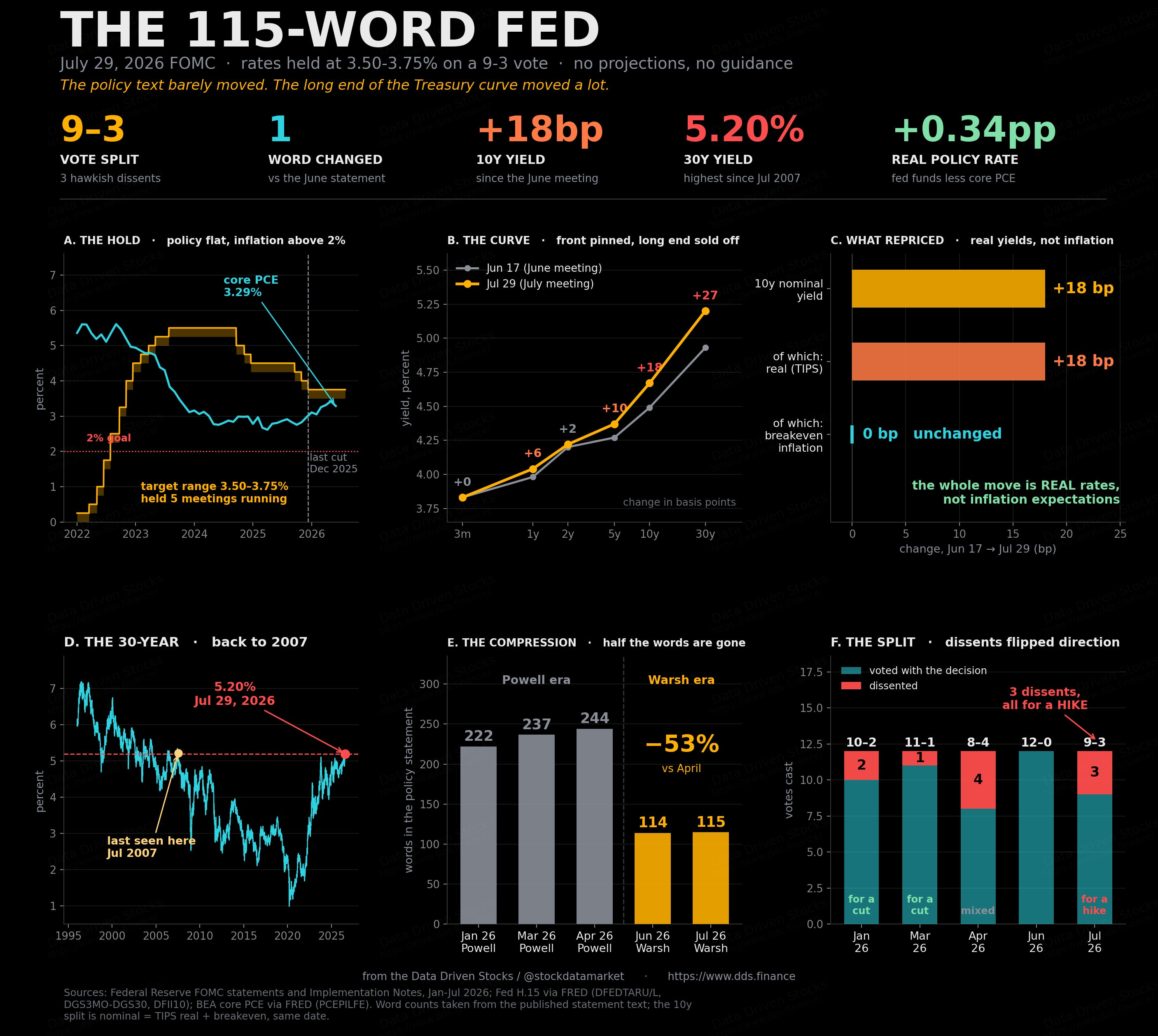
The Federal Reserve held its policy rate at 3.50 to 3.75 percent for the fifth meeting running. Three of the twelve voters wanted to raise it. The statement said almost nothing. And the long end of the Treasury curve went straight through a level it had not touched since the summer before the financial crisis.
What the meeting was actually about
The honest answer is that it was about what the Fed refuses to tell you. Why ? Because their new policy is “guess yourself, FED won’t tell you”.
The policy statement released at 2:00 p.m. Eastern ran to 115 words. Four short paragraphs. It said rates were staying where they are, that activity is expanding at a solid pace despite uncertainty tied in part to the conflict in the Middle East, that productivity growth and capital investment are strong, that job gains have kept pace with the workforce, and that inflation remains elevated relative to the 2 percent goal. Then one flat sentence: the Committee will deliver price stability.
That is the whole thing. No balance-of-risks language. No description of what would make the Committee move. No projections, because July is not a projection meeting.
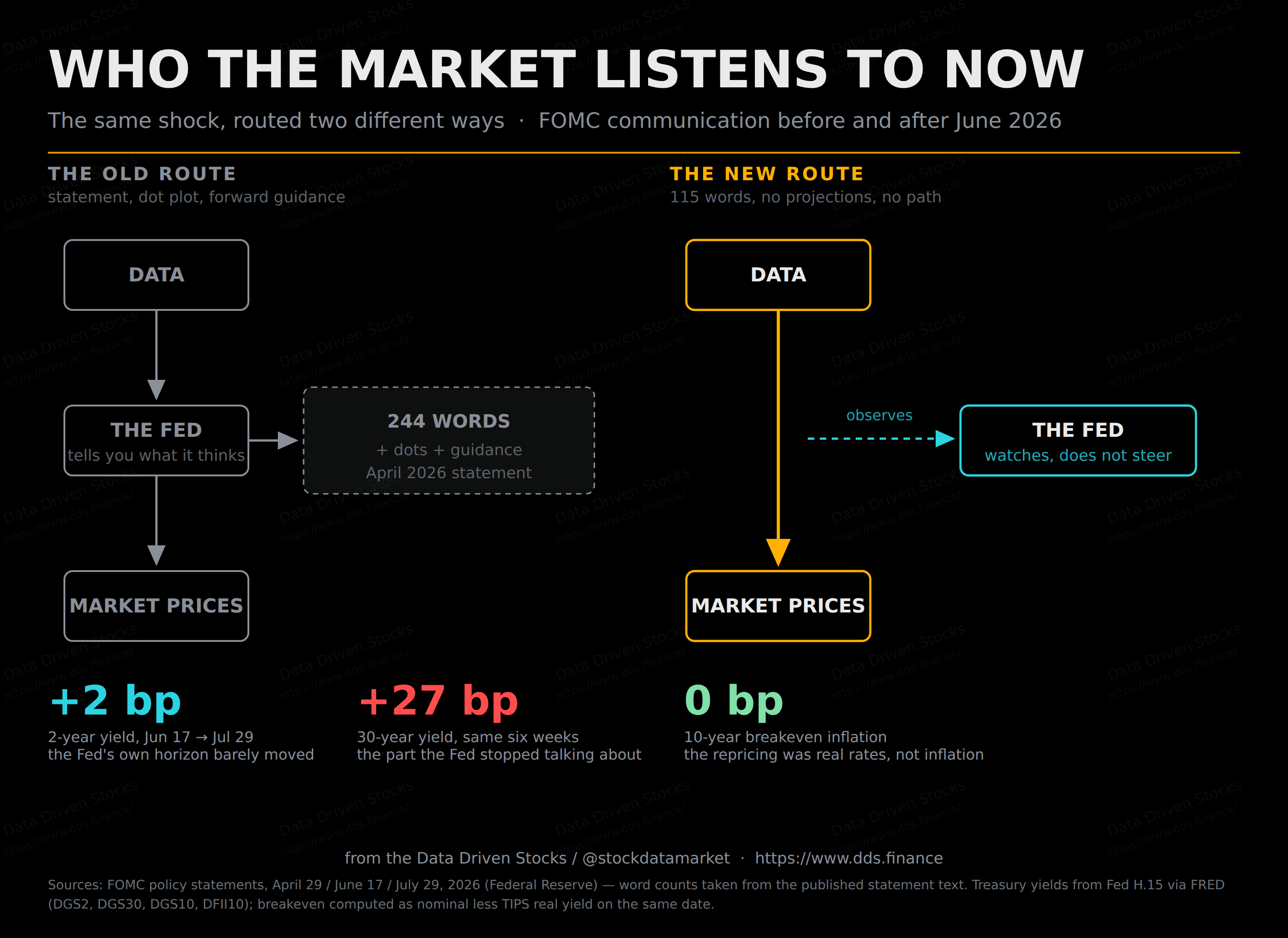
For comparison, Jerome Powell’s final statement in April ran to 244 words. Under Warsh the document has lost 53 percent of its length in two meetings. The paragraphs that disappeared were the ones that told you how the Fed thinks: the passage about carefully assessing incoming data and the evolving outlook, the passage about being prepared to adjust the stance if risks emerge, the list of things the Committee takes into account. All of it is gone.
Warsh has been explicit that this is deliberate. At the press conference he said he understood the appetite for rolling forecasts and commentary from the Committee, but that the Fed needs to observe market reaction to developments direct and unfiltered. He described investors as learning to play the ball, not the referee, and called it a change for the better.
The operational plumbing did not move at all. Interest on reserve balances stayed at 3.65 percent. The standing repo facility remained at 3.75 percent, the overnight reverse repo offering at 3.50 percent with the usual $160 billion per-counterparty cap, and the primary credit rate at 3.75 percent. The Desk keeps rolling over Treasury maturities and reinvesting agency principal into bills.
So the core message is that there is no message. That is the point. The Fed has stopped broadcasting its reaction function and started asking the market to work it out from the data.
What changed since June
Two things. One of them got all the coverage, and the other one matters more.
The one you read about is the vote. In June the Committee was unanimous, 12 to 0. In July it split 9 to 3, with Beth Hammack of Cleveland, Neel Kashkari of Minneapolis and Lorie Logan of Dallas all voting to raise the target range by a quarter point immediately. Three dissents pointing the same way has not happened since September 2016. Warsh, who has made internal argument a feature of his chairmanship rather than something to be smoothed over, told reporters he had asked for a good family fight and got one.
Look at the direction of travel and it gets stranger. In January the Committee voted 10 to 2, and both dissenters wanted a cut. In March it was 11 to 1, and the dissenter wanted a cut. By July the only three people voting against the majority wanted the opposite. The Fed’s internal argument reversed polarity in six months.
Now the part that got less attention. The text of the statement itself changed by exactly one word.
Set the June and July statements side by side and run them against each other. The policy body went from 114 words to 115. The only substantive edit is that the Committee “reaffirmed” its policy of maintaining ample reserves in June, and in July it “is continuing” that policy. Every other sentence is identical, word for word. The rest of the July document is the 35-word paragraph naming the three dissenters.
A committee that produced a unanimous vote and a committee that produced its most divided hawkish vote in a decade published, for practical purposes, the same document.
What the bond market actually did
This is the section I would keep if I had to throw the rest away.
Warsh spent part of his opening remarks on it. In the 42 days since the June meeting, he noted, nominal and real yields had risen materially across the Treasury curve, with some of the inter-meeting moves ranking in the top decile of the last two decades. He said he was comforted that markets had not been reacting to the Fed, to dots or to speeches, but to real data.
Here is what that looked like in numbers. Between the June 17 and July 29 closes, the three-month bill was unchanged. The two-year rose 2 basis points. The five-year rose 10. The ten-year rose 18. The thirty-year rose 27, closing at 5.20 percent, a level it had not reached since July 2007.
That shape is the story. The front of the curve is where the market expresses its view on what the Fed does next, and the front of the curve barely moved. Everything happened at the back.
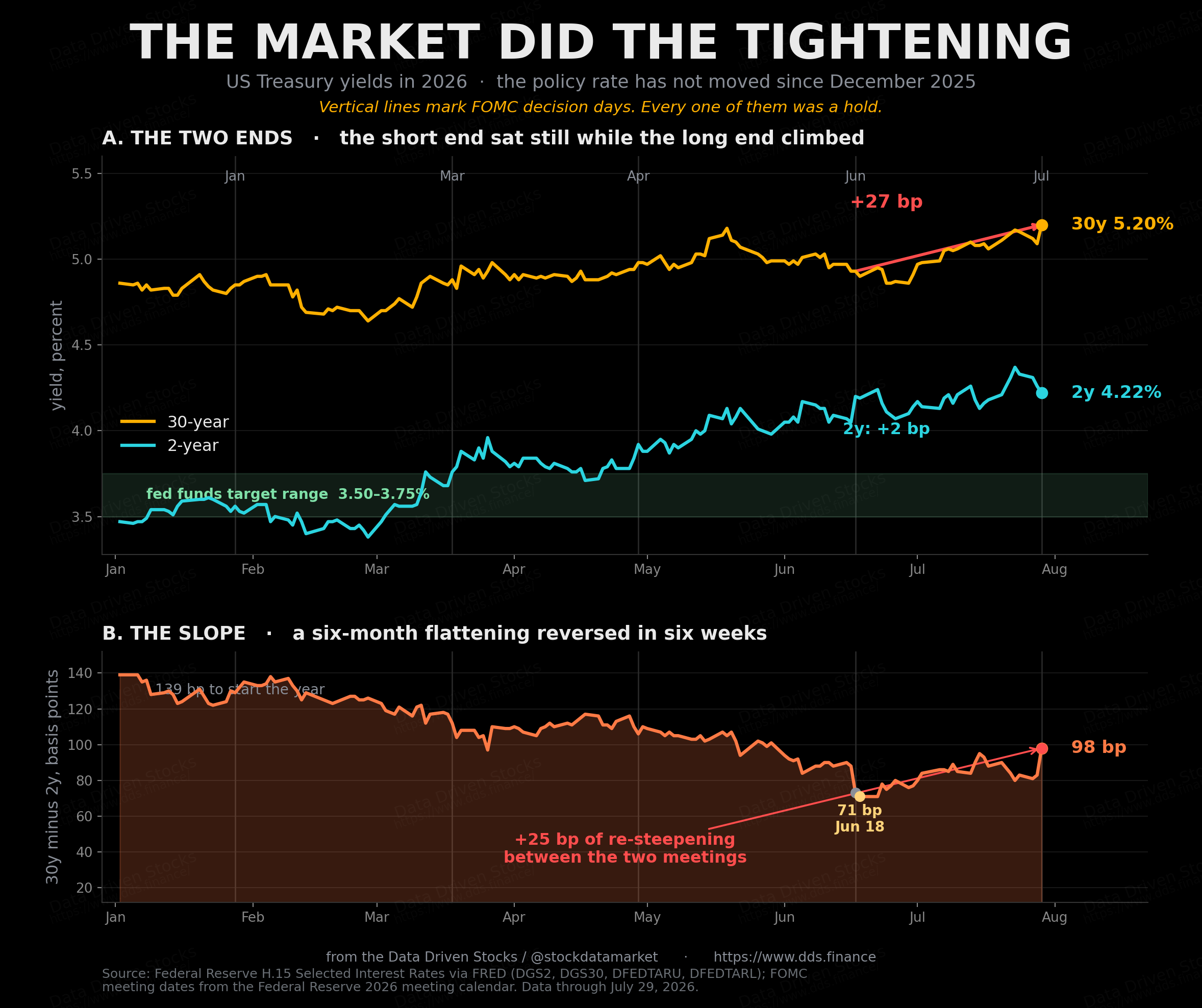
Most of the commentary read the long-end sell-off as the bond market doubting the Fed’s inflation-fighting credibility. Decompose the move and that reading gets hard to sustain.
A nominal Treasury yield is a real yield plus compensation for expected inflation. Split the ten-year that way, using the TIPS real yield on the same dates, and the arithmetic is blunt. Nominal: up 18 basis points. Real: up 18 basis points. Breakeven inflation: 2.26 percent on June 17, 2.26 percent on July 29. Zero.
The entire move was real rates. The market did not raise its inflation forecast at all over those six weeks. What it repriced was the real return it demands to hold long-dated government debt, which is a statement about the level and persistence of policy rates and about term premium, not about prices getting away from anyone. The five-year, five-year forward breakeven drifted up 7 basis points to 2.28 percent, which is a shrug rather than a warning.
There is a wrinkle worth flagging. One argument for standing pat, made by Goldman’s US economics team after the meeting, is that higher market rates are already tightening financial conditions enough that the Fed does not need to act. The Chicago Fed’s National Financial Conditions Index does not agree. It read minus 0.554 in the week to July 24 against minus 0.497 around the June meeting, meaning conditions were looser, not tighter, even with the thirty-year at a nineteen-year high. Long yields are not the whole of financial conditions, and credit spreads and equity valuations have been pulling the other way.
Who has the better case
The dissenters and the majority are both looking at the same inflation data and reaching opposite conclusions, and the reason is that they are looking at different properties of it.
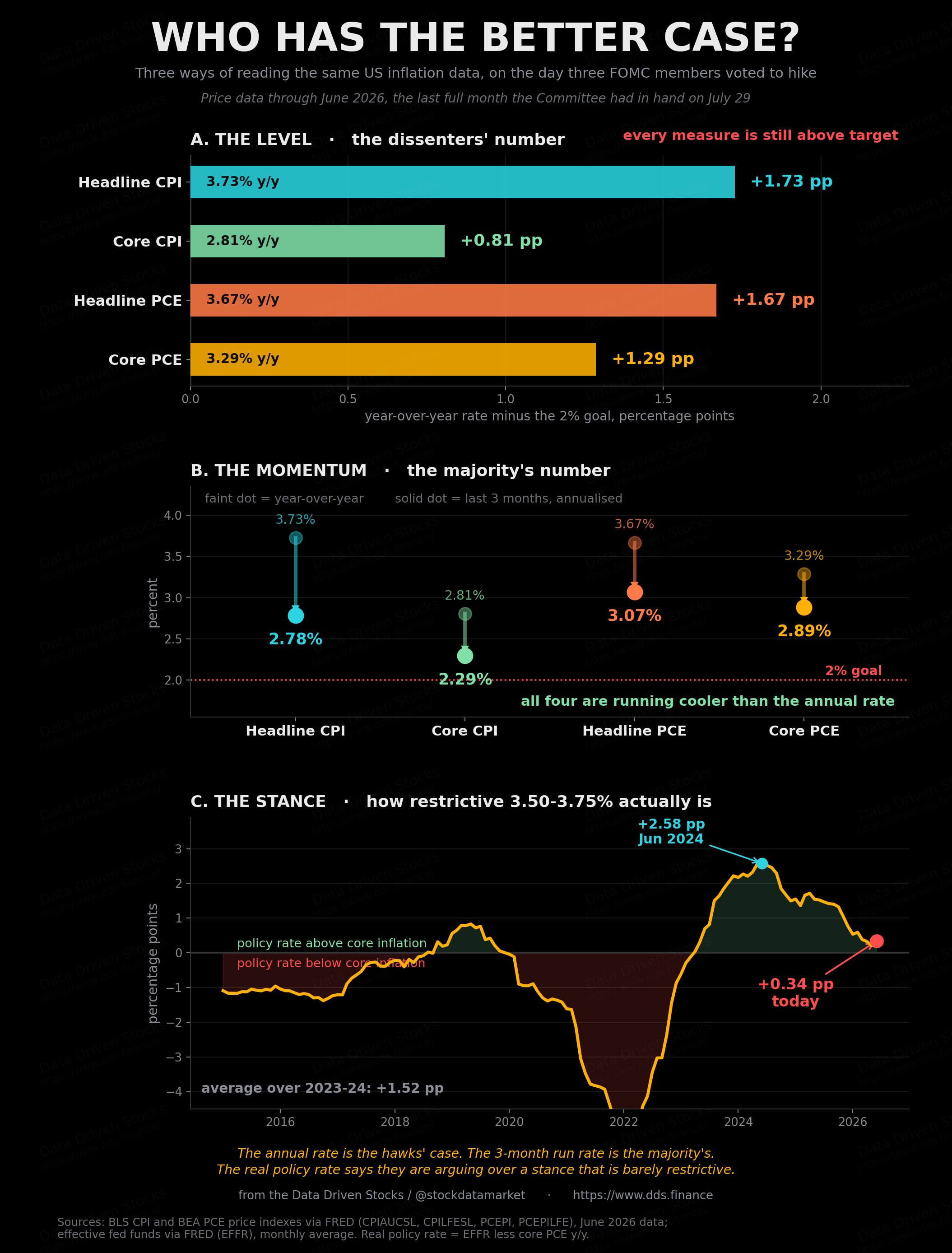
Take the level. Headline CPI ran at 3.73 percent over the year to June, core CPI at 2.81 percent, headline PCE at 3.67 percent and core PCE at 3.29 percent. Every one of those is above 2 percent, some of them substantially. Inflation has now been above target for more than five years. That is the dissenters’ case, and it is not a weak one.
Take the momentum instead and the picture inverts. Annualise the last three months and headline CPI is running at 2.78 percent, core CPI at 2.29 percent, headline PCE at 3.07 percent and core PCE at 2.89 percent. All four are running cooler than their own annual rates. Core CPI over three months is within thirty basis points of the target. Whatever the flare-up did earlier in the year, it is fading in the recent data.
Then there is the third number, which neither camp says out loud and which explains the argument better than either of the other two.
Subtract core PCE inflation from the effective fed funds rate and you get the real policy rate: what the Fed is charging in inflation-adjusted terms. Today that is plus 0.34 percentage points. In June 2024 it was plus 2.58. Across 2023 and 2024 it averaged plus 1.52.
The Fed did not loosen policy by cutting alone. Inflation rose while the target range came down, and the stance quietly stopped being restrictive. A committee holding at 3.50 to 3.75 percent today is running a materially easier policy than a committee holding at the same range eighteen months ago, without having taken a single vote to do so. Hammack, Kashkari and Logan are not really arguing that inflation is accelerating. They are arguing that the brake pedal came up on its own.
Five things to keep from this meeting
The first is the September calendar. The Committee next meets on September 15 and 16, and that one carries a Summary of Economic Projections. The Fed’s period of deliberate silence has an end date, and everything between now and then is data.
The second is that the Fed decided this without the numbers. Q2 GDP and the June PCE report both landed the following morning, July 30. GDP came in at 1.5 percent annualised, down from 2.09 percent in Q1 and below expectations, with the miss concentrated in federal spending and inventories. Core PCE eased to 3.3 percent from 3.4. Energy prices fell 5.9 percent in the month and gasoline dropped 9.2 percent, helped by the brief Iranian ceasefire. The Committee voted blind and the data that arrived a day later leaned dovish.
The third is that dissents are information now in a way they were not before. When the statement carried guidance, you could read the Fed’s reaction function off the document. Strip the guidance out and the vote count becomes the loudest signal in the release. Three names is the market’s best available estimate of how close the Committee is to moving.
The fourth is that the labour market is doing something the statement does not acknowledge. Payroll gains came in at 148,000 in April, 129,000 in May and 57,000 in June, a three-month average of 111,000 and a clear deceleration. Unemployment sat at 4.2 percent. The statement’s line about job gains keeping pace with the workforce is defensible, but it is the same sentence the Fed used in June, and June’s data looked better.
The fifth is that the rest of the world did the same thing. The ECB held on July 22, with the deposit rate at 2.25 percent. The Bank of England held Bank Rate at 3.75 percent at a meeting ending the same day as the FOMC’s, and split 6 to 3, with the three wanting 4 percent. Two major central banks, two hawkish minorities, one week. This is not a purely American argument.
Where rates go from here
No dot plot in July means the June projections are still the only official numbers on the table, and they are worth restating because they are more hawkish than most people remember.
In June the median participant put the federal funds rate at 3.8 percent at the end of 2026, 3.6 percent at the end of 2027 and 3.4 percent at the end of 2028, with a longer-run value of 3.1 percent. The current midpoint is 3.625. So the median participant in June had already penciled in roughly one more quarter-point this year, followed by a partial unwind next year. The central tendency for end-2026 ran from 3.6 to 4.1 percent.
The revision from March is the part that tells you how fast the ground moved. In March the median 2026 dot was 3.4 percent and the median 2026 PCE inflation projection was 2.7 percent. By June those had become 3.8 and 3.6. In three months the Committee’s own inflation forecast for this year rose by nearly a full percentage point and its rate path flipped from implying a cut to implying a hike.
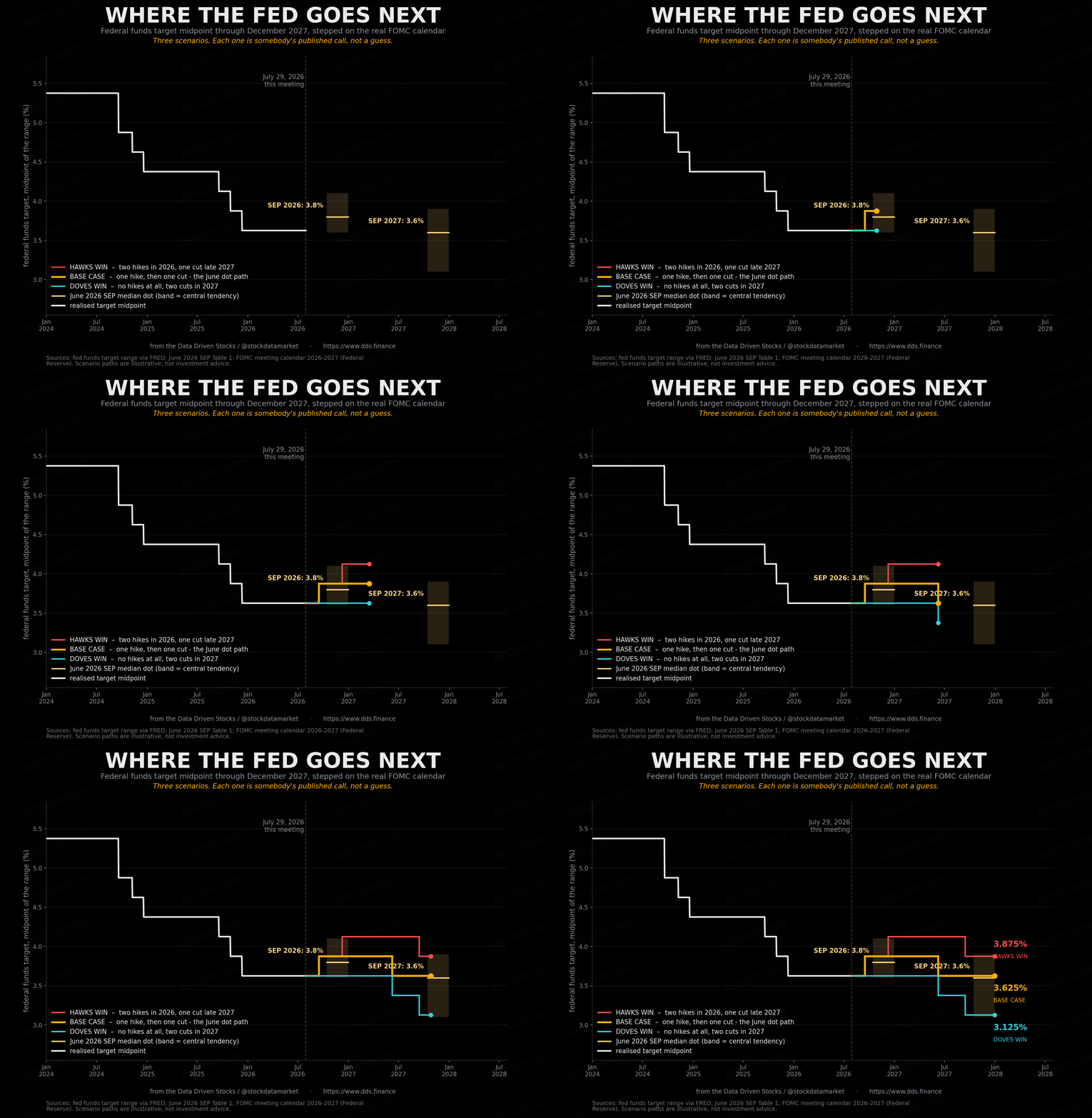
Market pricing after the meeting put the odds of a September hike somewhere in the mid-fifties, up from around 38 percent on July 24 and from under 11 percent on July 15. That is a violent repricing for nine days, and it happened before the meeting rather than because of it.
The sell side is not close to agreement. Goldman Sachs Asset Management read the three dissents as a Fed running out of patience and expects a September move. Goldman’s own economics team expects no hikes at all this year. JP Morgan pulled its next-hike call forward to December. Bank of America thinks the credibility problem raises the odds of September. Ian Lyngen at BMO summarised it neatly: a committee with vocal hawks, where the majority is siding with Warsh until the July and August CPI reports are in hand.
My own base case is the middle path, and it lines up with where the inflation work in this letter has been pointing since June. One quarter-point hike, most likely in September, taking the range to 3.75 to 4.00. Then a long hold while the Committee waits to see whether core services follow energy down. Then a single cut somewhere in the middle of 2027 as the annual inflation rates finally roll over toward the mid-twos, ending 2027 back at 3.50 to 3.75. That is the June dot path, and the June dots were built by people looking at the same tension the dissenters are now voting on.
The hawkish path, two hikes this year, needs the August and September inflation prints to stop improving. Given that oil went from $80 a barrel in mid-June to $105 on July 23 and back to $92 by the 27th, that is entirely possible. Brent moving twenty dollars in five weeks is not a stable input to a forecast.
The dovish path needs the three-month momentum to hold and the labour market to keep slowing. Payrolls at 57,000 and GDP at 1.5 percent are both arguments for it. If the September SEP arrives with a lower dot and a weaker growth forecast, the conversation turns to when the cuts start rather than whether the hike happens.
What would change my mind quickly is the composition of the next two CPI reports. If energy keeps falling while core services stay near 2.3 percent annualised, the hawks lose the argument on the data and the September dissents become a footnote. If core services re-accelerate while energy stops helping, the Committee will hike and Warsh will not need to have warned anyone first.
Though with two straits being closed, Iran using it as a leverage card during midterms, and reserves running empty. We can get a mild inflation shock. But this should come after the September, when reserves get almost empty. But then the economy can slow down and spiral down into a recession - but that would be 2027, after this inflation shock.
Nothing here is investment advice. Scenario paths are illustrative and are labelled with the published forecasts they follow.
Sources
Federal Reserve Board, “Federal Reserve issues FOMC statement,” July 29, 2026 - https://www.federalreserve.gov/newsevents/pressreleases/monetary20260729a.htm
Federal Reserve Board, “Implementation Note issued July 29, 2026” - https://www.federalreserve.gov/newsevents/pressreleases/monetary20260729a1.htm
Federal Reserve Board, “Federal Reserve issues FOMC statement,” June 17, 2026 - https://www.federalreserve.gov/newsevents/pressreleases/monetary20260617a.htm
Federal Reserve Board, FOMC statement, April 29, 2026 - https://www.federalreserve.gov/newsevents/pressreleases/monetary20260429a.htm
Federal Reserve Board, FOMC statement, March 18, 2026 - https://www.federalreserve.gov/monetarypolicy/files/monetary20260318a1.pdf
Federal Reserve Board, FOMC statement, January 28, 2026 - https://www.federalreserve.gov/monetarypolicy/files/monetary20260128a1.pdf
Federal Reserve Board, “Summary of Economic Projections,” June 17, 2026 - https://www.federalreserve.gov/monetarypolicy/files/fomcprojtabl20260617.pdf
Federal Reserve Board, “Transcript of Chairman Warsh’s Press Conference,” July 29, 2026 - https://www.federalreserve.gov/mediacenter/files/FOMCpresconf20260729.pdf
Federal Reserve Board, FOMC meeting calendars and information - https://www.federalreserve.gov/monetarypolicy/fomccalendars.htm
Federal Reserve Bank of St. Louis, FRED: DFEDTARU, DFEDTARL, EFFR, IORB, DGS3MO, DGS1, DGS2, DGS5, DGS10, DGS30, DFII10, T10YIE, T5YIFR, CPIAUCSL, CPILFESL, PCEPI, PCEPILFE, UNRATE, PAYEMS, GDPC1, NFCI, SP500, VIXCLS - https://fred.stlouisfed.org
US Energy Information Administration, Europe Brent and Cushing WTI daily spot prices - https://www.eia.gov/dnav/pet/pet_pri_spt_s1_d.htm
CNBC, “Fed rate decision July 2026: Divided Fed holds interest rates steady” - https://www.cnbc.com/2026/07/29/fed-rate-decision-july-2026.html
CNBC, “Fed meeting recap: July 2026” - https://www.cnbc.com/2026/07/29/fed-meeting-today-live-updates.html
CNBC, “30-year Treasury yield hits highest level since 2007 after Fed keeps rates unchanged” - https://www.cnbc.com/2026/07/29/treasury-yields-fed-interest-rates.html
CNBC, “US economy slowed to 1.5% growth rate in Q2; June core inflation at 3.3%” - https://www.cnbc.com/2026/07/30/us-economy-slowed-to-1point5percent-growth-rate-in-q2-june-core-inflation-at-3point3percent.html
Reuters, “Warsh-led Fed leaves rates on hold and a bond market scratching its head,” July 29, 2026 - https://www.reuters.com/markets/us/uncertainty-creeps-into-feds-rate-decision-warsh-keeps-his-cards-hidden-2026-07-29/
Bloomberg, “Fed Holds Rates Steady as Three Officials Dissent in Favor of a Hike” - https://www.bloomberg.com/news/articles/2026-07-29/fed-holds-rates-steady-three-officials-dissent-favoring-a-hike
Wall Street Journal, “Dissents Show Fed Is ‘Running Out of Patience’ With Inflation” - https://www.wsj.com/livecoverage/fed-meeting-warsh-interest-rate-07-29-2026/card/duhTHthZ6pyTyPkz4raf
Advisor Perspectives, “Fed’s Interest Rate Decision: July 29, 2026” - https://www.advisorperspectives.com/dshort/updates/2026/07/29/feds-interest-rate-decision-july-29-2026
Advisor Perspectives, “Core PCE Inflation at 3.3% in June, Edging Down from May” - https://www.advisorperspectives.com/dshort/updates/2026/07/30/core-pce-inflation-at-3-3-in-june-edging-down-from-may
Fox Business, “June PCE: Fed’s favored inflation gauge showed price growth eased” - https://www.foxbusiness.com/economy/june-2026-pce-inflation
Charles Schwab, market update, July 30, 2026 - https://www.schwab.com/learn/story/stock-market-update-open
Yahoo Finance, “Goldman Sachs Breaks With Market on Fed Rate Path” - https://finance.yahoo.com/economy/policy/articles/goldman-sachs-breaks-market-fed-202506684.html
Economic Times, “JP Morgan brings forward Fed rate hike call to December after July policy meeting” - https://economictimes.indiatimes.com/markets/us-stocks/news/us-stock-market-jp-morgan-brings-forward-fed-rate-hike-call-to-december-after-july-policy-meeting/articleshow/132734118.cms
European Central Bank, “Monetary policy decisions,” July 22, 2026 - https://www.ecb.europa.eu/press/pr/date/2026/html/ecb.mp260723~29f24d99bc.en.html
Bank of England, “Bank Rate maintained at 3.75% - July 2026 Monetary Policy Summary” - https://www.bankofengland.co.uk/monetary-policy-summary-and-minutes/2026/july-2026
Bureau of Economic Analysis, Personal Consumption Expenditures Price Index Excluding Food and Energy - https://www.bea.gov/data/personal-consumption-expenditures-price-index-excluding-food-and-energy