
The Crossover: How Anthropic Quietly Lapped OpenAI in 15 Months and Reset the Entire AI Market
A data-driven autopsy of the $30 billion moment that just rewrote the AI playbook - and what it means for global markets, enterprise software, and the coming wave of AI IPOs.

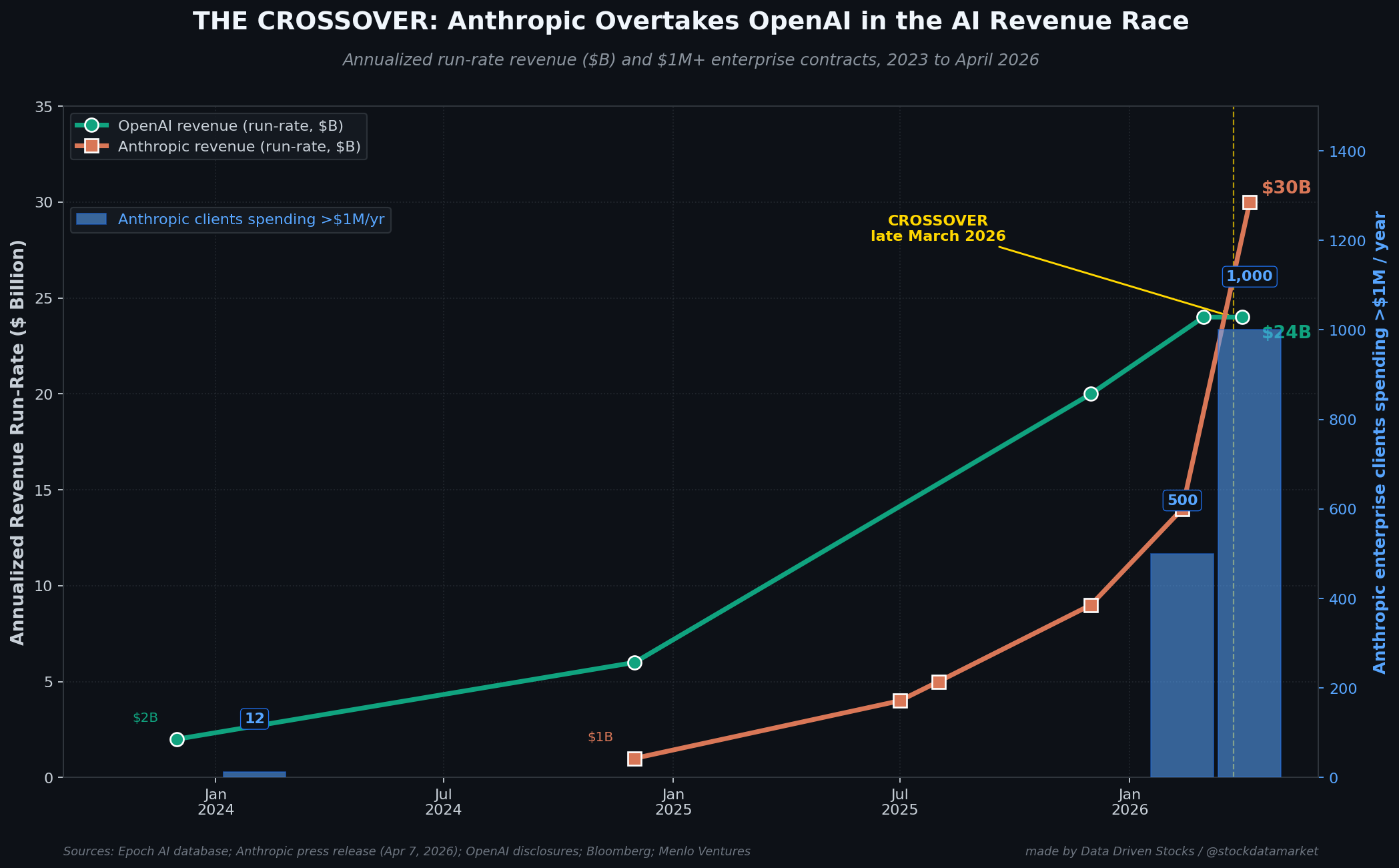
For two years, the consensus was simple. OpenAI had ChatGPT, Microsoft, the brand, the head start, and the biggest funding round in tech history. Anthropic was the polite, safety-obsessed sibling everyone respected but nobody expected to win. Then, on April 7, 2026, Anthropic published a blog post that turned the consensus into wallpaper. Annualized revenue had crossed $30 billion. OpenAI was sitting at roughly $24 billion - generating about $2 billion per month. For the first time, the smaller lab was outearning the household name.
This is the story of how that happened, what the data actually shows, and why the gap is structural rather than cosmetic. It is also the story of how a $4 trillion AI economy quietly bifurcated into two very different business models - one built on free users and consumer habit, the other built on enterprise contracts and a single killer developer product - and why the enterprise model is winning the cash race even as the consumer model wins the headlines.
The Numbers Nobody Thought Were Possible
Start with the trajectory, because it is genuinely difficult to overstate. When Anthropic first crossed $1 billion in annualized revenue in December 2024, OpenAI was already at roughly $6 billion and accelerating. Eight months later, in August 2025, Anthropic was at $5 billion. By the end of 2025 it had reached $9 billion - a number Anthropic confirmed in its own April 7 announcement. Then, in the four months between December 2025 and April 2026, the Claude maker’s run-rate more than tripled from $9 billion to over $30 billion. Epoch AI, the research outfit that tracks frontier-lab revenue, had modeled Anthropic growing at roughly 10x per year and projected a crossover with OpenAI sometime in mid-2026. The actual crossover happened months ahead of schedule, in late March.
OpenAI’s growth has been extraordinary by any normal benchmark - it went from roughly $2 billion in 2023 to $6 billion in 2024 to $20 billion by the end of 2025 - but its trajectory has compounded at “only” about 3.4x per year. By the end of March 2026 OpenAI had reached roughly $24 billion in annualized run-rate, or about $2 billion per month. When you stack a 10x curve against a 3.4x curve and let them run for long enough, the math is going to win, and the math just won.
A methodological caveat that matters more than it sounds: Anthropic and OpenAI do not report revenue on identical bases. According to Sacra, Anthropic books revenue from cloud resellers (AWS, Google, Microsoft) on a gross basis - counting total end-customer spend as revenue and treating partner payouts as expenses - which inflates the top-line figure relative to net-reporting peers. The practical effect is that Anthropic’s $30 billion and OpenAI’s $24 billion are not strictly apples-to-apples comparisons. Even after adjusting for that, however, the slope of the two curves is the part that has investors recalibrating - and the slope is real on either accounting basis.
To put $30 billion in perspective: Anthropic’s run-rate now exceeds the trailing twelve-month revenues of all but roughly 130 S&P 500 companies. A company that was effectively pre-revenue eighteen months ago now out-earns most of the Fortune 500. There is no precedent for this in software history.
The Real Engine: A Thousand Customers Spending a Million Each
Headline revenue is the part everyone screenshots. The number that actually explains the gap is buried one line down in Anthropic’s announcement: more than 1,000 enterprise customers now pay Anthropic over $1 million per year. That number was twelve two years earlier - Anthropic’s own framing in its February 2026 Series G announcement was that “two years ago, a dozen customers spent over $1 million annually with Anthropic, and today that number exceeds 500.” Eight weeks after the Series G round closed, that 500 had doubled again to over 1,000.

This is what makes the crossover structural rather than a quirk of accounting. A thousand contracts at over a million dollars each is a different kind of business than 50 million $20-per-month subscribers. Enterprise revenue is stickier, expands inside the customer as more teams adopt the tool, renews on multi-year cycles, and signals procurement-grade trust. A consumer subscription, by contrast, churns the moment the next shiny model ships. Enterprise revenue also commands different margins and different valuation multiples in public markets, which is why this single chart will likely matter more for both companies’ eventual IPOs than any single product launch.
Eight of the Fortune 10 are now Anthropic clients. OpenAI’s response to the divergence was reportedly internal: at a March all-hands meeting led by applications chief Fidji Simo, OpenAI’s enterprise weakness was flagged as a “red alert,” and the company moved to consolidate ChatGPT, Codex, and the Atlas browser into a single desktop application to claw back ground.
How Anthropic Took the Enterprise Crown
The market-share data tells the same story from a different angle. According to PitchBook and the Menlo Ventures Enterprise LLM Report, OpenAI commanded roughly 50% of enterprise LLM API usage at the end of 2023. By the start of 2026, that share had been cut in half to about 25%. Over the same window, Anthropic climbed from about 12% to 32%. Google’s Gemini quietly took third place with 20%, Meta’s Llama held 9%, and DeepSeek - despite the headline-grabbing launch earlier in the cycle - accounts for just 1% of enterprise production workloads.

What makes those numbers more striking is the directional momentum behind them. According to the same survey work, among first-time AI buyers - companies making their first serious LLM commitment - Anthropic’s selection rate runs roughly triple OpenAI’s. Seven out of every ten new enterprise customers are choosing Claude. That is not a customer base that is going to mean-revert next quarter.
Three things bought Anthropic this position. The first is multi-cloud distribution: Claude is the only frontier model available natively across all three major hyperscalers - AWS Bedrock, Google Vertex AI, and Microsoft Azure Foundry. Procurement teams who already had AWS contracts could buy Claude with no new vendor onboarding. The second is the safety-and-reliability story, which costs nothing in marketing but pays for itself in regulated industries like banking, healthcare, and law. The third, and probably the largest, is a single product almost nobody saw coming.
The Killer App Hiding in Plain Sight: Claude Code
Claude Code launched in mid-2025 as a developer-focused coding assistant. By early 2026 it had reached roughly $2.5 billion in annualized revenue, captured about 54% of the enterprise AI coding market, and become Anthropic’s single largest growth contributor. It is, by most measures, the first true killer application of generative AI for business productivity. By March 2026, the Model Context Protocol - Anthropic’s open standard for connecting agents to external tools - had crossed 97 million installs.
The numbers behind Claude Code are the kind that make competitors quietly delete their roadmap slides. Claude is now responsible for an estimated 4% of all GitHub commits. Claude Code holds more than double the market share of OpenAI’s Codex offering in enterprise developer environments, and the gap is widening. Cursor, Windsurf, Lovable, Bolt and the rest of the AI-IDE ecosystem - which now constitutes a roughly $1.9 billion sub-market in its own right - largely runs on Claude under the hood.
This is the part of the story that frames the next decade for AI-native software. A single workflow product, built for developers, generated more revenue in nine months than entire SaaS companies generate in a lifetime. If that is what one killer enterprise app looks like, it is hard to argue that we are anywhere near the ceiling of what frontier labs can monetize.
Two Business Models, One Race
The deeper reason Anthropic is winning the revenue race while OpenAI is winning the user race is that they are running two genuinely different businesses. OpenAI’s model is consumer-led: build the most-used AI product on earth, harvest free users into paid subscribers, then upsell into the enterprise. Anthropic’s model is the opposite: skip the consumer funnel almost entirely, sell directly to companies through APIs and partner clouds, and let a developer-grade product like Claude Code do the brand work.

Both models work. Both are growing. But they do not have the same unit economics. According to figures cited by Fortune Magazine, Anthropic generates roughly $2.10 of revenue per dollar of compute spent, compared to roughly $1.60 for OpenAI. When you start with 80% enterprise revenue versus a base where 95% of your users are free riders, your gross margin math looks fundamentally different. Anthropic’s gross margin is reportedly around 40%, up from negative 94% in 2024 - the kind of operating leverage curve that public-market investors would normally pay almost any multiple to own.
The Compute Bill That Changes Everything
If revenue is the offense in this game, compute is the defense, and the defensive postures of the two companies could not be more different. According to projections leaked to the Wall Street Journal and corroborated by The Information, OpenAI is on track to spend roughly $121 billion on compute in 2028 alone, climbing to about $125 billion per year by 2030. Anthropic’s projection for the same period is roughly $30 billion. Same race, four-times difference in burn rate.

The implications cascade. OpenAI is projected to lose roughly $14 billion in 2026 alone, burning around $150 million per day. Next Round Capital’s modeling suggests OpenAI could accumulate losses approaching $215 billion through 2029. Anthropic, by contrast, is projecting positive free cash flow as soon as 2027, with the same model implying roughly $18 billion in profit by 2029. OpenAI has reportedly pushed its breakeven target back to 2030. Anthropic’s path to profitability is roughly three years shorter on paper.
This is also why Anthropic’s recent infrastructure deals matter more than the headlines suggest. In early April 2026 the company announced an expanded chip-and-cloud partnership with Google and Broadcom that secures roughly 3.5 gigawatts of next-generation TPU capacity beginning in 2027. That is on top of an existing commitment to invest $50 billion in U.S. AI infrastructure announced in November 2025, and on top of Anthropic’s existing usage of AWS Trainium and NVIDIA GPUs. The strategic logic is to lock in compute costs at today’s prices before the next training generation makes capacity scarcer. By spreading workloads across three independent silicon stacks - AWS Trainium, Google TPU, NVIDIA GPU - Anthropic also avoids the single-supplier exposure that has historically been one of OpenAI’s quiet vulnerabilities.
What This Means for Global Markets
Zoom out and the OpenAI-Anthropic race is no longer a private-company curiosity. It is now one of the two or three largest single drivers of global capital expenditure. The combined compute commitments of the frontier labs, the hyperscalers building data centers to host them, and the chipmakers selling the silicon together represent the largest infrastructure buildout in modern technology history. NVIDIA’s market cap is not what it is because of gaming. Broadcom’s accelerated chip business is not what it is because of networking. The entire data-center REIT and power-generation complex is being repriced around AI demand that originates, ultimately, in the budgets of the companies in this article.


The Valuation Paradox and the IPO Window
Here is the part that should keep a sober portfolio manager up at night. OpenAI’s most recent funding round, completed in March 2026, raised roughly $122 billion at an $852 billion post-money valuation. Anthropic’s Series G in February 2026 raised about $30 billion at a $380 billion post-money valuation. OpenAI is valued at more than double Anthropic, but Anthropic is now generating more revenue and burning roughly four times less compute to do it.
The secondary markets noticed before the primary markets did. According to Bloomberg, in early April 2026 institutional investors holding roughly $600 million in OpenAI shares were unable to find a single buyer on three secondary platforms, while across the same platforms buyers had over $2 billion in cash queued up specifically for Anthropic equity. Goldman Sachs reportedly waived carry fees on its OpenAI vehicles while charging the full 15-20% carry on Anthropic positions. The relative price signal could not be clearer.
Both companies are now circling IPO windows in 2026. Anthropic is reportedly evaluating a public listing as early as October 2026, with bankers floating fundraising of more than $60 billion at valuations potentially well north of the current $380 billion mark. OpenAI is preparing its own listing, possibly in the same window. The risk, as CNBC’s Jim Cramer flagged, is that listings of this scale - combined with a possible SpaceX IPO - would dump enough new equity supply on public markets to distort pricing for the entire technology sector. The AI IPO calendar for late 2026 may end up being the single largest test of public-market appetite for high-growth, high-burn frontier tech since the dot-com window.
The Risks Nobody Is Pricing
None of this means Anthropic has won. There are at least three quiet risks worth tracking carefully.
The first is that Anthropic’s growth rate is mathematically required to slow. Epoch AI’s analysis of the run-rate trajectory shows weak evidence that the 10x annual growth rate has already started easing toward 7x since July 2025, and Anthropic’s own internal forecast for 2026 reportedly projects 4x growth or less. A 4x year on a $30 billion base is still extraordinary, but it is not the same shape of curve that just produced the crossover, and the gap with OpenAI could narrow again as both companies compete on the same enterprise opportunities.
The second is concentration. While Anthropic’s customer book is broader than OpenAI’s, both companies remain critically dependent on a small number of cloud and chip partners. OpenAI’s Microsoft relationship is so large that it reportedly accounts for roughly 45% of Microsoft’s reported order backlog. Anthropic’s expanded Google-Broadcom deal creates a similar single-relationship exposure on the chip side. Any meaningful tension between a frontier lab and its hyperscaler partner could move billions of dollars of revenue overnight.
The third is regulatory. Both companies are sitting at the center of antitrust scrutiny in the US, the UK, and the EU. The same multi-cloud distribution that bought Anthropic its enterprise lead is precisely the kind of arrangement that competition regulators are most interested in. A bad ruling in Brussels or a forced unwinding of an exclusivity term in a major hyperscaler contract could reshape the economics of the entire stack.
The Bottom Line
A year ago, the consensus view of the AI race was that OpenAI’s lead was insurmountable. The brand was too strong, the user base too large, the Microsoft partnership too valuable, the model too far ahead. Today, on the most important financial metric in private technology - annualized revenue - the smaller, quieter, enterprise-focused lab is in front. It got there by ignoring the consumer funnel, building a single killer developer product, distributing it across every major cloud, signing a thousand million-dollar contracts, and spending roughly a quarter of what its rival was spending on compute to do it.
The crossover does not mean Anthropic has won the long game. OpenAI still has 900 million weekly users, the most recognized brand in artificial intelligence, and a balance sheet that can absorb years of $14 billion losses. But the crossover does mean that the simplest narrative of the AI race - that scale of users equals scale of revenue equals scale of victory - is now empirically wrong. Enterprise pipelines compound. Consumer funnels leak. And when the next AI IPO bell rings, the company on the podium may not be the one anyone expected eighteen months ago.
The data has a way of catching up to the consensus, and then sprinting past it.
Sources
Anthropic, “Anthropic expands partnership with Google and Broadcom for multiple gigawatts of next-generation compute,” April 7, 2026 - https://www.anthropic.com/news/google-broadcom-partnership-compute
GIC, “GIC Leads $30 Billion Series G in Anthropic,” February 12, 2026 - https://www.gic.com.sg/newsroom/all/gic-leads-30-billion-series-g-in-anthropic/
Sacra, “Anthropic revenue, valuation and funding” - https://sacra.com/c/anthropic/
Sherwood News, “Anthropic boasts revenue run rate of $30 billion as the Claude developer expands its partnership with Google and Broadcom,” April 7, 2026 - https://sherwood.news/markets/anthropic-revenue-run-rate-30-billion-google-broadcom-partnership/
The Register, “Anthropic reveals $30bn run rate, plan to use new Google TPU,” April 7, 2026 - https://www.theregister.com/2026/04/07/broadcom_google_chip_deal_anthropic_customer/
Epoch AI, “Anthropic could surpass OpenAI in annualized revenue by mid-2026,” February 2026 - https://epoch.ai/data-insights/anthropic-openai-revenue/
Menlo Ventures, “Enterprise LLM Spend Reaches $8.4B as Anthropic Overtakes OpenAI” (via Yahoo Finance, July 2025) - https://finance.yahoo.com/news/enterprise-llm-spend-reaches-8-130000140.html
Trending Topics, “Anthropic Overtakes OpenAI in Revenue, Hitting $30 Billion Run Rate,” April 7, 2026 - https://www.trendingtopics.eu/anthropic-overtakes-openai-in-revenue-hitting-30-billion-run-rate/
Technobezz, “Anthropic Hits $30 Billion Revenue Run Rate as OpenAI Stalls at $24 Billion,” April 8, 2026 - https://www.technobezz.com/news/anthropic-hits-30-billion-revenue-run-rate-as-openai-stalls-at-24-billion
TradingKey, “Anthropic Revenue Surpasses OpenAI for First Time, IPO as Early as October,” April 7, 2026 - https://www.tradingkey.com/analysis/stocks/us-stocks/261756528-anthropic-openai-ipo-tradingkey
Stocktwits, “Anthropic Tops OpenAI On Revenue With $30B Run-Rate,” April 7, 2026 - https://stocktwits.com/news-articles/markets/equity/anthropic-tops-open-ai-on-revenue-with-30-b-run-rate-while-space-x-plans-june-investor-roadshow-ahead-of-mega-ip-os/cZJJmVzRIpR
Implicator.ai, “OpenAI Shares Go Unsold as Investors Deploy $2B to Anthropic,” April 1, 2026 - https://www.implicator.ai/openai-shares-cant-find-buyers-as-2-billion-floods-into-anthropic-instead/
Andreessen Horowitz, “Leaders, gainers and unexpected winners in the Enterprise AI arms race,” February 2026 - https://a16z.com/leaders-gainers-and-unexpected-winners-in-the-enterprise-ai-arms-race/
Winbuzzer, “Anthropic Tops $30B Annualized Revenue, Surpassing OpenAI,” April 8, 2026 - https://winbuzzer.com/2026/04/08/anthropic-tops-30b-annualized-revenue-surpassing-openai-xcxwbn/
The AI Corner, “Anthropic Passed OpenAI in Revenue: $30B ARR April 2026” - https://www.the-ai-corner.com/p/anthropic-30b-arr-passed-openai-revenue-2026
CNBC, “Broadcom agrees to expanded chip deals with Google, Anthropic,” April 6, 2026 - https://www.cnbc.com/2026/04/06/broadcom-agrees-to-expanded-chip-deals-with-google-anthropic.html
Seeking Alpha, “Anthropic targets $30B revenue, signs TPU deal with Google and Broadcom,” April 2026 - https://seekingalpha.com/news/4572848-anthropic-targets-30b-revenue-signs-tpu-deal-with-google-and-broadcom
Federal Reserve Economic Data (FRED), St. Louis Fed - https://fred.stlouisfed.org/

