

The Afternoon Burn: how short-dated options gain and lose (usually) value
So a tutorial how to lose money fast but with a style! If you are 0DTE retail - this article may induce anxiety

Most probably you bought few 0DTEs in your life. And you know the pain of losing 100% within hours or even minutes. Either way, you have picked the right topic. Same-day options are now the main event: in 2026, zero-days-to-expiry contracts made up over 60% of all S&P 500 index option volume in 2026. And retails love those 0DTEs!
The main feature of this instrument is defined by that it dies at 4 pm. Yet people often do not fully understand this instrument and lose a lot of money trading it!
The width is the price
Take that one-day bell and stretch it. Keep the spot and the clock fixed, and run the same day at vol 12, at 17.05, and at 30.
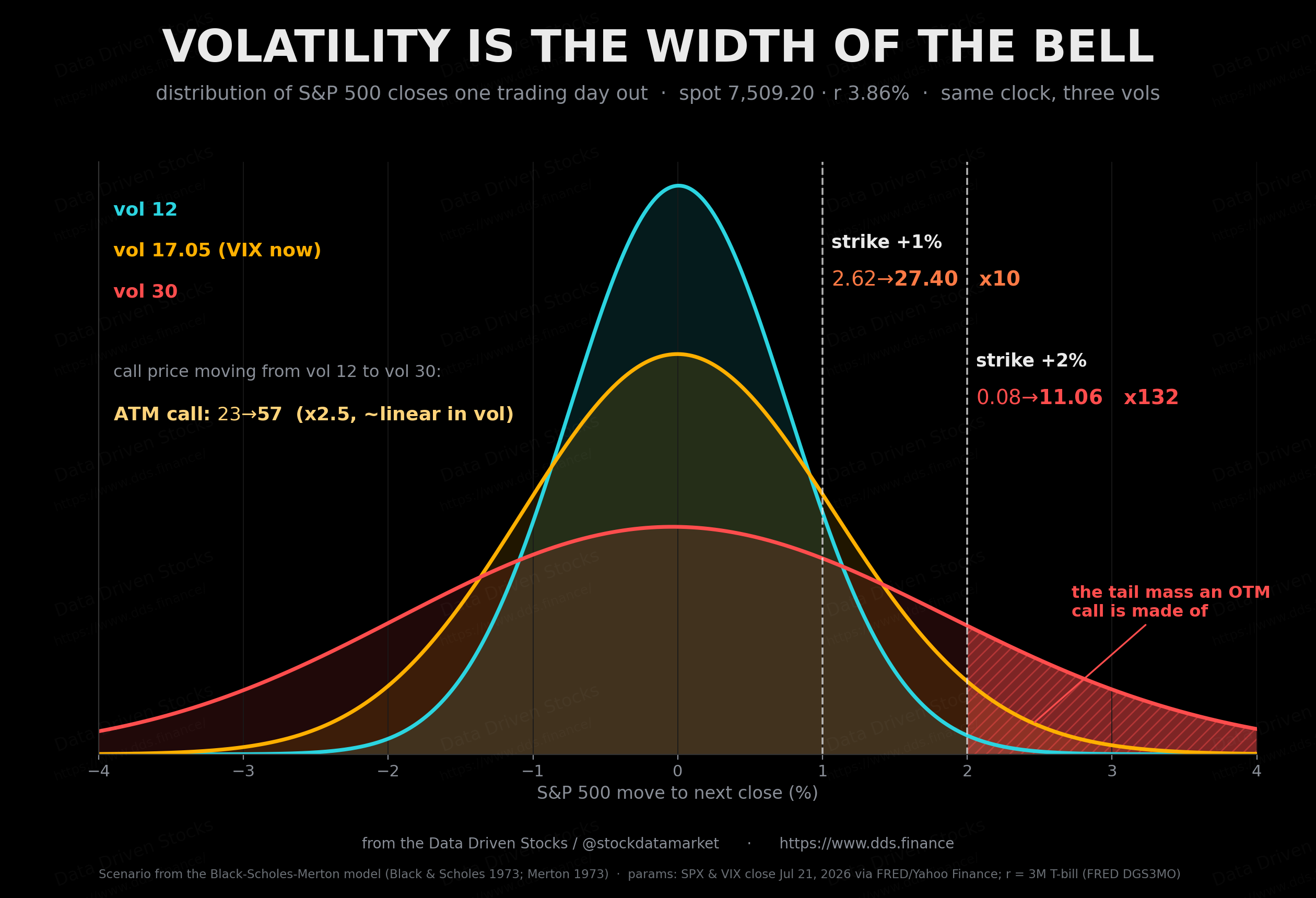
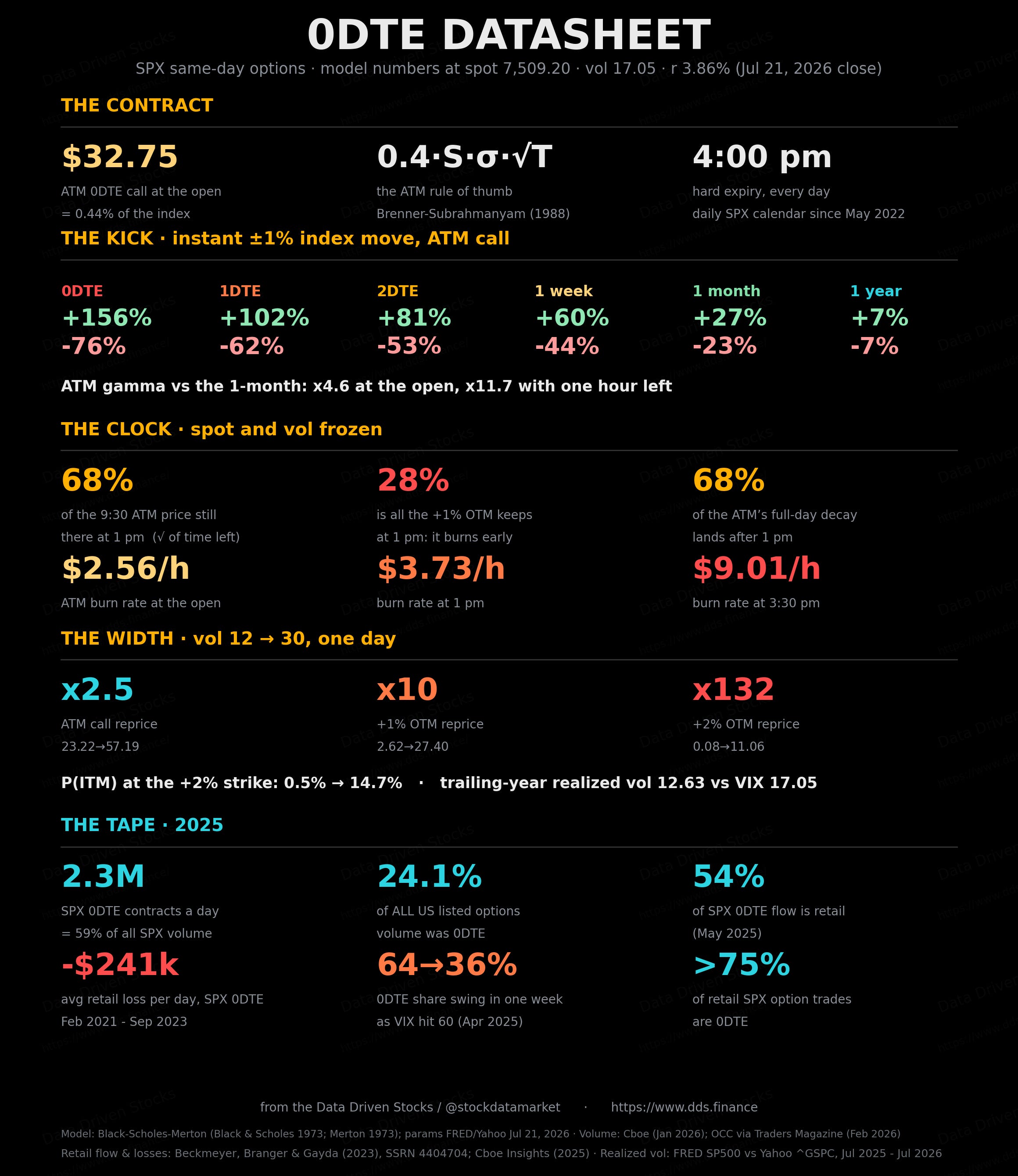
The asymmetry is the point. An ATM option sits under the fat middle of the bell, so widening the bell scales its value almost linearly: $23.22 at vol 12, $57.19 at vol 30, a factor of 2.5. OTM options are made entirely of tail mass. At vol 12, the +2% strike has a 0.46% chance of finishing in the money and trades at $0.08. Push vol to 30 and that probability is 14.7%, with the price at $11.06. The same strike on the same day is suddenly worth 132 times more. Far OTM options are bets on the width more than on direction, and the width can reprice them by two orders of magnitude while the index goes nowhere.
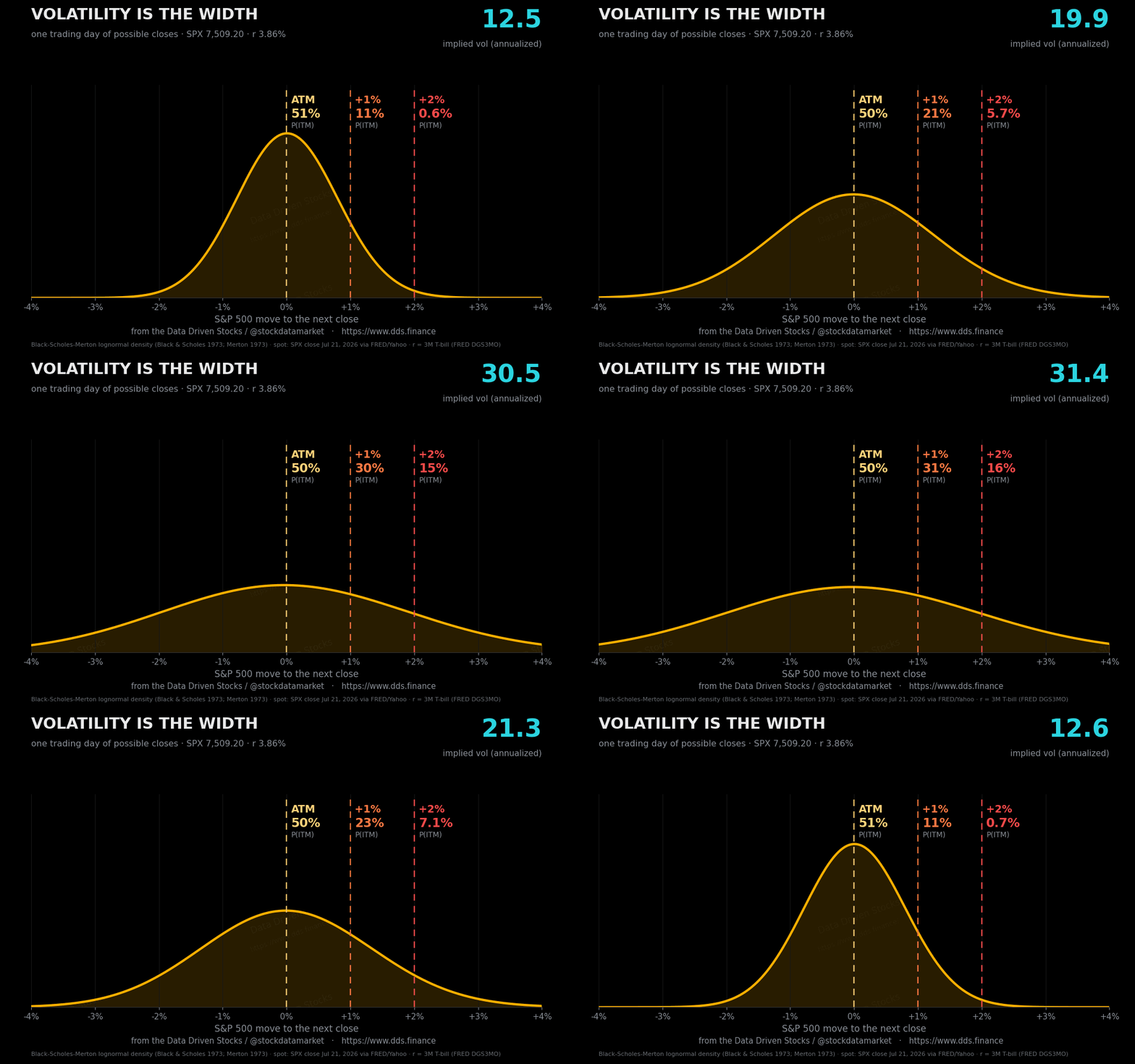
The animation below makes the same argument without words. One semi-transparent gaussian, breathing between vol 12.5 and vol 33, with the probability of finishing in the money updating live at each strike. It pauses briefly at 17.05, the actual VIX close behind every number in this piece.
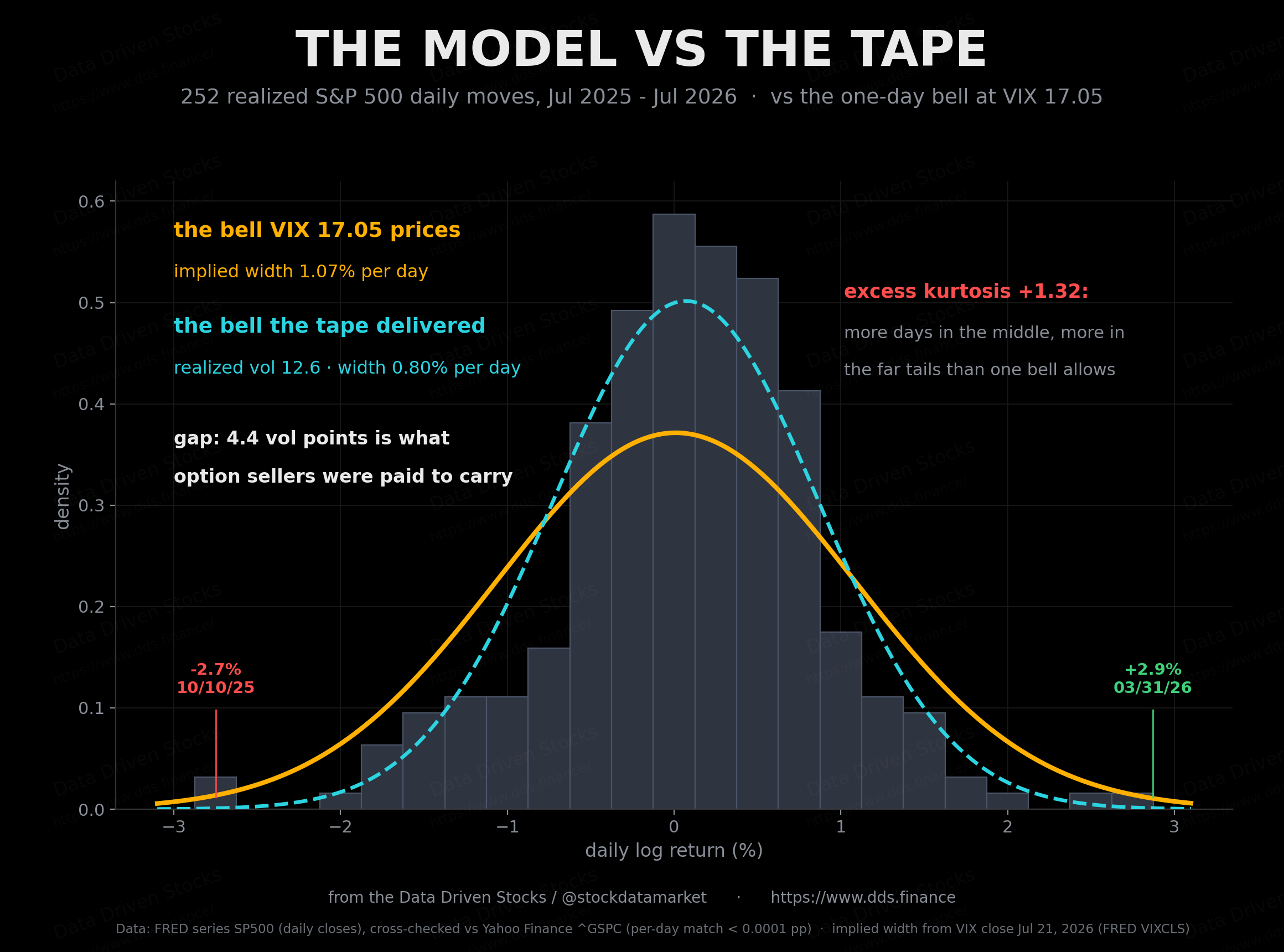
The past year is a decent test of that bell. Over the year to July 21, the S&P’s realized daily moves worked out to an annualized vol of 12.63 while the VIX priced 17.05, so option sellers collected about 4.4 vol points of rent for carrying the risk. The same tape shows excess kurtosis of +1.32, meaning more quiet days than a single bell allows and more violent ones, including a -2.75% session on October 10 and a +2.87% pop on March 31. Most of the time, implied width runs above delivered width, and sellers keep the difference. A handful of days a year, the tape jumps further than the day’s bell suggested, and that is when the +2% strike stops being cheap.
Lovely 0DTEs - Same move, different tenor
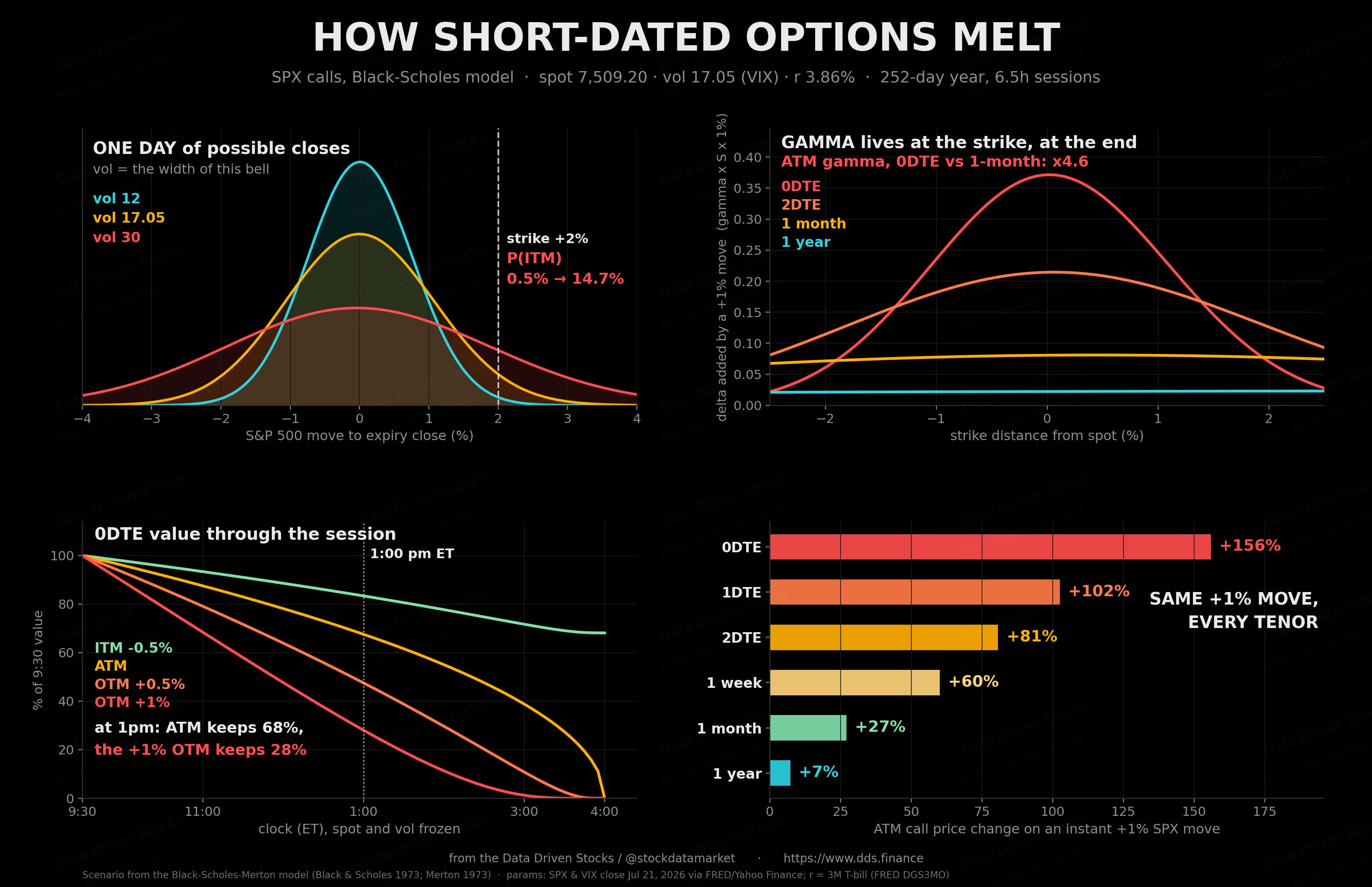
Now hold the vol still and vary the clock instead. Price the same ATM call at six tenors, from the 6.5 hours of a 0DTE at the open out to a full year, and hit each one with an instant 1% index move.
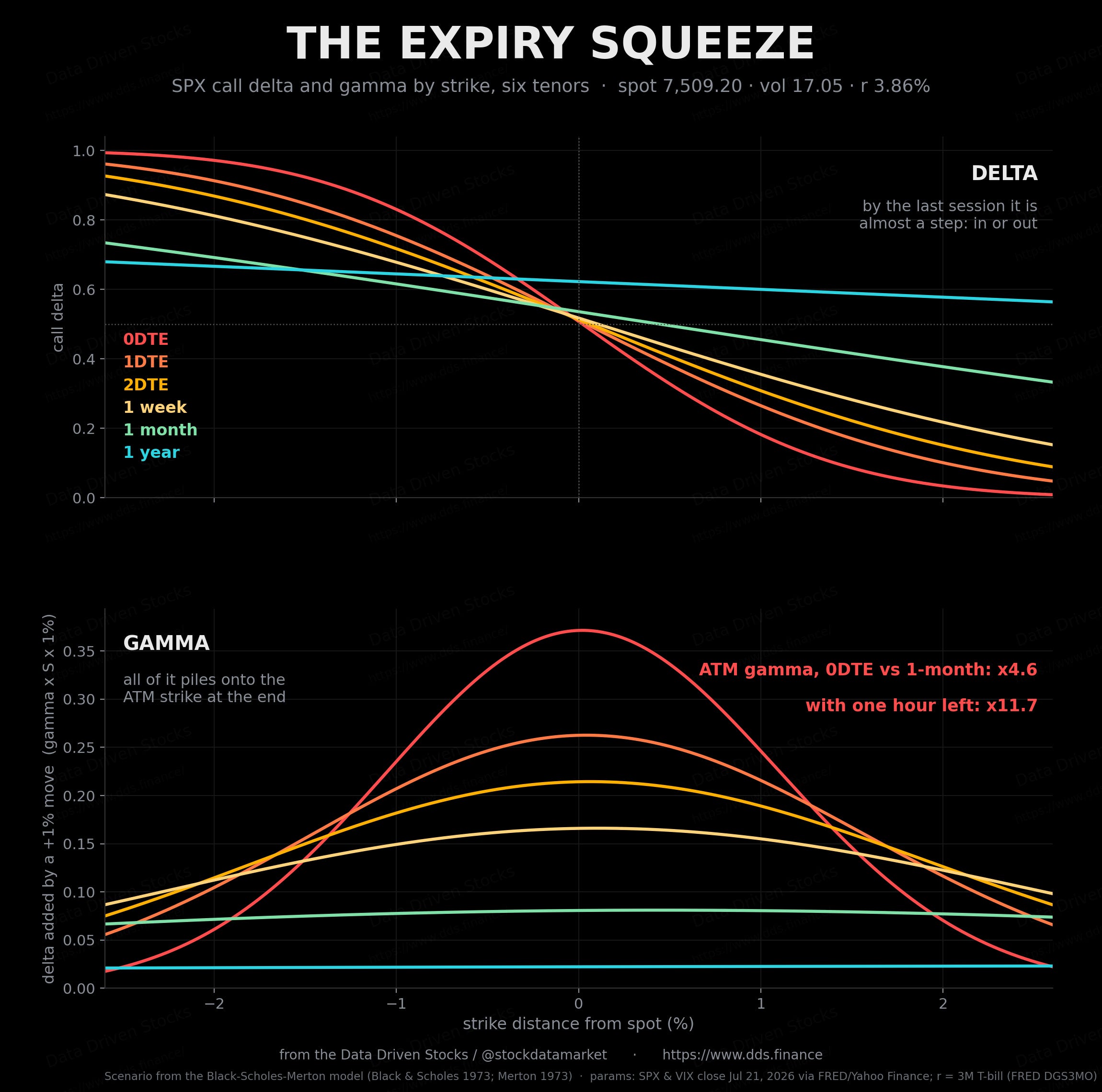
Delta answers “how much index am I holding”. For the 1-year option the answer changes slowly as the index moves. For the 0DTE it flips from almost nothing to almost everything within a percent of the strike. Gamma is the rate of that flip, and the formula already told you where it lives: sigma sqrt(T) sits in the denominator, so gamma at the strike scales like one over the square root of remaining time. Halve the time four times over and gamma quadruples. This is why near-ATM 0DTEs are the twitchiest instruments on the board, and this is exactly where the volume sits: research on Cboe intraday data finds 0DTE volume distributed evenly around the at-the-money strike.
For the P&L version, run the same +1% and -1% move across the whole ladder.
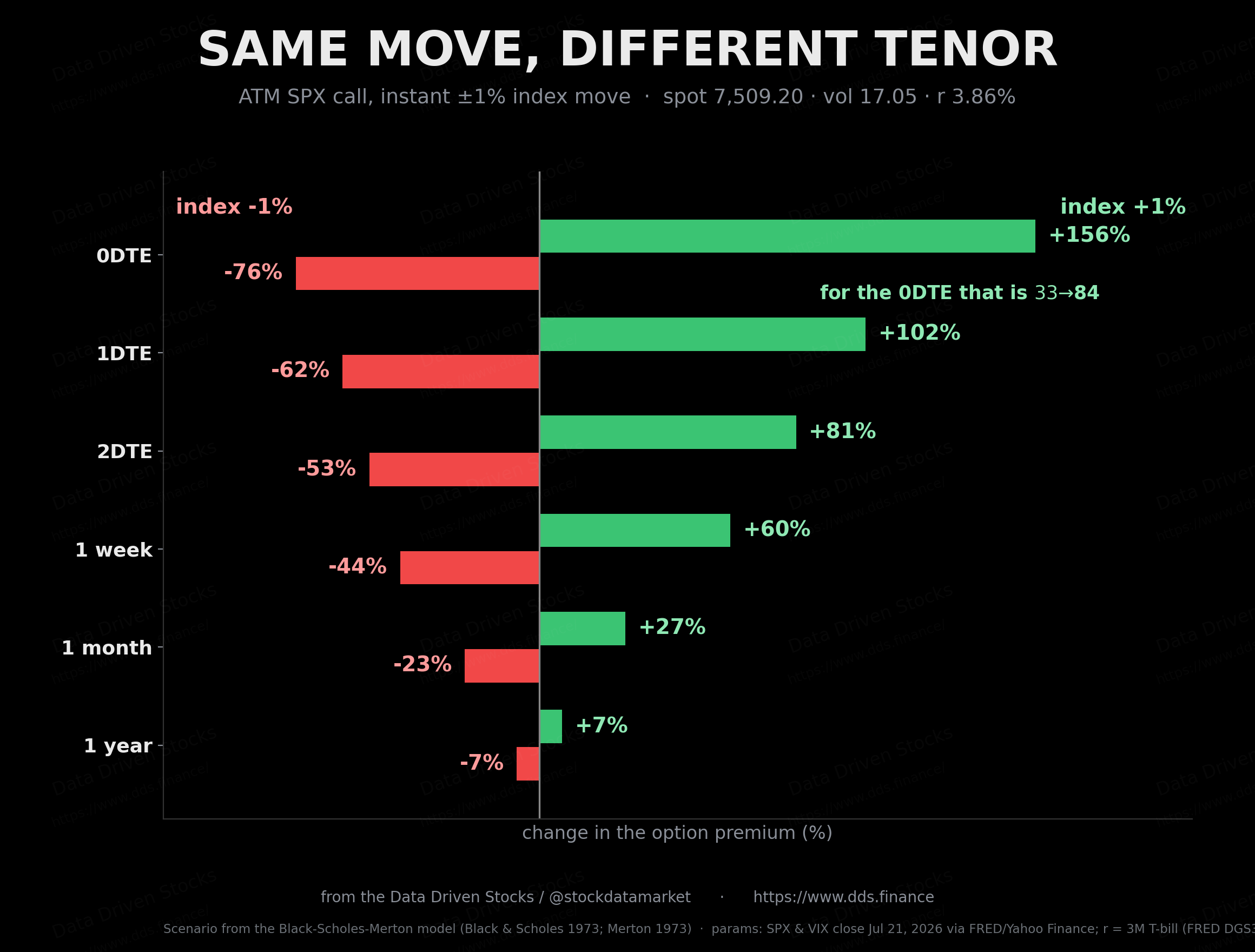
Read the two ends of that ladder together. A 1% index move is a 7% event for the 1-year option and a 156% event for the 0DTE. The 0DTE costs $32.75 against $655.40 for the year, so per dollar of premium you are buying roughly 21 times the kick. But the same leverage runs in reverse, and unlike the 1-year holder, you have no time to be early, which brings us to the clock.
The clock is the killer - and market makers chase 0DTEs
Freeze the index at 7,509.20 and the vol at 17.05, and just let a 0DTE session run from 9:30 to 4:00. The Brenner-Subrahmanyam formula already gives the ATM answer: value goes with sqrt of remaining time, so at 1:00 pm, with 3 of the 6.5 trading hours left, the ATM call holds sqrt(3/6.5) of its morning price. That is 68%. It then has three hours to give back all of it. In other words, roughly a third of the day’s decay happens in the first three and a half hours, and two thirds happens after 1 pm.
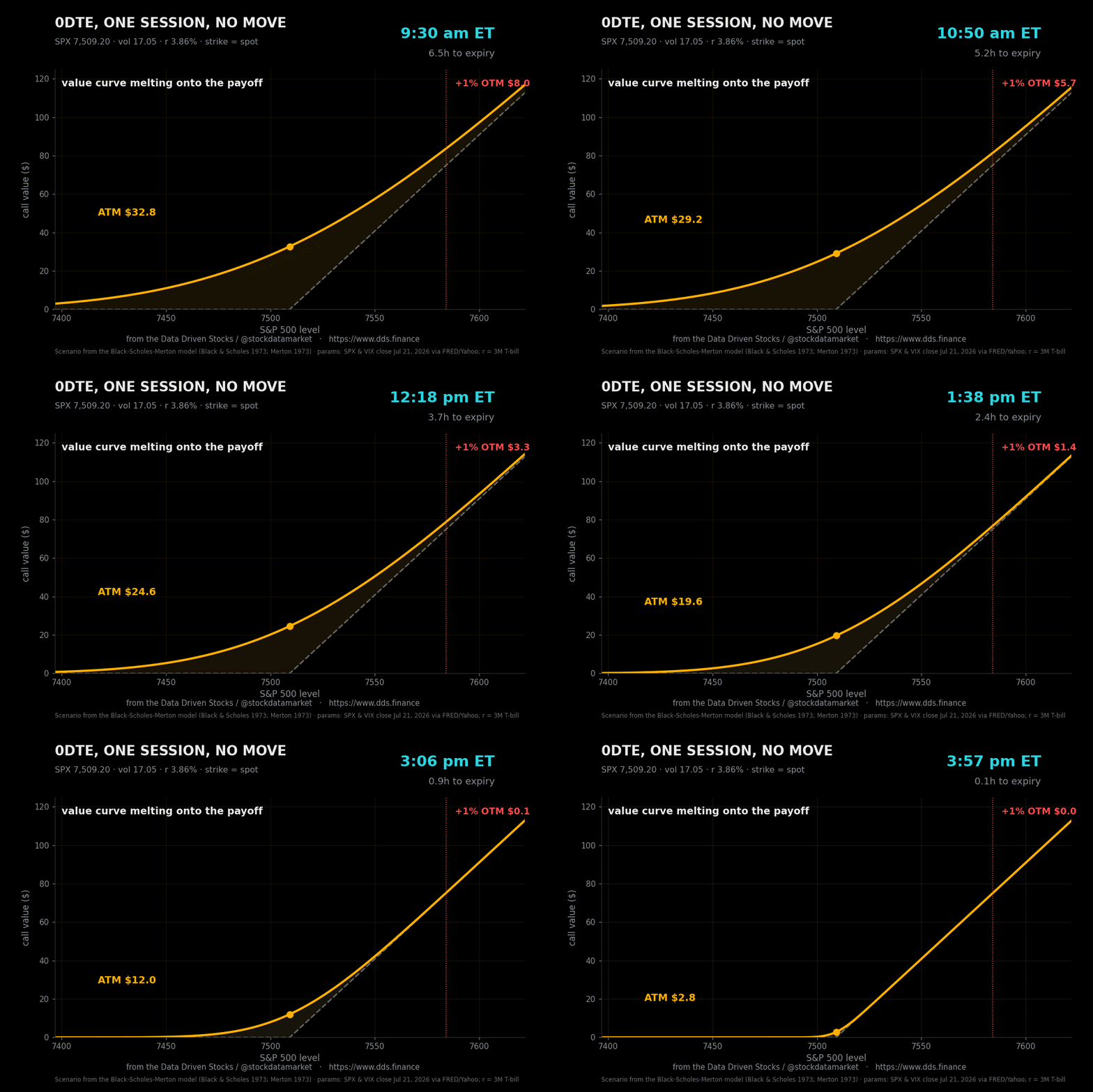
The moneyness detail is where it gets interesting, because the strikes do not bleed on the same schedule.
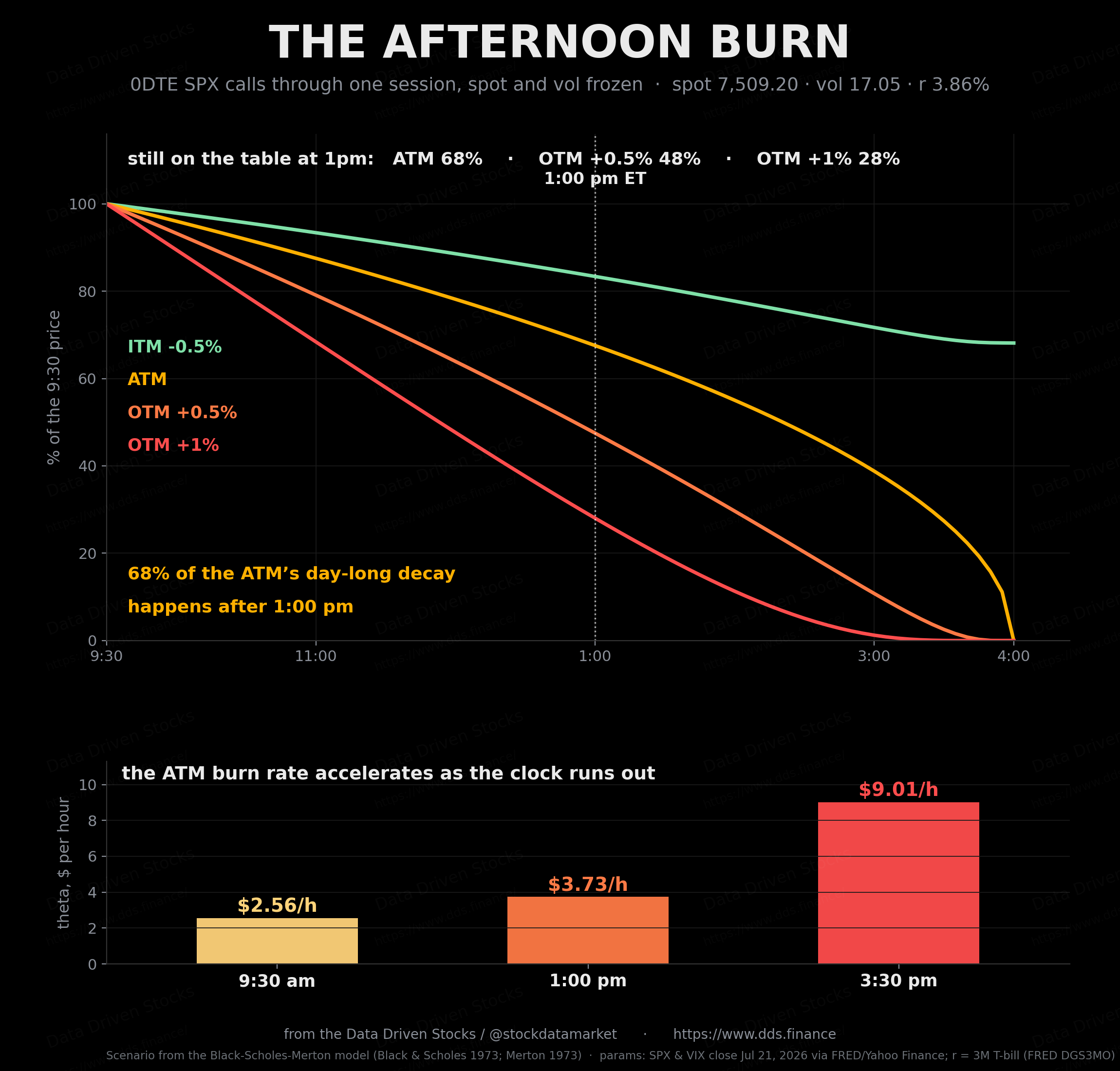
So the answer to “how fast does a 0DTE lose value after 1 pm” depends entirely on where your strike sits. The pinned ATM does about a third of its dying before 1 pm and two thirds after, on an accelerating burn: $2.56 an hour at the open, $3.73 an hour at 1 pm, $9.01 an hour at 3:30. Out-of-the-money strikes run the opposite schedule. The +1% OTM has already lost 72% of its morning value by 1 pm, because every quiet hour makes the required move less plausible, and the bell shrinks away from its strike early. By mid-afternoon it is a few dimes of hope. The ITM call looks calm at 83% of morning value, but only because of what it is made of: its $37.50 of intrinsic cannot decay, while its time value is cut roughly in half by 1 pm, on close to the same schedule as the ATM. Most of the 0DTE trades in fact are basically to “Enter from OTM to ITM zone ASAP to survive!”.
Who actually collects the rent
The volume says traders love this product. Research on the flow says most buyers pay for the privilege. Academic work identifying retail flow found that over 75% of retail trades in S&P 500 options are now in 0DTE contracts, and that between February 2021 and September 2023 retail traders in these products lost about $241,000 per day on average. Cboe’s own numbers put retail at 54% of SPX 0DTE volume as of May 2025. And usage is fair-weather: in the first week of April 2025, when the VIX spiked to 60, the 0DTE share of SPX volume collapsed from 64% to 36% within days as traders ran back to longer tenors.
Since every retail knows the pain of losing 0DTE trades, here is a datasheet how fast one can lose money! Just download and print at home.
Sources
Black, F. and Scholes, M. (1973). The Pricing of Options and Corporate Liabilities. Journal of Political Economy, 81(3), 637-654.
Merton, R. C. (1973). Theory of Rational Option Pricing. Bell Journal of Economics and Management Science, 4(1), 141-183.
Brenner, M. and Subrahmanyam, M. G. (1988). A Simple Formula to Compute the Implied Standard Deviation. Financial Analysts Journal, 44(5), 80-83.
Bandi, F. M., Fusari, N. and Reno, R. 0DTE Option Pricing. Journal of Finance, forthcoming. SSRN 4503344.
Beckmeyer, H., Branger, N. and Gayda, L. (2023). Retail Traders Love 0DTE Options... But Should They? SSRN 4404704.
Cboe Global Markets (January 2026). Cboe Global Markets Reports Trading Volume for December and Full Year 2025. Investor relations press release (SPX 0DTE ADV 2.3 million contracts, 59% of SPX volume).
Cboe Insights (September 2025). SPX 0DTE Options Jump to Record 62% Share in August.
Cboe / Benzinga (August 2025). What’s Behind the Growing Popularity of 0DTE Options (0DTE share swing 64% to 36% in April 2025; retail 54% of SPX 0DTE volume, May 2025).
Cboe Global Markets (April 13, 2022). Cboe to Add Tuesday and Thursday Expirations for SPX Weeklys Options.
OCC and Cboe data via Traders Magazine (February 2026). VOL REPORT: 0DTE, FLEX Options Are 2025 Heroes (0DTE at 24.1% of total U.S. listed options volume in 2025).
FRED, Federal Reserve Bank of St. Louis. Series VIXCLS (VIX close), SP500 (S&P 500 level), DGS3MO (3-month Treasury). Accessed July 22, 2026.
Yahoo Finance. ^GSPC and ^VIX daily closes (cross-check of the FRED anchors). Accessed July 22, 2026.