The $7 Trillion Chokepoint: What Happens If Iran Keeps the Strait of Hormuz Closed for Years
An indefinite Hormuz closure - on oil, food, fertilizer, and the growth outlook for the U.S., EU, Asia, Russia, China, North Africa and the Gulf.

The strait is already acting indefinite
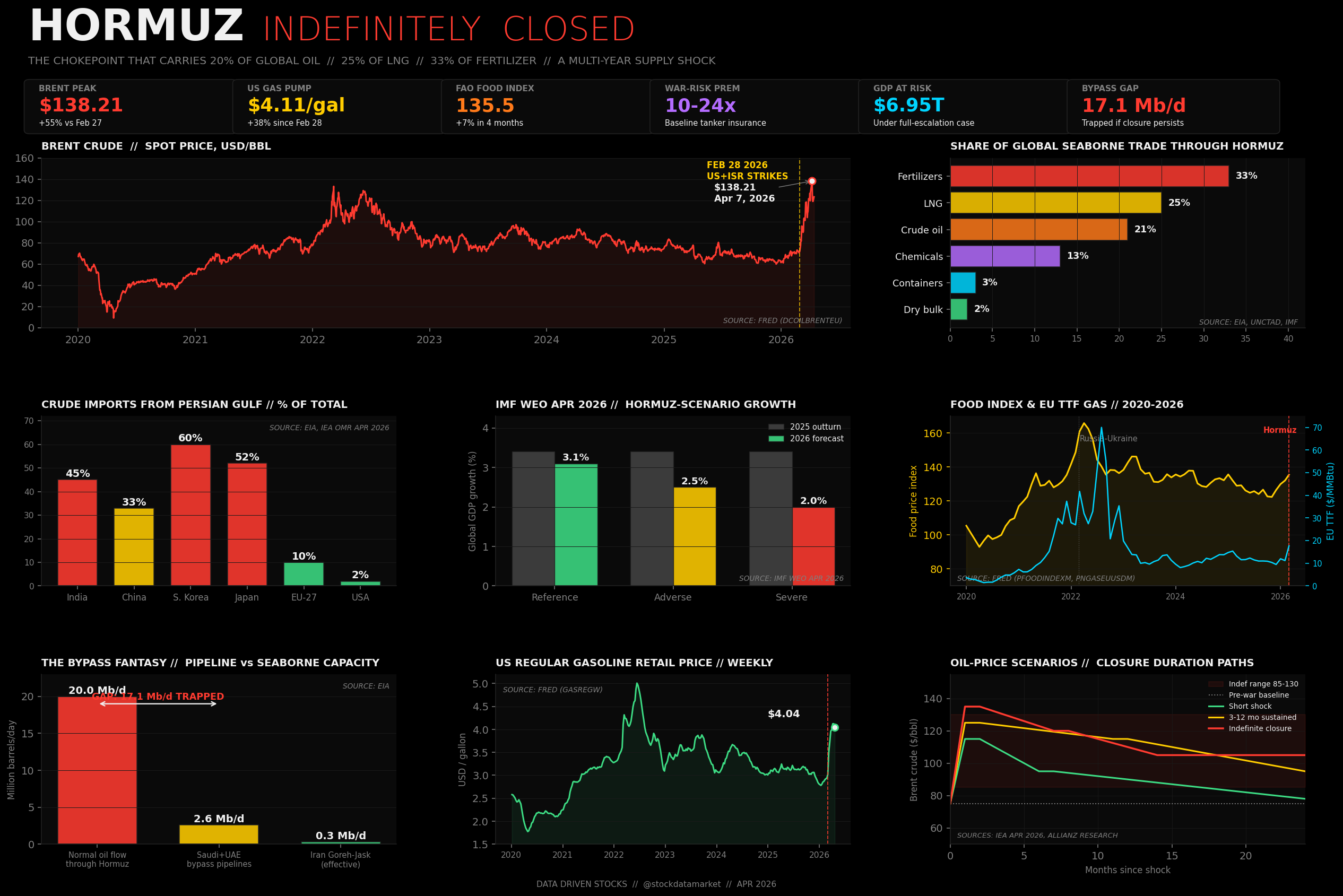
On April 7, 2026, Brent crude spot closed at $138.21 a barrel - the highest print on the FRED series since 2008. It did not get there because a hedge fund mis-timed a trade. It got there because the Islamic Revolutionary Guard Corps announced over VHF radio that any commercial vessel approaching the Strait of Hormuz would be considered “cooperation with the enemy” and targeted. Maritime traffic through the 34-kilometer waterway, which normally sees around 70 tanker crossings per day, collapsed toward zero.
The world got one plot-twist on April 17, when Iran’s foreign minister briefly announced the strait was “fully open and ready for full passage.” Crude dropped ten percent in a few hours. Within 24 hours the IRGC reversed the decision, opened fire on a tanker trying to pass, turned back Indian-flagged ships, and declared the Strait “under strict management and control” until the U.S. lifts its blockade of Iranian ports. Two merchant sailors have already died. Lloyd’s List has reported traffic has again come to a halt. This is not a tail-risk scenario on a slide deck. It’s happening.
What this article tries to do is take that reality - a Hormuz that operates intermittently, under threat, or outright closed - and ask a harder question: what does the world look like if this is not a week or a month, but a year or five? The answer, on the evidence, is a stagflationary shock larger than anything the modern oil market has priced, with asymmetric damage concentrated in exactly the economies that can least afford it.
Why “indefinite” is a different shock
A Hormuz closure is not just a bigger oil shock. It’s a different species of shock. Roughly 20 to 21 million barrels per day of crude and products move through the Strait - about one-fifth of world oil supply and more than a quarter of global seaborne oil trade. But the chokepoint also concentrates around one-quarter of global LNG, close to one-third of global fertilizer and helium trade, around 13% of seaborne chemicals flows, and material shares of container and dry-bulk volumes. Closing it simultaneously disrupts the energy, feedstock, fertilizer, packaging, and shipping complexes that sit underneath most of the global supply chain.
Past oil shocks do not map cleanly onto this. The 1973 embargo was a price shock; 1979 was an expectations shock; 1990 was a regional supply shock that was closed in months. Hormuz 2026 looks like all three at once, plus a maritime-insurance shock, plus a chemicals shock. The Dallas Fed has already done the arithmetic: a closure that removes close to 20% of global oil supplies during one quarter pushes WTI to around $98/bbl in their model and cuts global real GDP growth by an annualized 2.9 percentage points in that quarter. If the disruption persists for three quarters, their 2026 growth hit widens to roughly 1.3 percentage points on the full year.

Oil: the first wave
Oil is the most visible channel, and in some ways the simplest. The physical flow that vanishes when Hormuz closes is larger than any combination of bypass infrastructure and strategic reserves can plausibly replace. UNCTAD recorded a 27% jump in Brent in the early 2026 shock window and a 74% one-day move in EU TTF gas. Allianz Research’s prolonged-disruption scenario sits around $100/bbl with a tail-risk case above $130; those numbers had looked conservative, and then Brent printed $138.21.
The nonlinearity is the reason to care. As the 1979 Iranian Revolution demonstrated, a net global supply loss of just 4-5% can drive a much larger price move because fear, inventory building, and tanker-market dislocation do most of the work. The Hormuz loss at full closure is four times larger than 1979 on the supply side and at least as large on the expectations side, because the closure is being used as a geopolitical lever rather than resolved as a collateral disruption.

My central scenario ranges, read as analytical estimates not point forecasts, are $90-130 in the immediate shock, $100-150 average across 3-12 months if physical flows remain heavily impaired, and $85-130 in an indefinite adapted state. The reason the long-run range comes back down from the peak is that stock releases, demand destruction, route substitution, and non-Gulf supply eventually damp the spike even as a structural Gulf risk premium remains higher than before. The reason it does not fall back to pre-war levels is that insurance, financeability, and legal transit rights - not physical barrels - become the binding constraint, and those are slow to rebuild once broken.
The bypass fantasy
Every time Hormuz-closure fears spike, a version of the same argument appears: “Saudi Arabia and the UAE have bypass pipelines.” They do. They’re also far too small to save the oil market if the Strait is actually shut for an extended period.
The Saudi East-West Petroline can carry about 5 million barrels per day nameplate, but the EIA estimates only around 2 Mb/d is normally available for Hormuz bypass given existing throughput commitments. The UAE’s ADCOP line to Fujairah adds another 0.6 Mb/d or so. Iran’s own Goreh-Jask pipeline, on EIA’s effective-capacity basis, delivers about 0.3 Mb/d. Add an emergency U.S. SPR release at full operational drawdown (roughly 1 Mb/d over six months) and a coordinated IEA stock release of comparable size, and you get roughly 4.9 Mb/d of incremental supply against a 20 Mb/d seaborne flow that just disappeared. The gap is about 15 million barrels per day. That’s more oil than the entire United States produces from shale.

The practical implication is uncomfortable. You cannot engineer around a closed Hormuz with existing infrastructure. You can flatten the peak, but you cannot prevent a sustained price premium and a sustained physical shortage in refined-product markets. Diesel, jet fuel, and LPG are especially exposed because Gulf refiners and Qatari/UAE LPG exporters are disproportionately concentrated in the volumes that no longer move. IEA’s April 2026 Oil Market Report shows the first large industrial demand hits in naphtha down about 450 kb/d and LPG/ethane down about 320 kb/d relative to pre-war estimates - a petrochemical signal, not just a crude signal.
LNG, fertilizers, and the lag bomb
The fertilizer and food story is where the Hormuz shock stops looking like 1979 and starts looking like 2022. GCC countries account for more than 40% of global sulfur exports and roughly 20% of global ammonia and nitrogen-fertilizer exports. About one-third of global seaborne fertilizer trade passes through the Strait. IFPRI data put the Gulf as the largest regional exporter of urea and ammonia in 2023-25, and the second-largest exporter of DAP and MAP. When those volumes stop moving, you do not see the damage in the same quarter. You see it one planting cycle later, when farmers who could not access nitrogen inputs at reasonable cost produce smaller crops of exactly the grains that feed the world’s most import-dependent countries.
The 2022 analog is instructive. FAO noted that food prices were already elevated before Russia’s invasion because of energy, fertilizer, and shipping costs, and then the war pushed them to record highs. The St. Louis Fed documented that gas disruptions in 2022 forced at least 10 European fertilizer plants to shut or curtail output in July 2022 alone. The spillover into food showed up with a 3-9 month lag. In a Hormuz scenario where the gas and ammonia channel gets hit simultaneously in the Gulf, that lag structure still applies, but the transmission is bigger because the fertilizer share at risk is larger.

FAO’s March 2026 release already showed the Food Price Index up 2.4% month on month, with vegetable oils up 5.1%, sugar up 7.2%, and cereals up 1.5%. That’s a short-term reading consistent with a scenario range of +2% to +6% in the immediate phase, +5% to +15% for global traded food benchmarks across 3-12 months, and +3% to +12% in an indefinite-but-adapted state. The Federal Reserve’s cross-country panel work for advanced economies finds that a 10% permanent increase in oil prices pushes food CPI up around 0.3% over time with the effect building across roughly eight quarters. Headline CPI in advanced economies rises by almost 0.4% including energy. In lower-income economies, the pass-through is materially larger and faster because food is a bigger share of the consumer basket and currencies tend to weaken when fuel-import bills rise.
Who actually gets crushed
The geography of the damage is what makes Hormuz different from most energy shocks a New York or London reader imagines. The United States - despite being the most talked-about actor in the crisis - is the least directly exposed of any major economy in physical terms. EIA data show that only about 0.5 million barrels per day of U.S. crude and condensate imports in 2024 came through Hormuz, which is roughly 2% of U.S. petroleum-liquids consumption. The U.S. still imports the global price shock, but the quantity channel is small.
Asia is the main direct casualty. EIA estimates that 84% of Hormuz crude and 83% of Hormuz LNG went to Asia in 2024. Persian-Gulf crude is roughly 60% of South Korea’s imports, over 50% of Japan’s, roughly 45% of India’s, and about one-third of China’s. India’s SPR cover - about seven days according to IEA’s 2023-30 oil work - is materially thinner than the U.S. or EU buffer. Singapore, as a regional refining hub dependent on Gulf feedstocks, sits structurally long on Hormuz risk.
Europe is less directly exposed on crude than Asia, but the LNG and refined-product channels are larger. EU TTF gas jumped 74% on the first shock week. A prolonged closure would tighten the Atlantic-basin diesel and jet-fuel balance, push European industrial energy costs back toward 2022 levels, and re-intensify the competitiveness gap between European manufacturing and non-European rivals. UNCTAD’s financial-implications report also flags currency stress for European emerging neighbors and North African economies whose food and fuel import bills spike simultaneously.
China and Russia sit in the most ambiguous position. China is exposed as a Hormuz crude and LNG importer - roughly 33% of its crude comes through the Strait - but it also benefits from being the natural buyer of any Iranian, Russian, or sanctioned crude that finds a workaround. Russia benefits on price and on the strategic side, because a Hormuz shock raises the floor under Urals and gives the Kremlin more oil-revenue oxygen than almost any other macro outcome. That does not make either country a winner - higher commodity prices slow their customers’ economies, and China’s export machine does not work without solvent buyers.
The Middle East is the most bifurcated block. Higher world prices do not compensate Gulf exporters if their volumes are physically stranded. IMF’s April 2026 Regional Economic Outlook projects GCC countries to experience output contractions under the reference scenario rather than windfalls, because local storage fills, producers shut in wells, and the air-traffic and tourism channels deteriorate simultaneously with the export blockage. Saudi Arabia, Qatar, Iraq, Kuwait, the UAE, and Bahrain all run oil- and gas-dependent fiscal models that struggle when exports stop. The IMF’s Iran revision is the single largest in the April 2026 regional outlook: a 7.2-point cut from a small pre-war positive to a forecast -6.1% contraction in 2026.
North Africa sits in a stress band of its own. Egypt, Morocco, Tunisia, and Algeria are structurally exposed to imported food and imported fuel. Even though Algeria benefits from higher gas prices, the aggregate regional effect is negative because food-import bills swamp the export side for most of the bloc, and currencies weaken on the current-account channel.

Macro: a stagflationary shock with asymmetric damage
The summary version of the macro story is that this is a stagflationary shock with the regional pattern of a food-and-energy crisis, not the regional pattern of a banking crisis. Advanced economies see headline-inflation effects that are painful but finite. Emerging and developing economies, especially those that are net energy importers and heavily dependent on food imports, see welfare damage that is concentrated in their poorest households and fiscal damage that is concentrated in their narrowest budgets.
The IMF’s April 2026 World Economic Outlook makes the severity scale explicit. Under the reference forecast, global growth slows modestly to around 3.1%. Under the adverse scenario, broadly anchored to market conditions at the end of March, global output growth falls to around 2.5% with inflation rising to 5.4%. Under the severe scenario - which assumes energy-market dislocations that extend into 2027, inflation expectations de-anchoring, and financial conditions tightening - global growth falls to about 2%, which the IMF notes would be a close call with a global recession of the kind seen only four times since 1980.
SolAbility’s Day-42 Hormuz Economic Impact Model, which layers regional price tiers and refined-product channels on top of IMF coefficients and a structural multiplier for investment freeze and supply-chain disruption, produces a direct price-driven cost estimate of around $20 billion per day in global GDP losses. Their cumulative 180-day figures range from $3.57 trillion (3.24% of global GDP) under a “phantom ceasefire” path, to $4.81 trillion (4.38%) under prolonged closure, up to $6.95 trillion (6.32%) under full escalation.
These numbers are model outputs, not certainties. What they share is the same shape: the longer this lasts, the more the damage stacks nonlinearly. Each additional quarter of Hormuz impairment does not add the same increment. It compounds, because planting decisions get missed, fertilizer plants shut for longer, contracts re-price higher, and the insurance market’s willingness to re-underwrite Gulf transit at something like pre-war rates degrades further. That is why the debate about “indefinite” versus “long” matters more than the debate about the peak barrel-per-day number.
The multi-year scenario
Imagine Hormuz still operating as a “controlled” waterway in late 2027. What does the world look like?
The easy predictions are the ones that are already starting to happen. Brent settles in a range anchored higher than pre-war - my estimate is $85 to $130 as an adapted long-run band - because Gulf risk premia do not fully reverse even when physical flows partly resume. The U.S. SPR, having been drawn down materially in the first year, takes years to rebuild, and each rebuild cycle props up crude prices. The insurance market re-prices Gulf transit permanently higher; even a full political reopening would not restore 2024-era war-risk rates overnight. Tanker fleets reorganize toward longer, more expensive routes. The Atlantic basin becomes a more important refinery hub, which is a second-order benefit for U.S. Gulf Coast refiners and a second-order cost for European industrial users.
The harder predictions are downstream. Global fertilizer trade restructures around non-Gulf producers, which is a slow and capital-intensive adjustment. Countries that built their food security on cheap nitrogen imports from Saudi Arabia or Qatar substitute toward expensive domestic production or toward reduced yields. Food-price elevation persists for years rather than months; the lag bomb is also a lag plateau. European petrochemicals face a second wave of deindustrialization because they cannot match the feedstock cost structure of U.S. and Asian competitors that have non-Hormuz energy bases. China accelerates its Belt-and-Road and Central-Asia pipeline strategy as a long-term Hormuz bypass, which is a geopolitical win for Beijing even as it’s a macro drag for its immediate 2026-2027 growth.
The Middle East itself goes through its most difficult structural adjustment since the 1970s. Gulf sovereign-wealth funds, which were quietly dominant global capital allocators in 2023-2025, see their revenue base hit from two directions at once (stranded exports and volatile prices). Fiscal buffers get drawn down. The diversification agenda - Saudi Vision 2030, UAE’s non-oil strategy, Qatar’s LNG expansion - gets stress-tested under conditions none of them planned for. Iran itself faces a catastrophic medium-term contraction, with output still below pre-war trends in 2030 by IMF estimates, regardless of the political outcome.
For the United States, the strategic payoff of being an energy exporter rather than importer looks vindicated. But it also means the U.S. becomes structurally tied to a pricing regime that penalizes its allies in Europe and Asia more than it penalizes itself - a version of the “exorbitant privilege” dynamic extended into energy. The political economy of that asymmetry is not stable, and it will produce its own follow-on shocks in trade and capital flows.
What actually mitigates, and what doesn’t
A practical hierarchy emerges from the evidence. The most effective near-term tools are IEA emergency stock releases and lowered stockholding obligations, temporary demand-restraint measures, refinery-specification flexibility, maximum use of UAE and Saudi bypass pipelines, fast substitution toward Atlantic-basin and American supply, and insurance/naval backstops that keep insured, financeable, legally movable barrels flowing even when the commercial market pulls back. None of these eliminate the shock. What they do is flatten the peak, shorten the shortage window, and reduce second-round inflation.
The most important medium-term move is to prevent the energy shock from becoming a food shock. That means protecting fertilizer availability at almost any cost - targeted subsidies, natural-gas priority for fertilizer plants, reduced trade restrictions, emergency trade credit for poor importers, and a serious review of biofuel mandates that compete with food-crop calories. Every one of these has political costs. The cost of not doing them compounds into higher real damage, especially in South Asia and sub-Saharan Africa.
The long-run mitigation is structural: new pipelines, LNG sourcing diversification, petrochemical reshoring, recycled-content expansion, and semiconductor-materials dual-sourcing. None of those solve a 2026 problem. All of them matter for the 2028-2030 shape of the world if this crisis persists.
Bottom line
A long or indefinite Hormuz closure is first and foremost an oil and LNG shock, then a freight and insurance shock, then a fertilizer and food shock, and only after that a more modest but still meaningful industrial-input shock for sectors like packaging and semiconductors. The economies most likely to feel the largest sustained macro damage are India and other import-dependent Asian economies, energy-intensive European industry, and Gulf exporters whose volumes are physically blocked. The United States would be relatively insulated in quantity terms but not in prices or global financial spillovers.
The trickiest aspect is how the base case has already shifted. Two months ago, an indefinite Hormuz closure was a tail risk. Today, after the April 17-18 reopening-and-reclosing, it is closer to a working assumption than a stress-test. Brent is telling the same story the IMF severe scenario is telling. So is EU gas. So are FAO food prices. So, increasingly, is the pump price on the corner.
None of that is a forecast that the strait will stay closed forever. It’s a forecast that the cost of it staying closed for a year or more is now being underestimated in most consensus models - and that the longer this drags, the more the damage compounds into structural, rather than cyclical, harm.
Sources and further reading
U.S. Energy Information Administration, “Nearly all of the oil transported through the Strait of Hormuz goes to Asia,” https://www.eia.gov/todayinenergy/detail.php?id=65504
U.S. Energy Information Administration, “Most of the LNG transported through the Strait of Hormuz goes to Asia,” https://www.eia.gov/todayinenergy/detail.php?id=65584
International Energy Agency, Oil Market Report, 14 April 2026, https://iea.blob.core.windows.net/assets/f7785a70-754e-49d9-bf47-3c44cf77ca98/-14APR2026_OilMarketReport_Free_version.pdf
International Energy Agency, “Sheltering From Oil Shocks,” https://www.iea.org/reports/sheltering-from-oil-shocks
International Monetary Fund, World Economic Outlook April 2026 (Chapter 1 - Global Prospects and Policies), https://www.imf.org/-/media/files/publications/weo/2026/april/english/ch1.pdf
International Monetary Fund, Regional Economic Outlook: Middle East and Central Asia April 2026, https://www.imf.org/-/media/files/publications/reo/mcd-cca/2026/english/text.pdf
UNCTAD, “Strait of Hormuz Disruptions: Implications for Global Trade and Development,” https://unctad.org/system/files/official-document/osgttinf2026d1_en.pdf
UNCTAD, “Strait of Hormuz Disruptions: Growth and Financial Implications,” https://unctad.org/system/files/official-document/osginf2026d2_en.pdf
Federal Reserve Bank of Dallas, “What the closure of the Strait of Hormuz means for the global economy,” https://www.dallasfed.org/research/economics/2026/0320
FAO, World Food Situation - Food Price Index, https://www.fao.org/worldfoodsituation/foodpricesindex/en/
Howden Re, Strait of Hormuz insurance impact report, March 2026, https://www.howdenre.com/sites/howdenre.howdenprod.com/files/2026-03/HowdenRe_Strait_of_Hormuz_report_March272026.pdf
World Bank, Commodity Markets hub, https://www.worldbank.org/en/research/commodity-markets
SolAbility Sustainable Intelligence, “Gulf Crisis 2026: The Daily Cost of the Closure of the Strait of Hormuz,” https://solability.com/news-insights/iran-war-marginal-cost
Al Jazeera, “Iran closes Strait of Hormuz again over US blockade of its ports,” 18 April 2026, https://www.aljazeera.com/news/2026/4/18/iran-closes-strait-of-hormuz-again-over-us-blockade-of-its-ports
Al Jazeera, “IMF cuts global growth forecast during Hormuz blockade,” 14 April 2026, https://www.aljazeera.com/economy/2026/4/14/imf-cuts-global-growth-forecast-during-hormuz-blockade
CNBC, “A timeline of how the Iran war shook oil prices - and what comes next,” 21 April 2026, https://www.cnbc.com/2026/04/21/oil-price-iran-war-middle-east.html
CNN, “Day 50 of Middle East conflict - Iran says it’s closing Strait of Hormuz again,” 18 April 2026, https://www.cnn.com/2026/04/18/world/live-news/iran-war-trump-israel
Washington Post, “Iran says it has closed Strait of Hormuz again over U.S. blockade,” 18 April 2026, https://www.washingtonpost.com/world/2026/04/18/iran-strait-hormuz-us-oil/
Wikipedia, 2026 Strait of Hormuz crisis, https://en.wikipedia.org/wiki/2026_Strait_of_Hormuz_crisis
Federal Reserve Economic Data (FRED): DCOILBRENTEU (Brent), DCOILWTICO (WTI), GASREGW (US regular gasoline), CPIAUCSL (CPI all items), CPIUFDSL (CPI food), PNGASEUUSDM (Europe natural gas), PFOODINDEXM (IMF Global Food Price Index), PCU325311325311 (Nitrogen Fertilizer Manufacturing PPI) - https://fred.stlouisfed.org