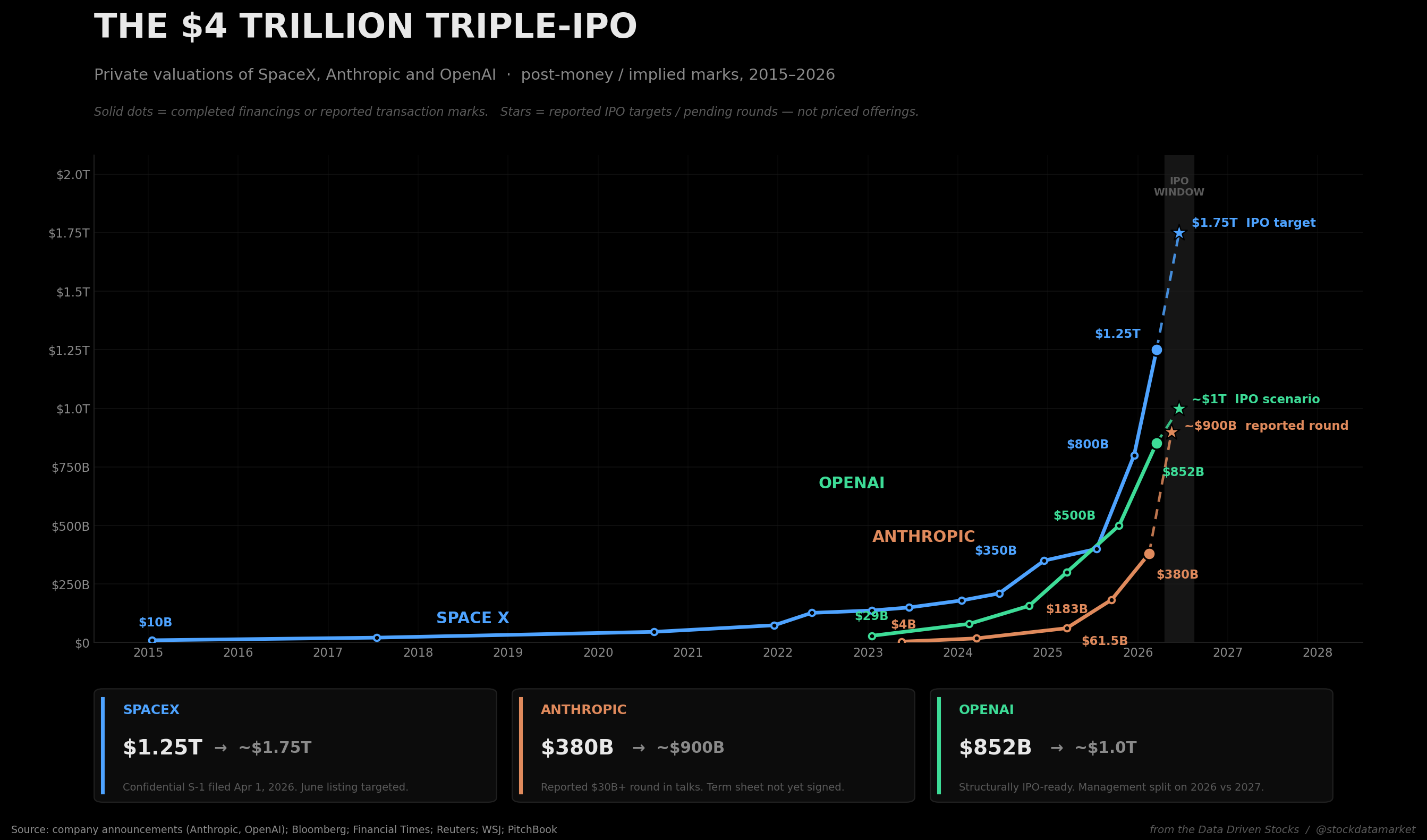
The $4 Trillion Triple-IPO Is Coming - and Only One of These Three Is Actually Ready
SpaceX, Anthropic and OpenAI are all stampeding toward the public market at once. We pulled the numbers. The gap between the hype and the homework is enormous.

Here is the setup nobody in markets has seen before. Three of the most valuable private companies on earth are all walking toward the exit at the same time, in the same quarter, with a combined paper value north of four trillion dollars. SpaceX. Anthropic. OpenAI. Any one of them would headline an entire IPO year. All three at once is not a pipeline - it is a traffic jam.
And the lazy take is that they are basically the same story: hot company, huge number, buy the dip. They are not. When you actually read the filings, the funding histories and the cash-flow math, what you find is three completely different animals wearing the same “AI mega-IPO” costume. One is a live deal with a printing press attached and a governance problem. One is a rocket ship of revenue that may not even need your money. One is the most famous name of the bunch and arguably the least ready to show you its books.
Let us go through them properly, because the difference between these three is the difference between a calendar entry and an investment thesis.
The race nobody planned, but everybody is now running
Start with the trajectories, because they are genuinely without precedent. Anthropic went from a roughly four-billion-dollar valuation snapshot in 2023 to a $380 billion official Series G in February 2026 - and is now reportedly in talks for a round at more than $900 billion barely three months later. SpaceX climbed from a $10 billion mark in early 2015 to a verified $1.25 trillion fund mark by March 2026, and is reportedly chasing an IPO valuation between $1.75 trillion and $2 trillion. OpenAI stepped from $29 billion in early 2023 to an $852 billion official financing in March 2026.
Those are not growth curves. They are launch profiles. And they all converge on the same narrow window: roughly June 2026 onward.
The reason this is happening now is not coincidence. It is compute. Every one of these companies has signed multi-year infrastructure commitments so large that private fundraising, however generous, is starting to strain against them. The public market is the biggest pool of capital on the planet, and when your spending commitments are measured in hundreds of billions, that pool starts to look less like an option and more like a necessity. But - and this is the whole article - “needs capital” and “ready to be a public company” are two very different conditions. Only one of these three clears both bars cleanly.

The schema above is the fastest way to see the real story. Every IPO walks the same five gates - hire the bankers, file confidentially, file the public S-1, run the roadshow and price, then trade. SpaceX is already through gate two and reportedly knocking on gate three. Anthropic and OpenAI have, on the public evidence, cleared only the first. That single fact reorders the entire “AI IPO” narrative. This is not a three-horse race down the same stretch. It is one horse on the final furlong and two still being saddled.
SpaceX: the live deal with a cash machine bolted to a furnace
SpaceX is the only one of the three that currently looks like an IPO in motion rather than an IPO in theory. The company confidentially filed a draft S-1 with the SEC on April 1, 2026. Reporting since then has described a 21-bank syndicate, a roadshow pencilled in for early June, and a Nasdaq listing targeted for around June 12 under the ticker SPCX. Reuters has reviewed excerpts of the draft prospectus. The valuation target has drifted upward from roughly $1.75 trillion toward $2 trillion, which would make it comfortably the largest IPO in human history - more than three times the size of Alibaba’s record 2014 debut.
So far, so triumphant. Then you open the financials, and the picture gets genuinely strange.

According to Reuters’ review of the draft S-1, the combined company generated $18.67 billion in revenue in 2025 - and posted a net loss of $4.94 billion. That is the part that should make you sit up. In 2024, SpaceX on a standalone basis is estimated to have earned a roughly $791 million profit. So in the space of one year, a profitable company became a five-billion-dollar loss-maker. What happened?
The xAI merger happened. In February 2026, SpaceX absorbed Elon Musk’s AI company, and with it absorbed roughly $14 billion a year of cash burn. Strip the business into its parts and the logic snaps into focus. Starlink, the satellite-internet arm, brought in about $11.4 billion of revenue and roughly $4.42 billion of operating profit in 2025. It is the only profitable segment, and it is a genuinely excellent one - the subscriber base more than doubled over the year and crossed 10 million customers by early 2026. The launch business is structurally entrenched, with 170 Falcon 9 missions flown in 2025 and a deep moat in government and defense work. And then there is xAI, which contributed a few billion in revenue while burning, by itself, more cash than every other part of SpaceX generates.
In plain terms: the rockets and the satellites earn money, and the AI division sets it on fire. Capital expenditure tells the same story.

SpaceX’s annual capital spending jumped from roughly $4.2 billion in 2024 to about $20.7 billion in 2025 - a near-fivefold increase - and more than half of that went into AI infrastructure rather than rockets. This is the central tension of the SpaceX deal. You are not being asked to buy a launch company. You are being asked to buy a satellite-broadband utility, a launch monopoly and a money-losing AI bet stapled together, then pay a multiple that, at $2 trillion against $18.67 billion of revenue, works out to something like 100-plus times sales. That is not a space valuation. It is a faith valuation.
There is also a governance problem that has nothing to do with the numbers. Reporting on the draft registration describes a dual-class share structure that would leave public investors holding Class A stock with effectively minimal voting power, alongside mandatory-arbitration provisions and tighter rules on shareholder proposals. One governance critic, quoted in Reuters-based coverage, described the structure as closing the voting door, the courthouse door and the proposal door at once. For a company this size, that is a real discount risk - and it is exactly the kind of thing the public S-1 will force into the open.
Bottom line on SpaceX: the timing confidence is the highest of the three, the business has a genuine crown jewel in Starlink, and the deal will almost certainly clear. Whether it clears at $1.25 trillion or $2 trillion depends entirely on how investors weigh that crown jewel against the furnace bolted next to it.
Anthropic: the company that is growing too fast to need you
If SpaceX is the live deal, Anthropic is the puzzle. Here is a company whose financial momentum is, frankly, the most impressive of the three - and yet it is arguably under the least pressure to go public. Both things are true at once, and understanding why is the key to the whole company.

Anthropic confirmed in its April 2026 announcement with Amazon that its run-rate revenue had surpassed $30 billion, up from approximately $9 billion at the end of 2025 and roughly $1 billion a year earlier. That is a 30x ramp in about sixteen months. No company in American technology history has scaled revenue at that pace. And critically, this is not consumer-fad revenue - enterprise customers make up roughly 80% of it, with more than a thousand businesses each spending over a million dollars a year. Reporting also indicates gross margins have climbed sharply, dispelling some of the early fear that frontier-model economics could never work.
That trajectory is why investors are climbing over each other to get in. After the $380 billion Series G in February 2026, Anthropic received a wave of unsolicited offers, and by May it was reportedly in talks for a round of $30 billion or more at a valuation above $900 billion - a figure that, if it closes, would make Anthropic the most valuable private AI company in the world, ahead of OpenAI. Reporting suggests the company’s shares were already changing hands on secondary markets at an implied valuation near a trillion dollars.
And here is the paradox. The easier it is for Anthropic to raise enormous sums privately, the less it needs an IPO. An IPO brings quarterly-earnings scrutiny, disclosure obligations and governance dilution. If institutional money will hand you tens of billions at ever-higher prices without any of that, a rational management team can simply keep doing that - which is exactly what the wave of $900 billion-round reporting describes. The company has reportedly engaged IPO counsel and held early talks with banks about a listing as soon as October 2026, but it has filed nothing public. It does not have to.
The catch - and there is always a catch - is the spending. Anthropic has committed to more than $100 billion in AWS technologies over ten years, reportedly $200 billion with Google Cloud over five years, and $30 billion with Azure, on top of deals with CoreWeave and others. That is a colossal forward obligation, and reported internal projections suggest the company expects to lose roughly $11 billion in both 2026 and 2027 before turning a profit. Revenue is exploding, but so is the bill. At some point even Anthropic’s remarkable private-fundraising machine runs into the sheer scale of those commitments - and that is the moment an IPO stops being optional.
For now, the honest read on Anthropic is this: best growth story of the three, cleanest enterprise revenue base of the three, and the company most likely to keep you waiting precisely because it can.
OpenAI: the most famous name, the least finished homework
OpenAI is the one everybody assumes is first in line. It is the household name, the company that put generative AI on every phone, the one with the most users. It is also, on the evidence, the one furthest from a clean public listing.

The scale is real. OpenAI generated about $13.1 billion in full-year revenue in 2025, up from roughly $3.7 billion in 2024, and reached an annualized run rate above $25 billion by early 2026. The company closed a $122 billion round at an $852 billion valuation in March 2026. By any normal standard those are extraordinary numbers.
But look at what grew alongside the revenue: the losses. OpenAI is reported to have lost roughly $9 billion in 2025 - meaning it spent something like $1.69 for every dollar it earned - and internal projections reportedly point to a loss near $14 billion in 2026. Independent reporting suggests cash burn rising from around $27 billion in 2026 to roughly $63 billion in 2027, with profitability not expected until about 2030. The company has accumulated something on the order of $1.4 trillion in data-centre and infrastructure commitments. One analyst estimate, from HSBC, suggests OpenAI may need more than $207 billion in additional capital through 2030 - meaning it could need to raise money even after going public.
This is why the company’s own CFO has become the most important voice in the story. Sarah Friar said in 2025 that OpenAI’s restructuring into a public-benefit corporation creates an “IPO-able event” if the company ever wants one - then later said an IPO was simply not a near-term plan. Reporting through spring 2026 has described a genuine internal split: CEO Sam Altman reportedly pushing for a listing as soon as the fourth quarter of 2026 to claim the “first big AI stock” narrative, and Friar reportedly arguing for caution, worried the company is not yet ready for the reporting rigor of public markets and uneasy about those compute commitments. The Wall Street Journal reported that OpenAI missed internal revenue and user-growth targets in early 2026, which spooked investors and rattled the stock prices of its public-market partners.
Layer on the live Musk litigation seeking to unwind the PBC restructuring, congressional scrutiny, and an unusual governance structure in which a nonprofit foundation retains control of a company that might seek trillion-dollar public equity - and OpenAI’s path looks less like a sprint and more like an obstacle course. The independent analyst consensus has accordingly drifted: a Q4 2026 listing increasingly looks like the aggressive case, with mid-to-late 2027 the more credible one.
The risk with OpenAI is not demand. A company this famous would have no trouble selling stock. The risk is what the S-1 forces into daylight. Private capital has been willing to look past the loss trajectory; an audited public filing makes that much harder, and the gap between management’s projections and independent analyst estimates is exactly the kind of disagreement public investors would demand to settle with hard numbers.
So is the window even open?
All three of these deals depend on one thing they do not control: the market’s mood. A record-size IPO needs a calm tape. If volatility spikes or credit conditions tighten, even a great company can see its offering flop. So we pulled the two gauges underwriters actually watch.

As of May 18, 2026, the picture is benign. The VIX is sitting around 18, well inside the low-volatility zone where mega-IPOs price cleanly. High-yield credit spreads are tight, near 2.8% - a sign that the bond market is relaxed and capital is flowing freely. In other words, the door is open right now. That is almost certainly why SpaceX is sprinting: when you have a deal this size ready and the tape is this calm, you go.
But anyone who has watched markets knows how quickly that changes. The same chart shows volatility spikes in 2024 and 2025 that would have made any of these deals impossible for weeks at a time. A calm window is an opportunity, not a guarantee - and it is one more reason the company that is ready has an enormous advantage over the two that are not.
The verdict: one deal, two question marks
Strip away the noise and the four-trillion-dollar headline, and here is what the data actually says.
SpaceX is the real, near-term IPO. It has filed, it has bankers, it has a date, and it has a calm market to land in. The questions are about price and governance, not timing - you are deciding whether Starlink’s cash engine justifies a faith-priced multiple while the xAI furnace burns, and whether you are comfortable holding shares with almost no votes attached.
Anthropic has the best growth story of the three and the cleanest enterprise revenue base - and may make you wait the longest, precisely because its private-fundraising machine works so well that an IPO is a choice rather than a need. Watch the $900 billion round: if it closes near those terms, a public listing could be priced far above the $380 billion February anchor. If it does not, that February figure is the last hard number.
OpenAI is the most famous, the most consequential, and the least ready. The demand for its stock is not in doubt. What is in doubt is whether it can present an audited S-1 that survives contact with the loss trajectory, the compute commitments, the litigation and the governance structure - and its own CFO has signalled that 2027 may be the more honest answer than 2026.
Three companies. One costume. Completely different bodies underneath. The investors who do well in this cycle will be the ones who refuse to treat “AI mega-IPO” as a single trade - and who remember that being indispensable to the future and being ready to be a public company are not the same thing.
Do your own homework. The companies certainly haven’t all finished theirs.
Not investment advice. Data Driven Stocks is market commentary for informational purposes only. Private-company valuations and financials are based on company announcements, reported transactions and media reporting; figures for private firms are estimates and subject to revision. The Anthropic ~$900 billion round and the SpaceX ~$1.75 trillion-plus IPO target are reported figures, not closed or priced transactions.
Sources
SpaceX confidentially files for IPO - CNBC: https://www.cnbc.com/2026/04/01/spacex-confidentially-files-for-ipo-setting-stage-for-record-offering.html
SpaceX plans public IPO filing; June listing timeline - Fortune: https://fortune.com/2026/05/15/spacex-ipo-public-filing-elon-musk-trading-debut-ticker-spcx/
SpaceX IPO timeline - The Motley Fool: https://www.fool.com/investing/2026/04/27/spacex-ipo-timeline-every-important-date-need-know/
SpaceX files for largest IPO ever; $4.94B xAI loss - TechTimes: https://www.techtimes.com/articles/316724/20260516/spacex-files-largest-ipo-ever-while-absorbing-494-billion-loss-its-xai-merger.htm
SpaceX revenue, valuation and funding - Sacra: https://sacra.com/c/spacex/
SpaceX spending on Starship and capex detail - The Next Web: https://thenextweb.com/news/spacex-has-spent-more-than-15-billion-on-starship-and-is-racing-to-make-rocketry-resemble-an-airline-schedule
Starlink revenue and margin detail - TradingKey: https://www.tradingkey.com/analysis/stocks/us-stocks/261779128-starlink-spacexipo-rocket-launch-tradingkey
SpaceX-xAI merger detail - Futurum: https://futurumgroup.com/insights/spacex-acquires-xai-rockets-starlink-and-ai-under-one-roof/
Report on SpaceX IPO governance structure - Ars Technica: https://arstechnica.com/tech-policy/2026/05/report-spacex-ipo-gives-musk-unchecked-power-and-forbids-investor-lawsuits/
Anthropic in talks to raise $30B at $900B valuation - Bloomberg: https://www.bloomberg.com/news/articles/2026-05-12/anthropic-in-talks-to-raise-30-billion-at-900-billion-valuation
Anthropic potential $900B+ round - TechCrunch: https://techcrunch.com/2026/04/30/anthropic-potential-900b-valuation-round-could-happen-within-two-weeks/
Anthropic Series G announcement - Anthropic: https://www.anthropic.com/news/anthropic-raises-30-billion-series-g-funding-380-billion-post-money-valuation
Anthropic and Amazon compute expansion - Anthropic: https://www.anthropic.com/news/anthropic-amazon-compute
Amazon to invest up to $25B in Anthropic - CNBC: https://www.cnbc.com/2026/04/20/amazon-invest-up-to-25-billion-in-anthropic-part-of-ai-infrastructure.html
Google to invest up to $40B in Anthropic - TechCrunch: https://techcrunch.com/2026/04/24/google-to-invest-up-to-40b-in-anthropic-in-cash-and-compute/
Anthropic commits $200B with Google Cloud - Reuters via U.S. News: https://www.usnews.com/news/top-news/articles/2026-05-05/anthropic-commits-to-spending-200-billion-on-googles-cloud-and-chips-the-information-reports
Anthropic revenue and burn detail - The Next Web: https://thenextweb.com/news/anthropic-900-billion-valuation-funding-round
OpenAI IPO timing, Friar comments and missed targets - TechMarketBriefs: https://techmarketbriefs.com/pre-ipo/openai/
OpenAI IPO transparency risk and loss detail - Investing.com: https://www.investing.com/analysis/openais-real-ipo-risk-is-financial-transparency-200680136
OpenAI revenue, valuation, burn projections - Sacra: https://sacra.com/c/openai/
OpenAI internal IPO timing debate - TechTimes: https://www.techtimes.com/articles/316323/20260504/openai-ipo-delay-2027-sarah-friar-flags-600-billion-risk-sam-altman-pushes-2026-listing.htm
OpenAI missed revenue targets - Inc.: https://www.inc.com/brian-contreras/openais-missed-revenue-targets-spooking-investors-1-trillion-ipo/91337067
AI capex 2026 overview - Futurum: https://futurumgroup.com/insights/ai-capex-2026-the-690b-infrastructure-sprint/
CBOE Volatility Index (VIXCLS) - FRED: https://fred.stlouisfed.org/series/VIXCLS
ICE BofA US High Yield Index Option-Adjusted Spread (BAMLH0A0HYM2) - FRED: https://fred.stlouisfed.org/series/BAMLH0A0HYM2