The 3.3% Inflation Trap: How One Gasoline Spike Just Rewrote the Fed’s 2026 Playbook
Strait of Hormuz remains closed - but inflation is open to rise!

The American disinflation story of 2023-25 just got an asterisk. For two years the message from every economist deck, every Fed minutes release, and every market commentator was the same: inflation is coming back to target. Slowly, painfully, with stops and starts, but coming back. Then March 2026 happened - and one number on one BLS release page broke the entire narrative.
That number was 3.3%.
Headline CPI rose 0.9% month over month in March 2026, the largest monthly increase since the back end of 2022, and the year-over-year rate jumped to 3.3%. Producer prices rose 4.0% YoY. The Fed’s preferred gauge - PCE - hit 3.5%. None of this happened because the U.S. economy quietly overheated. It happened because of one thing, in one place, traveling through one waterway: oil flowing through the Strait of Hormuz, or rather, oil that suddenly stopped flowing through it.
This piece breaks down what is actually driving U.S. inflation right now, what the components say versus what the headline says, why the energy shock is geopolitically different from 2022 even though the price action looks similar, and where this all lands by the end of 2027 under three plausible scenarios. It’s a long read - because it has to be. The thing that just happened to the inflation data deserves more than a headline.
The print that broke the room
Before unpacking why, look at what.

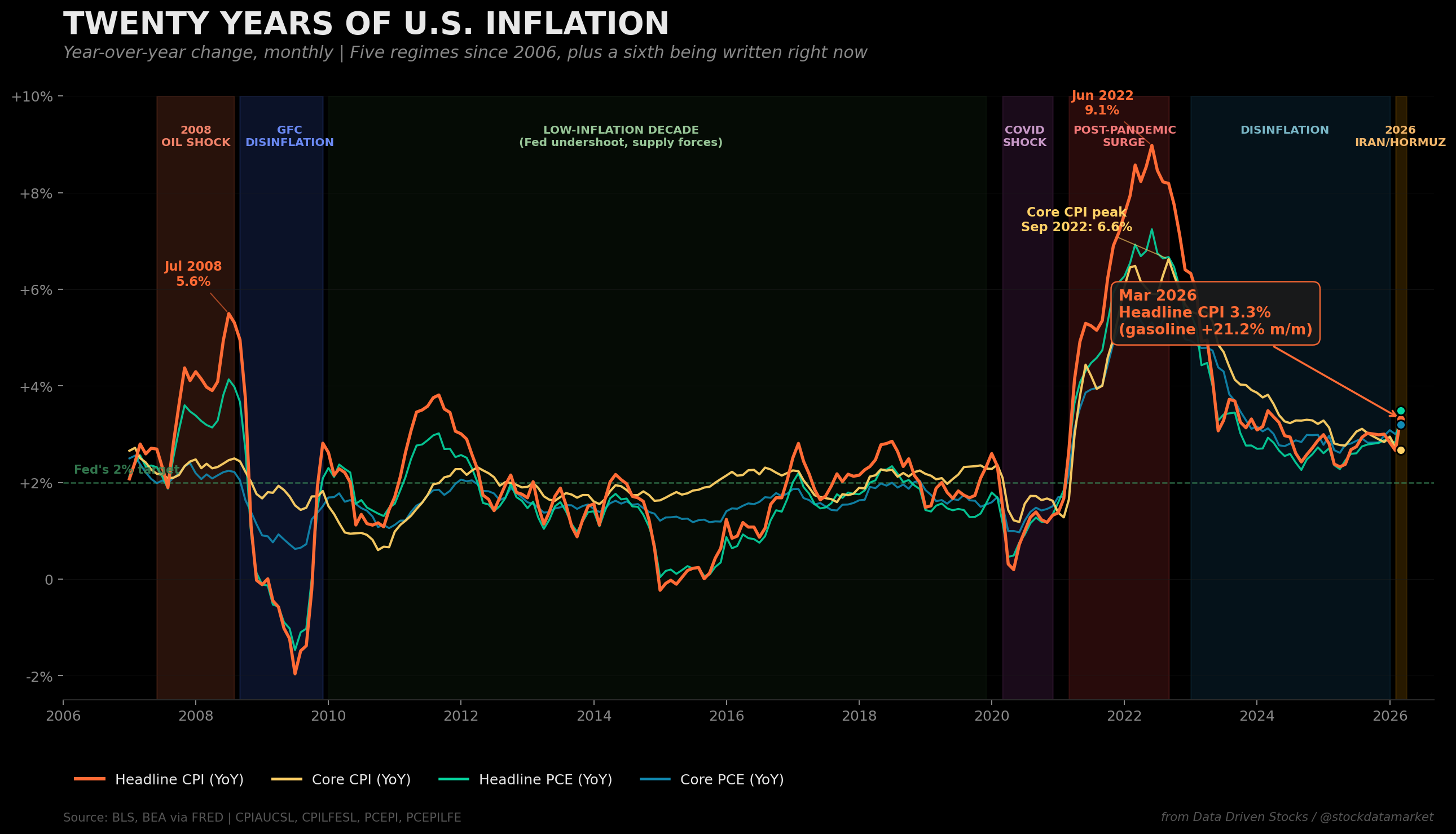
The March 2026 release wasn’t a uniform inflation blowout. It was a very specific kind of report: hot headline, calm core. CPI went from 0.2% MoM in February to 0.9% in March, a more than 4x acceleration in a single month. Year-over-year, headline CPI jumped to 3.3% from 2.8%. Yet core CPI - the measure that strips out food and energy and is what the Fed actually watches for trend signals - rose only 0.2% MoM and 2.6% YoY. The headline-core gap on the annual measure was 0.7 percentage points, the widest it has been since the 2022 oil shock.
PPI told the same story. Final demand prices rose 4.0% YoY, and final demand goods rose 1.6% in a single month. But the broad core measure - final demand less food, energy, and trade services - rose only 0.2% MoM and 3.6% YoY. PCE, the BEA-published Fed-preferred index, came in at 3.5% headline YoY versus 3.2% core. Three reports, three different statistical agencies, one common signal: the move was almost entirely energy.
The detail that matters is in the BLS commentary, not in the topline. BLS said gasoline alone accounted for nearly three-quarters of the all-items CPI increase, with the gasoline index up 21.2% MoM and energy overall up 10.9%. On the producer side, BLS said nearly half of the goods PPI rise came from a 15.7% increase in wholesale gasoline. Strip those numbers out and the U.S. inflation pulse for March was actually quite ordinary.
The line that did all the work
Almost nothing happens that fast in macroeconomics. A 21% jump in a single CPI subcomponent, in a single month, after years of disinflation, is not a normal observation. It points directly at one chart.

Two days before the war started on Feb 28, the average U.S. retail price for regular gasoline was $2.98 according to AAA - $2.94 in the EIA’s weekly survey. As of May 4, 2026, the average is $4.45. That is a $1.45-1.52 jump in roughly nine weeks. AAA called it the highest May 2 price ever recorded, $1.28 above the same date a year earlier. In Mono County, California - geography conspires with refinery closures - the county average just hit $7.00 a gallon. The statewide California average is $6.11.
Gasoline is the most visible inflation input in the U.S. economy. Roughly half of American adults notice gas prices weekly because they pay them weekly. Gasoline weights about 3.4% of the CPI basket directly, but its psychological weight is much larger because every consumer survey - the Michigan one-year inflation expectation, the New York Fed survey, the Conference Board - reweights gas heavily in respondents’ minds. When pump prices move 50% in two months, expectations move whether the BLS likes it or not.
So the whole monthly print decomposes very cleanly.

Gasoline alone added approximately 0.65 percentage points to the monthly CPI move. Other energy - electricity, piped gas, fuel oil - added another 0.10. Shelter, still the stickiest core component, added about 0.11. Food was unchanged in March. Core goods and services contributed a small residual. Energy, end-to-end, was responsible for roughly 83% of the entire monthly print.
That ratio is unusual. In a normal CPI month, energy contributes between -10 and +20 basis points to the monthly figure - sometimes, especially during 2024-25’s disinflation, even pulling the print lower. A single category accounting for four-fifths of the monthly move is the statistical fingerprint of a relative-price shock, not generalized inflation.
How a barrel of oil becomes 0.9% on your CPI print
Energy doesn’t propagate through inflation in one channel. It travels through five, with three different timing windows. Understanding which window you are in tells you whether the next print is going to be an aftershock or the start of something broader.

Stage 1 is the source shock. Iran’s restriction of Strait of Hormuz traffic - which carries roughly 20% of global seaborne oil and significant LNG volumes - took something like 14 million barrels per day of capacity offline at the start of the war. The IEA called it the largest supply disruption in the history of the global oil market. Brent and WTI repriced immediately. Refining margins (crack spreads) widened as refiners priced scarcity into gasoline, diesel, and jet fuel ahead of summer driving season.
Stage 2 is the producer pipeline. PPI final demand energy jumped 8.5% MoM in March. PPI final demand goods rose 1.6%, with BLS attributing nearly half the goods rise to wholesale gasoline. Trucking and logistics - everything that runs on diesel - reprices. This is the wholesale channel and it leads CPI by roughly two to four weeks.
Stage 3 is direct CPI energy: the line items the average household actually sees on their statements. Pump gasoline, +21.2% MoM. Energy commodities aggregate, +10.9%. Energy services - electricity and piped natural gas - move slower because most are regulated and tariff schedules adjust on lags of three to six months.
Stage 4 is where this becomes a real Fed problem. Second-round effects spread across airfares, food, and core goods over one to six months. Jet fuel pass-through to airfares is fast - typically 60 to 90 days, with 5-10% lifts in airline ticket pricing. Food embeds diesel through agriculture and natural gas through fertilizer, so food at home and food away normally show pressure with a one- to two-quarter lag. Whether core CPI services break wider depends on whether the wage cycle reignites - the question that keeps the Fed up at night.
Stage 5 is the policy reaction. The Fed’s April 29, 2026 statement said it directly: “Inflation is elevated, in part reflecting the recent increase in global energy prices.” The committee held the federal funds rate at 3.50%-3.75% for the third consecutive meeting. Markets are pricing essentially no further moves through the rest of 2026, with J.P. Morgan now penciling in a 25 bp hike in Q3 2027 if the energy shock proves persistent. Powell’s term as Chair ends May 15. Kevin Warsh, nominated as his replacement, has historically supported lower rates - but the committee will inherit the same Hormuz problem the day Warsh takes the gavel.
Why now? The geopolitics behind the price tag
Macro shocks have macro causes, but this one has a very specific geopolitical address.
The 2026 Iran war began on February 28. The combination of U.S. and Israeli operations against Iranian targets and Iran’s retaliatory closure of the Strait of Hormuz pulled an estimated 20% of seaborne global oil out of the market overnight. By the first week of March, Brent had jumped 10-13% to $80-82 per barrel. From late February to early April, oil prices rose more than 76% on a peak basis. Even after the U.S.-Iran ceasefire was announced on April 8, ship traffic through the Strait remained “far below pre-war levels,” and Qatari LNG was operating under force majeure. Whatever the diplomatic situation looks like on paper, the physical market is still impaired.
The OECD’s late-March Interim Economic Outlook revised G20 inflation upward by 1.2 percentage points to 4.0% for 2026, before easing to 2.7% in 2027. The OECD’s technical assumption was that Brent oil prices were running about 40% higher in 2026 than the December 2025 baseline had assumed, with TTF natural gas roughly 60% higher in Europe. By the OECD’s April 9 count, 26 OECD countries had implemented at least one fuel-tax cut, VAT reduction, or price-support measure. The U.S. has not, but it is releasing from the SPR for the second time this decade, which is part of why retail gasoline at $4.45 is high but not at the $5.01 peak seen during the 2022 Russia-Ukraine shock.
What is genuinely odd about the 2026 episode is that oil is lower than it should be. CNN, citing Kpler analyst Matt Smith, captured the conundrum: with 14 million barrels removed and only about 8 million barrels of replacement supply mobilized plus 4 million barrels of demand destruction, oil “should be much higher” than $110-120 per barrel. The market is implicitly pricing a fast, durable resolution. Roughly 11% of crude futures open interest is held by speculators, and Helima Croft of RBC told CNN the White House has been “very successful in convincing a corner of the market that the war will be over soon.” If that assumption breaks, the gap reprices upward.
Speculative positioning is normally a footnote. In May 2026 it is the swing factor on whether U.S. headline CPI peaks at 3.7%, 4.2%, or 5%+. That asymmetry alone justifies treating the situation as a real macro risk and not a passing summer story.
The 2026 spike in historical perspective
The fastest way to know whether this episode rhymes with 2008 or with 2022 is to overlay the three.

The 2008 shock took most of a year to fully unfold. WTI rose roughly 90% from the August 2007 baseline to the July 2008 peak - and then the global financial crisis crushed it. By the end of 2008, oil was lower than where the shock had started. The 2022 shock was different: oil shot up almost 90% within roughly 100 days of Russia’s invasion of Ukraine, then traded in a high range for several quarters. The 2026 trajectory looks unmistakably more like 2022 than 2008, but with a sharper early angle. Up 62% in 85 days and still rising weekly.
The implication for inflation is that 2008’s headline shock was relatively short-lived because the demand collapse during the GFC instantly disinflated everything. 2022’s shock was more persistent because it landed inside an already-tight, already-overheated economy, with services inflation broadening and wages catching up. 2026 sits awkwardly between those two templates. Demand is not collapsing - U.S. payrolls grew 178,000 in March and unemployment is 4.3%. But the economy is also not as overheated as it was in 2022; core inflation has been on a real disinflation path.
The animation below shows what that path looked like, month by month, since 2018.

Five things are visible in the rolling animation. First, the long, slow reaccumulation of inflationary pressure starting in early 2021. Second, the shockingly fast collapse of headline inflation from 9.1% in June 2022 to roughly 3% by mid-2023. Third, core’s lag - core CPI peaked three months after headline, in September 2022 at 6.6%, and only crossed back below 4% in 2024. Fourth, the persistence of a slight floor around 2.7-3.0% throughout 2024-25 even as the Fed talked about “the last mile.” Fifth, the sharp uptick in the final two data points, when the energy shock arrived.
Importantly, the 2026 uptick is so far entirely visible in the orange line (headline) and not in the blue line (core). That is the data version of what every Fed governor has been saying in speeches: this looks like a relative-price shock, and they want to look through it - if they can.
Why disinflation isn’t dead, but it’s complicated
The core-versus-headline divergence visible in March 2026 is genuinely informative. The 2021-22 inflation surge was characterized by unusually broad price increases - the Atlanta Fed and the FRBSF both documented that inflation breadth (the share of the CPI basket rising faster than 4%) hit historic highs. By contrast, the 2026 reacceleration is, so far, narrow. Energy moved. Almost nothing else did. Shelter inflation is still drifting lower (3.0% YoY in March, down from 5%+ in 2023). Core goods inflation is mildly disinflationary. Wages are growing at roughly 3.7% YoY, a level that is consistent with 2% inflation if productivity holds.
Federal Reserve Board researchers have argued that pandemic-era U.S. fiscal stimulus added roughly 2.5 percentage points to U.S. inflation in 2021-22, and FRBSF work has estimated that global supply chain pressures explained about 60% of the above-trend headline run-up in those years. Neither of those forces is operative now in the same way. There is no large fiscal pulse. Supply chains are functioning. The only active inflation force is energy, and even that has not yet broken into the wage-services bucket.
That is the case for the Fed continuing to “look through” the spike. The case against is that the line between a contained shock and a generalized one is determined by inflation expectations, not by current data. If the University of Michigan one-year survey - which has been drifting up since the war started - keeps drifting, and if 5-year breakevens follow, the Fed will lose the look-through option. Once expectations re-anchor higher, the cost of getting back to 2% goes up substantially.
This is exactly the dilemma the OECD flagged in its April 2026 brief and in its March Interim Economic Outlook: a relative-price shock that is heterogeneous across countries and sectors, and the right policy response depends on whether the price level move becomes a price growth move. The U.S. is on the right side of that line at the moment. April and May 2026 data will tell us whether it stays there.
What the April-May releases will actually tell you
The April 2026 CPI release lands on May 12, the PPI on May 13, and the PCE on May 28. The May data follows on June 10, June 11, and June 25. As of May 5, 2026, none of those numbers exist in official form. Anyone telling you they do is making it up.
But the April-May data has a very specific job to do, and the question being asked of it is sharper than usual. Here is what each number is being watched for.
Headline CPI YoY for April: FactSet’s median forecast was 3.9% as of late April. The market is implicitly priced for a print between 3.7% and 4.0%. A number above 4.1% would be hot. A number below 3.6% would suggest the spike is already moderating.
Core CPI MoM for April: this is the one to watch. If it stays at 0.2% (the March pace) or goes lower, the look-through case holds. If it jumps to 0.4% or higher, the breadth question gets opened. Core CPI YoY at or below 2.6% keeps the disinflation picture intact; above 2.8% reignites concern about persistence.
PPI core YoY for April: 3.6% was the March pace. If that holds or eases, second-round effects through the wholesale channel are limited. If it accelerates to 4%+, the pipeline is loaded.
PCE deflator and core PCE for April: PCE has historically run cooler than CPI because of weighting differences - core PCE was 3.2% in March versus 2.6% for core CPI, and the gap is mostly housing and medical services. The Fed cares about this measure first, so any acceleration in core PCE matters more for policy than the equivalent CPI move.
Inflation expectations: T5YIE (5-year breakeven) and the University of Michigan 1-year inflation expectation. These are real-time gauges of whether the bond market and consumer surveys are absorbing the energy shock as transitory or as the start of something stickier. If T5YIE crosses 2.7% and the UMich 1-year crosses 4.0% simultaneously, the look-through option is gone.
Three paths through 2027
Putting the pieces together, this is what the next 18 months looks like under three plausible scenarios.

The optimistic path assumes the Strait reopens substantively within a few months, oil retraces toward the high $80s, and gasoline drifts back below $4 by Q4 2026. In that world, headline CPI peaks around 3.7% in early summer, drifts back down through Q4, and lands near 2.3% by mid-to-late 2027. Core CPI never breaches 3% on a YoY basis. The Fed gets to cut once or twice. This is roughly the path implied by current oil futures and roughly the OECD’s lower-bound case.
The base case assumes the Strait reopens partially but capacity stays impaired through summer 2026, with elevated tanker insurance and re-routing costs. Oil stabilizes in the $90-100 range. Gasoline sits between $4 and $4.50 through summer driving season and then eases. Headline CPI peaks at roughly 4.2% in Q3 2026, plateaus through year-end, and drifts to 2.7% by end-2027. Core CPI rises to about 3% on YoY before falling back. The Fed holds at 3.50-3.75% through 2026 and considers a small cut in early 2027. This is closest to the OECD’s published baseline (G20 inflation 4.0% in 2026, 2.7% in 2027) and to J.P. Morgan’s “hold then hike Q3 2027” view.
The stagflation path assumes a prolonged Strait disruption, refinery and infrastructure damage that extends repair timelines, and second-round effects breaking into airfares, food, and core services. Oil holds above $100 for two to three quarters. Gasoline pushes toward $5+. Headline CPI surges to 5.2% in Q4 2026 and stays above 4.5% through mid-2027 before easing toward 4.0% by year-end 2027. Core CPI lifts above 3.5% on the back of pass-through. Inflation expectations re-anchor higher. The Fed has to choose between hiking aggressively into a slowdown or accepting persistent overshoot. Markets reprice the SOFR curve sharply higher. Equities derate. This is the OECD’s downside risk scenario and the IMF’s tail case in its January 2026 WEO update.
The base case carries the highest probability under a Bayesian read of futures markets and consensus forecasts as of early May 2026 - probably 50-55%. The optimistic scenario probably runs 25-30%. The stagflation tail is uncomfortably high at 15-20%, mainly because of how much of the current oil price is built on the assumption of fast resolution. If that assumption breaks, the path shifts.
What this means for portfolios and policy
Two things to take away from where the U.S. inflation cycle is sitting in May 2026.
First, the headline-core gap is the message. The gap between a 3.3% headline CPI and a 2.6% core CPI is exactly 70 basis points. That gap is large, but it is also concentrated in one category, and that category is one whose cause is identifiable, geographic, and potentially reversible. Investors who treat the 3.3% number as “the inflation rate” are misreading the report. The Fed certainly is not.
Second, the fragility of disinflation should be priced. Over the 2023-25 period, the assumption baked into many portfolios was that inflation was structurally heading back to 2%. The 2026 episode shows what should have been obvious from the 2008 and 2022 episodes: the U.S. consumer price level is exposed to global energy markets, and global energy markets are exposed to political shocks, and those shocks are not predictable. A real-yield framework that assumes terminal CPI of 2.0-2.5% should be stress-tested against scenarios where it sits at 3.5-4.5% for two or three quarters at a time, and where that stickiness compounds with policy uncertainty during a Fed leadership transition.
The April-May releases will not resolve any of this on their own. What they will do is decide whether the line in the next version of this chart bends back toward 2% by mid-2027 or whether it sits stubbornly above 4% for another year. That is the trade. That is the watch.
The Iran war started 67 days ago. The Strait of Hormuz is still operating below capacity. Gasoline rose another 33 cents this week alone. The April CPI release is in seven days. We’ll find out then how much of this has actually leaked into the data the Fed cares about.
Until then, the best read of U.S. inflation in May 2026 is exactly what the March release said: hot headline, calm core, and a single answer to the question of why - one that is not in the BLS press release at all. It is on a chart of crude oil prices, and it is not stable yet.
Sources
This article uses data and analysis from the following sources, all of which I encourage readers to consult directly.
Official inflation releases (March 2026):
BLS Consumer Price Index, March 2026 release: https://www.bls.gov/news.release/archives/cpi_04102026.htm
BLS Producer Price Index, March 2026 release: https://www.bls.gov/news.release/archives/ppi_04142026.htm
BEA Personal Income and Outlays, March 2026: https://www.bea.gov/news/2026/personal-income-and-outlays-march-2026
FRED data series used in charts:
Headline CPI (CPIAUCSL): https://fred.stlouisfed.org/series/CPIAUCSL
Core CPI (CPILFESL): https://fred.stlouisfed.org/series/CPILFESL
Headline PCE (PCEPI): https://fred.stlouisfed.org/series/PCEPI
Core PCE (PCEPILFE): https://fred.stlouisfed.org/series/PCEPILFE
PPI Final Demand (PPIFID): https://fred.stlouisfed.org/series/PPIFID
U.S. retail gasoline (GASREGW): https://fred.stlouisfed.org/series/GASREGW
WTI crude oil (DCOILWTICO): https://fred.stlouisfed.org/series/DCOILWTICO
Federal Reserve and policy:
FOMC statement, April 29, 2026: https://www.federalreserve.gov/newsevents/pressreleases/monetary20260318a.htm
FOMC minutes, March 2026 meeting: https://www.federalreserve.gov/monetarypolicy/fomcminutes20260318.htm
2025 Statement on Longer-Run Goals and Monetary Policy Strategy: https://www.federalreserve.gov/monetarypolicy/monetary-policy-strategy-tools-and-communications-statement-on-longer-run-goals-monetary-policy-strategy-2025.htm
OECD:
OECD Economic Outlook Interim Report March 2026: https://www.oecd.org/en/publications/oecd-economic-outlook-interim-report-march-2026_d4623013-en/full-report/component-3.html
OECD Energy prices are spiking again, April 2026 brief: https://www.oecd.org/en/publications/energy-prices-are-spiking-again_a68e5c37-en.html
OECD Consumer Prices statistical release, April 7, 2026: https://www.oecd.org/en/data/insights/statistical-releases/2026/04/consumer-prices-oecd-updated-7-april-2026.html
IMF and FRBSF analysis used for historical context:
IMF, The Rise and Retreat of US Inflation: An Update: https://www.imf.org/en/publications/wp/issues/2025/05/16/the-rise-and-retreat-of-us-inflation-an-update-566795
IMF, The Energy Origins of the Global Inflation Surge: https://www.imf.org/en/publications/wp/issues/2025/05/09/the-energy-origins-of-the-global-inflation-surge-566804
FRBSF, How Much Do Supply and Demand Drive Inflation?: https://www.frbsf.org/research-and-insights/publications/economic-letter/2022/06/how-much-do-supply-and-demand-drive-inflation/
FRBSF, Global Supply Chain Pressures and U.S. Inflation: https://www.frbsf.org/research-and-insights/publications/economic-letter/2023/06/global-supply-chain-pressures-and-us-inflation/
Federal Reserve Board, Fiscal policy and excess inflation during Covid-19: https://www.federalreserve.gov/econres/notes/feds-notes/fiscal-policy-and-excess-inflation-during-covid-19-a-cross-country-view-20220715.htm
EIA and energy market context:
EIA, Crude oil prices increased in first-half 2022 and declined in second-half 2022: https://www.eia.gov/todayinenergy/detail.php?id=55079
EIA, Crude oil prices rise above $100 per barrel after Russia’s further invasion into Ukraine: https://www.eia.gov/todayinenergy/detail.php?id=51498
EIA, Gasoline price fluctuations: https://www.eia.gov/energyexplained/gasoline/price-fluctuations.php
News and market commentary on the 2026 episode:
CNBC, Fed interest rate decision April 2026: https://www.cnbc.com/2026/04/29/fed-interest-rate-decision-april-2026.html
CBS News, Fed holds rates steady for third straight meeting (Powell to remain as governor): https://www.cbsnews.com/news/federal-reserve-fomc-meeting-today-rate-decision-jerome-powell-kevin-warsh/
CNN Business, The weirdest aspect of the Iran war that has befuddled oil experts: https://www.cnn.com/2026/05/01/business/oil-market-price-high-low-iran
NPR, Gas prices went up more than 30 cents a gallon last week: https://www.npr.org/2026/05/03/nx-s1-5809433/gas-prices-rise-week-hormuz-iran-war
Fox Business, Iran conflict pushes US gas prices to all-time record highs: https://www.foxbusiness.com/politics/national-average-gas-price-reaches-4-45-before-summer-driving-season
J.P. Morgan Global Research, What’s the Fed’s Next Move?: https://www.jpmorgan.com/insights/global-research/economy/fed-rate-cuts
U.S. Bank, Federal Reserve Monetary Policy: https://www.usbank.com/investing/financial-perspectives/market-news/federal-reserve-tapering-asset-purchases.html