The $2.5 Billion Hair Dryer: How NVIDIA’s AI Chips Keep Smuggling Themselves Into China
The largest export-control failure in the AI era, and why Washington’s H200 deal with Beijing just hit a wall the smugglers built.

Yesterday, May 14, 2026, the U.S. cleared NVIDIA to sell its H200 chips to ten Chinese firms. Alibaba, Tencent, ByteDance, JD.com, Foxconn, Lenovo. Each approved customer can buy up to 75,000 H200s. The deal was negotiated by President Trump and includes a 25% revenue cut going to the U.S. government as the chips physically transit American soil before being re-exported. Jensen Huang flew to Alaska to meet Trump’s delegation before heading to Beijing, hoping his presence could finally unlock the deals.
Not a single chip has been delivered.
Why? Because the Chinese central government quietly told its companies to hold. Beijing is “trying to keep their investment focused on their own domestic industry,” Commerce Secretary Howard Lutnick said. That’s the diplomatic version. The operational version is more interesting, and it’s the subject of this piece: the chips are already there. The market that the H200 license was supposed to open had been substantially filled for the better part of three years, and not by NVIDIA. By a sprawling network of shell companies, fake brand labels, hair-dryer-wielding label swappers, dummy servers, fraudulent end-user certificates, and around seventy distributors in Guangdong, Zhejiang, and Anhui openly advertising banned hardware.
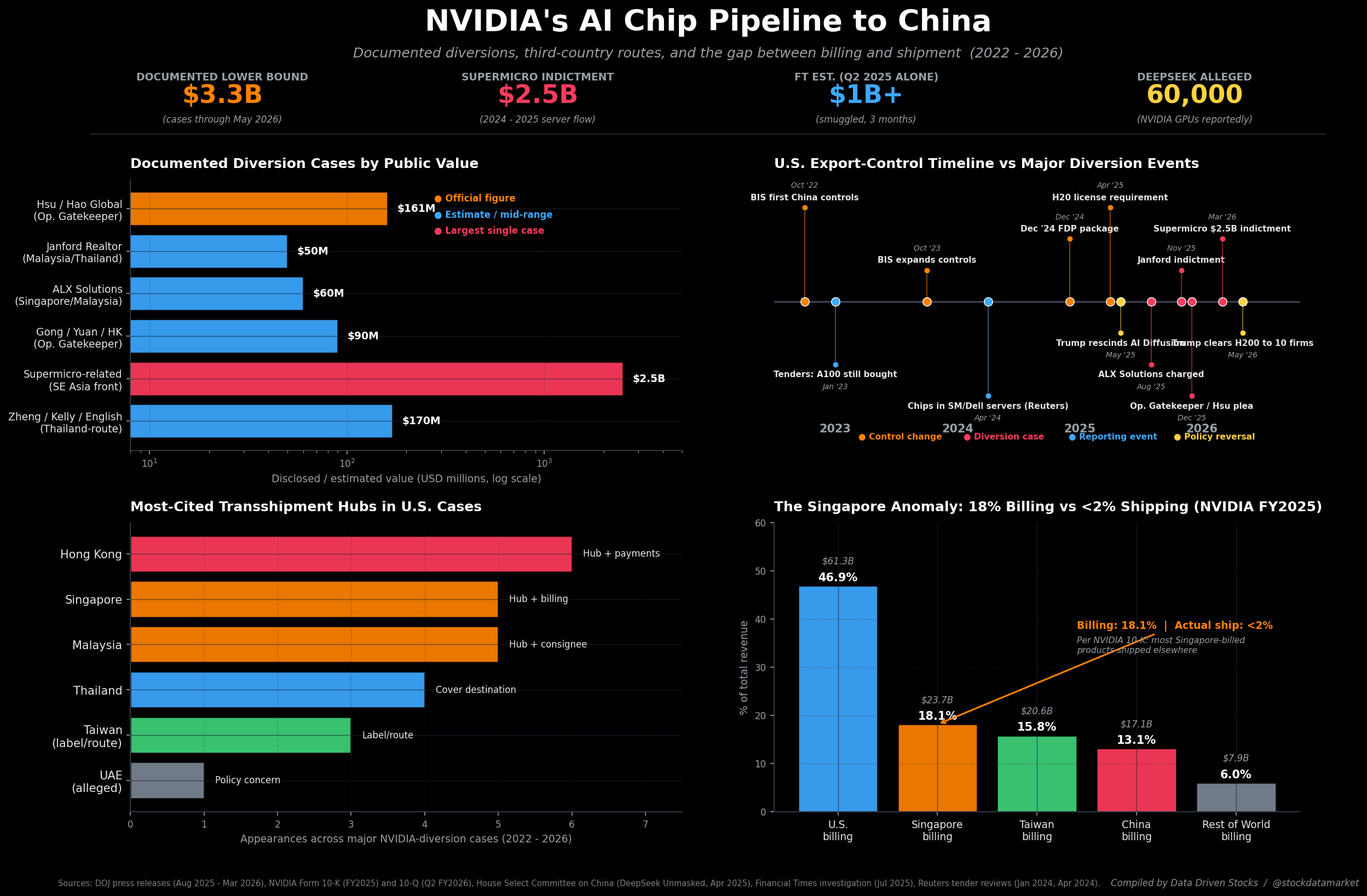
So let’s address the question head-on: did NVIDIA smuggle AI chips to China? The short, honest answer is no - the corporation itself has not been charged in any of the major diversion cases. The longer and more useful answer is that NVIDIA’s hardware has moved into China at industrial scale anyway, through routes the company maintains it does not control. The publicly-documented lower bound across U.S. cases through May 2026 is roughly $3.3 billion. The single largest case alone, the Supermicro-related indictment unsealed in March, alleges $2.5 billion in NVIDIA-equipped servers routed through a Southeast Asian front company. The Financial Times found that more than $1 billion in restricted NVIDIA chips entered China in just one quarter of 2025. And the House Select Committee on China alleges DeepSeek’s models were trained on tens of thousands - reportedly over 60,000 - NVIDIA processors that should never have been there.
This is what an industrialized backdoor looks like.
The Setup: How Washington Tried, and How the Chips Got Through Anyway
The modern China AI-chip restriction regime began in October 2022. The Biden Bureau of Industry and Security imposed advanced-computing export controls covering China, Hong Kong, and Macau, citing risks to military modernization, intelligence collection, and weapons-of-mass-destruction applications. NVIDIA’s A100 and H100 went on the list. The company designed downgrade versions - the A800 and H800 - to comply with the new thresholds. In October 2023, BIS closed that loophole too: the A100, A800, H100, H800, and L40S all required licenses for China effective October 23, 2023.
In December 2024, the outgoing Biden administration tightened the framework again with new Foreign Direct Product Rule additions and entity-list designations. In January 2025, two more rules followed: a foundry due-diligence rule explicitly aimed at preventing diversion to the PRC, and the AI Diffusion rule, which tried to create a global tiered licensing system to stop China from accessing advanced chips through third countries. In April 2025, NVIDIA disclosed in an SEC filing that the U.S. government had imposed an indefinite license requirement on H20 exports to China - citing “diversion risk to a supercomputer in China” as the justification.
Then in May 2025, the Trump administration rescinded the not-yet-effective AI Diffusion rule but simultaneously issued anti-diversion guidance and warnings that access to advanced U.S. ICs for Chinese AI-model training could trigger export-control liability. In January 2026, BIS revised the framework again, agreeing to review some advanced-computing exports to China - including the H200 - on a case-by-case basis, which is the regime the Trump administration extended yesterday.
The pattern is striking. Every tightening produced a fresh wave of more sophisticated workarounds. And the headline cases - the ones that make this measurable - mostly came to light after the late-2024 tightening cycle.

The Cases That Defined Industrialized Diversion
Six cases dominate the public record, and they tell a story that gets uglier as you scroll down the docket.
ALX Solutions was the first big Singapore-and-Malaysia transshipment prosecution. Charged in August 2025, the criminal complaint alleged that ALX exported sensitive GPUs to China without licenses from October 2022 to July 2025. A December 2024 shipment plus at least twenty prior shipments went to freight-forwarding companies in Singapore and Malaysia, while payments came from Hong Kong and China - including a $1 million wire from a China-based company in January 2024. DOJ stated the value as “tens of millions of dollars” and alleged that the December 2024 shipment was falsely labeled to conceal that the GPUs required a license for China.
Janford Realtor showed how absurdly thin the front companies could be. Indicted in November 2025, the defendants used a Tampa “realty” LLC as a cover to export advanced NVIDIA GPUs to the PRC through Malaysia and Thailand. Prosecutors said two completed shipments moved 400 A100 GPUs to China between October 2024 and January 2025. They then tried to ship 10 HPE supercomputers loaded with H100s plus 50 H200 GPUs before law enforcement intervened. Wire transfers tied to the scheme included $3.89 million from PRC accounts.
Operation Gatekeeper, publicized in December 2025, linked multiple PRC- and Hong Kong-connected actors. The Hsu / Hao Global component is the cleanest piece of the official record: Alan Hao Hsu agreed to a guilty plea acknowledging the purchase of 3,872 H100 and 3,160 H200 GPUs - 7,032 units worth $160.815 million. The Gong and Yuan complaints exposed the operational tradecraft. NVIDIA labels were physically removed at U.S. warehouses, fake “SANDKYAN” brand stickers were applied, the GPUs were described in shipping paperwork as “adapters” or “adapter groups,” and some boxes were marked “Made in Taiwan.” Agents detained more than $30 million worth of hardware from one New Jersey warehouse alone, and DOJ said the broader operation yielded over $50 million in seized NVIDIA technologies and cash.
The Supermicro-related indictment, unsealed in March 2026, is the case that made the rest of the diversion story look small. The Southern District of New York charged Yih-Shyan “Wally” Liaw - the Supermicro co-founder and a board member at the time of his arrest - along with sales manager Ruei-Tsang “Steven” Chang (still a fugitive) and broker Ting-Wei “Willy” Sun. Prosecutors alleged the trio sold roughly $2.5 billion in Supermicro servers, packed with NVIDIA’s H100, H200, and Blackwell B200 GPUs, to an unnamed Southeast Asian “Company-1” that operated as a sham buyer. From late April to mid-May 2025 alone, at least $510 million in U.S.-assembled servers were diverted to China. Bloomberg later identified Company-1 as Thailand-based OBON Corp. and reported that Alibaba was among multiple end customers - an allegation Alibaba denied.
The methods read like a manual.

To deceive Supermicro’s own compliance team and BIS auditors, the defendants allegedly stored thousands of dummy non-working replica servers in a warehouse, organized on-site teams paid down to meals and van transport to populate the warehouse during inspections, and - in the detail that ended up in every headline - used hair dryers and heat guns to peel manufacturer labels and serial-number stickers off real servers and stick them on the decoys. The real servers were already on their way to China by the time the auditors arrived. The defendants used encrypted messaging to coordinate. In January 2025, when Trump announced the new H20 restrictions slated for May 13, Liaw allegedly texted his Southeast Asian counterpart: “We need to speed these up before May 13!” A few days later: “Let us run fast before May 13!” In August 2025, after another DOJ press release on AI-chip smuggling, a broker forwarded it to Liaw, who allegedly replied with sobbing-face emojis and kept working. The Southeast Asian front company had grown to be Supermicro’s eleventh-largest global customer by fiscal 2024, with $99.7 million in disclosed revenue.
The Georgia Thailand-route case, charged one week after the Supermicro indictment, completed the picture. Prosecutors alleged that the defendants began conspiring in May 2023 to ship controlled servers from a California seller through Thailand to an ultimate destination in China. In October 2023 they ordered 750 servers for approximately $170 million, including 600 containing controlled chips. The same playbook, a different cover destination.
The Architecture of the Pipeline
Strip away the names and the dollar amounts, and every one of these cases runs on the same five-stage scaffold. A U.S. supplier sells legitimately. A shell front company in a third country signs as the buyer. Invoices route through a hub - Singapore most often, sometimes Hong Kong. The hardware moves to a warehouse in the third country, gets repackaged, gets relabeled, gets fitted with falsified paperwork, and then ships onward to the actual Chinese end user. BIS’s own May 2025 anti-diversion guidance lists those same red flags verbatim: freight forwarders as consignees, obscure companies, unknown delivery addresses, abnormal shipping routes.

The asymmetry that BIS faces here is brutal. A single export-control officer can credibly inspect one warehouse. A determined network can stand up a new front company between the inspection and the next quarter’s shipments. The Supermicro defendants allegedly created false records on the spot, recruited a separate logistics firm to repackage servers in unmarked boxes, and ran the whole operation through encrypted coordination tools. The compliance function did not detect it. An external auditor noted plainly to Fortune that the scheme was “pretty sophisticated, and one apparently that was not detected by the compliance function.”
The Singapore Anomaly Nobody Can Explain Away
Singapore is the place where the public mathematics gets uncomfortable for everyone. In NVIDIA’s fiscal year 2025, which ended January 26, 2025, the company reported 18.1% of total revenue - $23.7 billion - billed to Singapore. That made Singapore NVIDIA’s second-largest geography after the United States, larger than Taiwan, larger than China itself.
But in the same Form 10-K, NVIDIA disclosed that physical shipments to Singapore amounted to less than 2% of total revenue. The company’s own language: “Customers use Singapore to centralize invoicing while our products are almost always shipped elsewhere.” The Singapore government echoed that, telling investigators that NVIDIA had “no reason to believe” DeepSeek obtained export-controlled products from Singapore and emphasizing that Singapore-linked revenue often reflects billing, not shipment.

That gap is the most-discussed line in any NVIDIA filing of the past two years. It is also why the House Select Committee on China, in April 2025, demanded that NVIDIA produce a list of all customers in eleven Asian countries who had purchased more than 499 AI chips since the beginning of 2020, with specific focus on Malaysia and Singapore. The committee cited Reuters reporting that Singaporean authorities had arrested three individuals for selling advanced NVIDIA chips to DeepSeek, and SemiAnalysis estimates that DeepSeek had at least 60,000 NVIDIA processors - 10,000 A100s, 10,000 H100s, 10,000 H800s, and 30,000 H20s - with orders for thousands more. Two of those classes, the A100 and H100, have been banned from China since 2022 and 2023. NVIDIA’s defense was that Singapore revenue reflects billing addresses for subsidiaries of its U.S. customers, and that the products are shipped elsewhere, including the United States and Taiwan, but “not to China.” That defense is consistent with the company’s filings. It is also a corporate position, not a customs trail.
In December 2025, the House Select Committee escalated further. Chairman John Moolenaar sent a letter to Commerce Secretary Lutnick stating that documents produced to the committee showed NVIDIA had provided “extensive technical support” to DeepSeek - which the committee said is now “integrated into People’s Liberation Army systems.” The committee called for clarifying H200 restrictions to prevent prohibited end users from gaining the type of access the PLA had gained via DeepSeek. That letter was sent the same month BIS was drafting the case-by-case review framework that eventually authorized yesterday’s H200 sales.
The Gray Market That Filled the Gap
While the prosecutions were piling up, a parallel commercial structure was visible to anyone willing to look. The Financial Times reported in July 2025 that more than $1 billion in restricted NVIDIA chips - B200s, H100s, H200s - entered China between April and June 2025. Servers preloaded with these chips were openly advertised by resellers in Guangdong, Zhejiang, and Anhui. One Shanghai distributor, “Gate of the Era,” handled nearly $400 million in B200 systems, selling pre-assembled AI server racks for as much as $500,000 each. A single smuggler reportedly handled an order worth $120 million for servers containing 2,400 banned NVIDIA H100s. Malaysia’s GPU imports surged over 3,400% in early 2025 - a number that hides not so much production growth as throughput. By mid-2025, more than seventy Chinese distributors were openly marketing restricted processors.
The pricing tells you everything about the dynamics. At the peak of the shortage, H100-based servers traded in mainland China for over ¥3 million - roughly $420,000 - against an official price of $280,000 to $300,000. That premium represented logistics costs, tariffs, risk, and the smugglers’ cut. By late 2024 the premium had compressed as more supply arrived through the gray channels and the H200 launched. In 2026, Reuters reported NVIDIA’s still-restricted B300 server trading on gray channels in China for approximately $1 million per unit. The premium is back - because the B-series is more advanced, harder to source, and harder to repair without official support.
A repair industry has emerged alongside the import flow. Reuters has documented Shenzhen firms specializing in diagnosing, repairing, and maintaining banned NVIDIA chips, servicing up to 500 chips per month at ¥10,000 to ¥20,000 ($1,400 to $2,800) per unit. They do board-level testing, component replacement, firmware work. They effectively keep smuggled hardware operational without NVIDIA’s official support. The entire ecosystem - import, distribution, repair, resale - operates as a parallel market that the U.S. export-control regime, on paper, made impossible.

Why the H200 Deal Hit a Wall
Beijing’s response yesterday was not, by any conventional reading, what NVIDIA’s investors expected after Trump’s deal. Each approved customer was cleared to buy up to 75,000 H200 chips. Zero have been delivered. Lenovo confirmed it was among the firms approved as part of the export license. Alibaba, Tencent, ByteDance, JD.com, Foxconn did not respond to press inquiries. Sources told Reuters that Chinese firms “pulled back after guidance from Beijing.” The shift was partly triggered by changes on the U.S. side, though “exactly what changed remains unclear.”
The 25% revenue cut Trump negotiated is, technically, not an export tariff - those are illegal under U.S. law. The structural workaround is that the chips physically pass through U.S. territory before being re-exported to China, which makes the 25% a domestic revenue arrangement rather than a forbidden export fee. Beijing finds the detour insulting at best and operationally suspect at worst. Officials worry that the chips could be modified or fitted with hidden vulnerabilities during their U.S. layover. Insiders dismiss those concerns as legal-workaround paranoia. But the deeper reason for the freeze is something neither government is saying out loud: China doesn’t urgently need the official channel. Jensen Huang himself has acknowledged that NVIDIA’s market share in China has effectively gone to zero on the official ledger. NVIDIA’s CEO publicly called the policy that produced that outcome “largely backfired.” Bernstein estimated earlier this year that NVIDIA’s share of China’s AI GPU market could fall from 66% in 2024 to roughly 8% in coming years - with domestic vendors like Huawei filling up to 80% of demand.
Huawei’s Ascend 910C began mass shipments in May 2025. Its successor, the Ascend 910D, was reportedly entering Chinese data centers by early 2026. DeepSeek confirmed its V4 model could run on Ascend processors. The smuggled NVIDIA hardware filled the bridge - the official suspended channel - while Chinese domestic capacity ramped up to absorb the long-run demand. In that frame, paying a 25% surcharge to NVIDIA for a chip Chinese cloud firms can already get through other means, or substitute with domestic silicon, is a poor commercial choice. Beijing is choosing to wait.
That is what it looks like when an export-control regime has been substantially outflanked. The official market closes, the unofficial market scales, the domestic substitute matures, and by the time the official market reopens the question isn’t whether China will buy - it’s whether the official channel still offers anything China values enough to pay the premium for.
What the Numbers Actually Tell Us
The bottom line, with all the caveats stacked clearly:
NVIDIA the corporation has not been charged in any of the major diversion cases. The criminal liability sits with shell-company operators, freight forwarders, sales managers at server-maker partners, and brokers. That distinction matters legally and ethically. It does not, however, change the macro outcome. Through May 2026, the publicly-documented lower bound of NVIDIA-equipped diversion to China is approximately $3.3 billion across the six largest cases. The single Supermicro-related case accounts for $2.5 billion in purchases with at least $510 million in proven diversions in a six-week window. The Financial Times found another $1 billion+ moving in a single quarter through gray-market channels that no DOJ press release has yet touched. Senate and GAO assessments have repeatedly stressed that exposed cases represent a floor, not a ceiling, because BIS enforcement is structurally under-resourced and relies heavily on private-sector compliance.
That makes the public record a fragmentary view of a much larger phenomenon. The full scale is unknowable from open sources. But the direction is not in dispute. Diversion moved from a small loophole in 2022 to gray-market consolidation in 2023, to documented routing schemes in 2024, to industrialized billion-dollar networks in 2025, to a generation of prosecutions in 2026 - and into a moment, this week, when Beijing politely declined to take what the U.S. was finally willing to sell.
A trillion-dollar AI hardware company. A four-year export-control regime. A hair dryer in a warehouse in Southeast Asia. The story of which one mattered most is still being written, but the receipts are starting to add up.
Sources and citations
DOJ Press Releases: ALX Solutions criminal complaint (SDNY, August 2025); Janford Realtor / Hon Ning Ho indictment (November 2025); Hsu / Hao Global plea agreement and Gong / Yuan complaints, Operation Gatekeeper (SDTX, December 2025); Supermicro-related indictment of Liaw, Chang, Sun (SDNY, March 19, 2026); Thailand-route conspiracy charged against Zheng, Kelly, English (Georgia, March 2026).
NVIDIA SEC Filings: Form 10-K for fiscal year ended January 26, 2025 (revenue by billing location, Singapore shipping disclosure); Form 8-K dated April 9, 2025 (H20 indefinite license requirement and diversion-risk justification); Form 10-Q for Q2 fiscal 2026 (geographic revenue breakdown); Q1-Q4 FY2026 earnings releases (May 2025 - February 2026).
U.S. Government: BIS October 2022 advanced-computing controls IFR; BIS October 2023 expanded controls IFR; BIS December 2024 FDP package and advanced-computing controls; BIS January 2025 Biden AI Diffusion rule; BIS January 2025 foundry due-diligence rule; BIS May 2025 anti-diversion guidance; BIS January 2026 H200 case-by-case review framework; House Select Committee on China, “DeepSeek Unmasked: Exposing the CCP’s Latest Tool for Spying, Stealing, and Subverting U.S. Export Control Restrictions” (April 16, 2025); House Select Committee Moolenaar letter to Commerce Secretary Lutnick (February 12, 2026); GAO-25-107386 report on the semiconductor export-control architecture.
Press and Investigations: Reuters, “Exclusive: US clears H200 chip sales to 10 China firms as NVIDIA CEO looks for breakthrough” (May 14, 2026); CNBC, “NVIDIA’s unofficial exports to China face scrutiny after arrest of silicon smugglers in Singapore” (March 3, 2025); CNBC, “US tech execs smuggled NVIDIA chips to China, prosecutors say” (March 19, 2026); CNN, “Co-founder of tech company charged with diverting $2.5 billion in NVIDIA AI chips to China” (March 19, 2026); NBC News, “Three men charged with illegally smuggling advanced AI chips into China” (March 20, 2026); Fortune, “Supermicro’s cofounder was just arrested for allegedly smuggling $2.5 billion in GPUs to China” (March 19, 2026); Fortune, “Encrypted texts reveal how NVIDIA chips and U.S. tech are being smuggled to China and Russia” (May 13, 2026); Fortune Asia, “NVIDIA CEO Huang calls China AI market a $50B opportunity” (August 28, 2025); Financial Times investigation on $1B+ NVIDIA chips smuggled into China (July 2025); Reuters, multiple reports on Chinese tender procurement of restricted NVIDIA chips (January 2024, April 2024); TrendForce / Economic Daily News reporting on H100 black market pricing in mainland China and Hong Kong (April 2024, 2026); SemiAnalysis estimates of DeepSeek’s NVIDIA installed base (cited in House Select Committee report); Tom’s Hardware reporting on the NVIDIA H100 black market in China; GamersNexus, “The NVIDIA AI GPU Black Market” investigation (December 2025); Bloomberg, identification of Supermicro Company-1 as Thailand-based OBON Corp. (May 2026).
Singapore and Malaysia Official Statements: Singapore Ministry of Trade and Industry statement on DeepSeek allegations (February 2025); Singapore MTI / MAS joint advisory on anti-circumvention expectations (April 2025); Malaysia MITI statements on cooperation in U.S.-sanctioned AI-chip trade (March 2025, July 2025).