
The 21-Mile Chokepoint Hiding in Your Yogurt Cup: Why an Iran War at the Strait of Hormuz Could Rewire Global Food Packaging in 2026
Everyone talks about Hormuz as an oil story. Almost nobody talks about the pellets. That is a mistake - and 2026 may be the year we finally pay for it.

The part of the Hormuz story nobody covers
When analysts talk about the Strait of Hormuz, they almost always reach for the same sentence. Roughly a fifth of the world’s oil passes through it. That number is accurate, and it is the reason every trading desk in the world has a Hormuz dashboard open somewhere. But it is also incomplete, and the part that gets skipped happens to be the part most relevant to your breakfast.
The Gulf is not just an oil province. It is also one of the largest export-oriented petrochemical complexes on earth. Saudi Arabia, Qatar, the UAE and Kuwait ship enormous volumes of polyethylene and polypropylene pellets - the raw material of plastic film, bottles, trays, pouches and closures - to converters in Turkey, the EU, India, China, Malaysia and Egypt. Almost all of those shipments leave from Persian Gulf ports. Almost all of them sail under the same hulls that need to thread a two-mile-wide shipping lane at the Strait of Hormuz. And almost none of them have a realistic bypass.
The short version of this article is simple. If the Strait of Hormuz closes in 2026 - whether because of a direct Iran-Israel war, an Iranian response to strikes on nuclear facilities, or a miscalculation during the kind of escalation ladder we have been climbing since 2023 - the crisis will not stop at crude oil. It will propagate into plastic resin prices, into packaging converter costs, and from there into the shelf-stable, containerised, plastic-wrapped food economy that feeds most of the planet. The channel is narrow. The buffer is thin. And it has been invisible to most of the people who should be watching it.
Why food packaging matters more than you think
Before getting into Hormuz specifically, it is worth sitting with how structurally plastic-dependent modern food is. Plastic is not a branding choice. It is the physics that lets a Brazilian mango reach a Berlin shelf without rotting, and it is the reason a gallon of milk costs less than a takeaway coffee. The OECD’s Global Plastics Outlook documents that global plastics production nearly doubled from 234 million tonnes in 2000 to 460 million tonnes in 2019, and that packaging alone accounts for roughly 42 percent of all plastic waste generated each year. That 42 percent figure is not an environmental slogan. It is a throughput signal. Packaging has an extremely short life cycle because food is constantly moving through the system, which means converters cannot “draw down” pellets the way a construction firm can postpone a build. When pellet supply tightens, food supply tightens within weeks.
The packaging resin basket that matters for food is narrow and well understood. Polyethylene in two flavours (high density and low density) dominates films, bags, wraps and milk bottles. Polypropylene dominates yogurt pots, microwave trays, bottle closures and film laminates. PET dominates beverage bottles and a growing share of thermoformed meat and produce trays. Between them, these three polymers cover the overwhelming majority of the plastic touching food in a modern supermarket. Every one of them is a derivative of oil and gas. Every one of them is produced at scale in the Persian Gulf. And every one of them moves by ship.
Hormuz as an energy story - the numbers you have heard
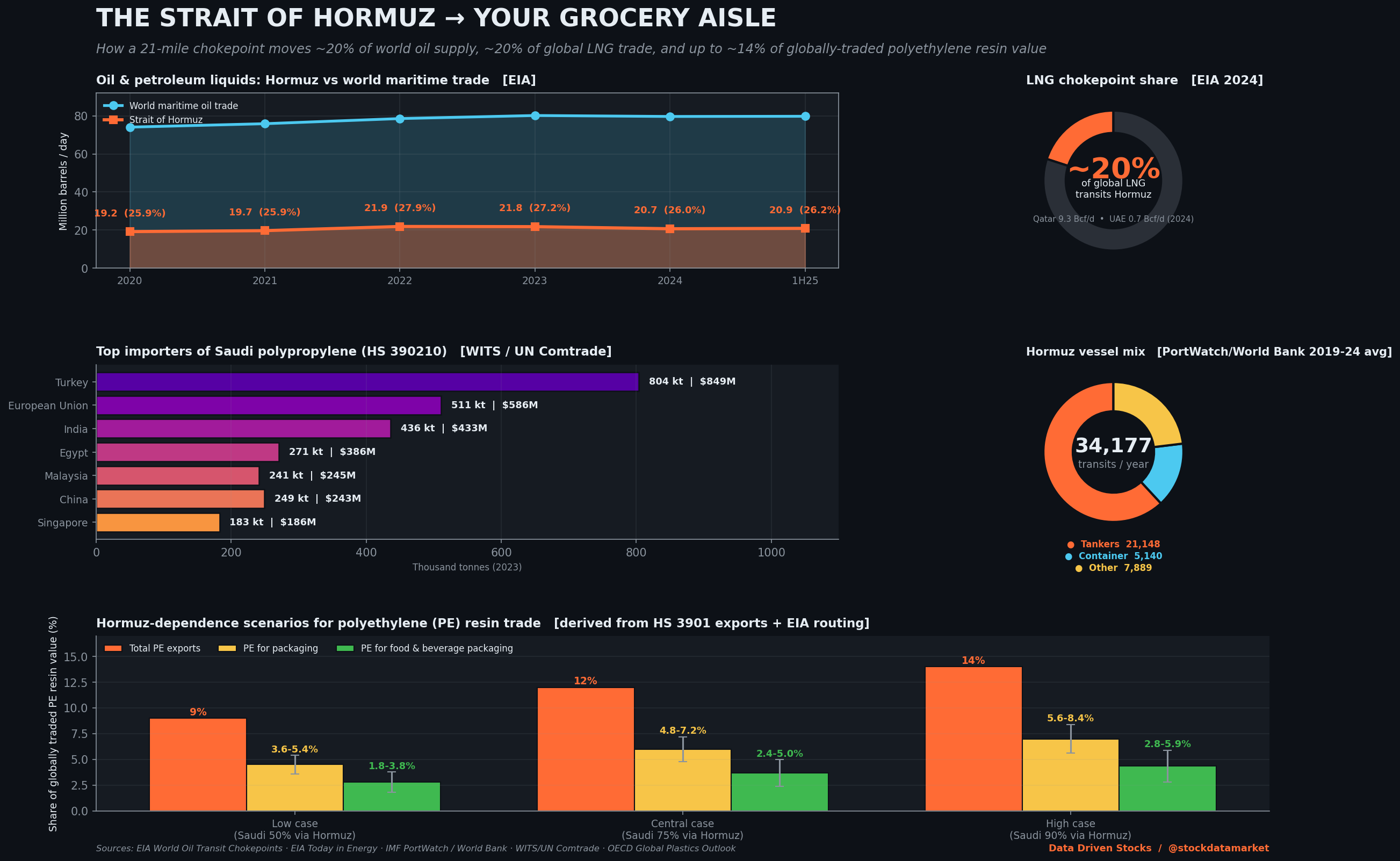
Start with the familiar part. The U.S. Energy Information Administration’s most recent chokepoint tables put oil and petroleum liquids through the Strait of Hormuz at between 19.2 and 21.9 million barrels per day every year since 2020, with the first half of 2025 clocking 20.9 mb/d. That is equivalent to roughly 26 percent of world seaborne oil trade and about 20 percent of total world oil supply. The EIA frames Hormuz as the world’s most important oil transit chokepoint for a reason - there is nothing close to it in scale, and the alternatives are embarrassingly limited.

On LNG, the picture is nearly identical in scale. The EIA estimates that about 20 percent of global LNG trade transited Hormuz in 2024, with Qatar alone exporting roughly 9.3 billion cubic feet per day through the strait and the UAE another 0.7 billion. In the first half of 2025 the figure was 11.4 Bcf/d. If you want to make energy prices move, closing this strait is the most efficient way on the planet to do it. And here is the thing almost nobody says out loud: there is no real bypass. The EIA notes that only Saudi Arabia and the UAE operate pipelines that can circumvent Hormuz at all, and that the effective unused bypass capacity is around 3.5 mb/d. Against flows of 20-plus million barrels per day, that is not a safety net. It is a rounding error.
The part nobody covers - Hormuz as a plastics story
Now for the story almost nobody puts in front of you. The same waterway that carries Qatari LNG and Saudi crude also carries the containerised output of one of the largest polymer export complexes on earth. The IMF PortWatch chokepoint database, surfaced through the World Bank’s Data Partnership monitoring, uses AIS satellite tracking to count every vessel transiting Hormuz. Between 2019 and 2024 the average was about 34,177 transits a year. Of those, around 21,148 were tankers, about 5,140 were container ships, and the balance was dry bulk and general cargo. The top industries associated with Hormuz transit cargo in that same dataset include “Chemical and Allied Industries.” That is not a coincidence. Every pellet ship leaving Jubail or Ras Laffan or Jebel Ali rolls through Hormuz by default.
When you pull the trade data on a single polymer from a single Gulf country, the scale starts to feel real. The World Bank’s WITS interface to UN Comtrade shows that in 2023, the top importers of Saudi polypropylene alone were Turkey at roughly 804 thousand tonnes, the European Union at 511, India at 436, Egypt at 271, Malaysia at 241, China at 249, and Singapore at 183. Just those seven flows add up to around 2.69 million tonnes of polypropylene from one exporter in one polymer category in one year. Multiply that across PE, PET, PVC and across every GCC exporter, and you start to see why “Hormuz is an oil chokepoint” is the wrong frame. It is also one of the largest plastic-pellet chokepoints in the world.

Who buys this stuff? Exactly the countries you would expect to be the world’s food-packaging factories. Turkey has become one of the largest flexible-packaging converters in the world. The EU runs a vast food-contact plastics industry. India, China, Malaysia and Egypt host some of the largest FMCG supply chains on the planet. These are not abstract trade partners - they are the places that extrude the films your bread bag is made from, injection-mould the caps on your sauce bottles, and thermoform the trays your meat sits on. When their pellet supply shakes, the shelves shake.
The 2026 crisis in context - how does it stack up
The question everyone keeps asking me in 2026 is whether this crisis is actually different from the shipping crises we have already lived through. The honest answer is: on some dimensions yes, and on others it matches the worst precedent we have.

Take the three crises we have actual data on. The 2019 Gulf of Oman tanker attacks were brief, sharp and mostly a psychological event - insurance premia spiked, a handful of tankers were damaged, and the broader market absorbed the shock within a month. The COVID resin crunch of 2020 to 2022 was the opposite: a slow, grinding, two-year disruption in which force majeures cascaded through the petrochemical sector and the U.S. PPI for plastic resins and materials ran up by the better part of sixty percent from trough to peak. Suez 2021, despite its iconic imagery, was over in six days and never really touched the resin complex. The Red Sea reroute that began in late 2023 is still ongoing after more than 800 days and has permanently re-drawn container trade-lane economics, but because the ships themselves could still sail (just longer), the pellet market took it in stride.
A Hormuz closure in 2026 is different from all four. It combines the chokepoint concentration of 2019 with the resin severity of COVID, and it can deliver both at once inside a single news cycle. The WTO Trade DataLab’s war-tracker, logging a Strait of Hormuz closure event dated 2 March 2026, already shows the shape of that propagation: energy flows reroute first, insurance war-risk premia spike within hours, container schedules unravel within days, and pellet availability tightens within weeks. Even as a scenario exercise, the fingerprint is unmistakable. Hormuz is the only event in the last decade that can drag the chokepoint-share bar and the plastic-resin bar up together.
How a Hormuz closure actually breaks food packaging
The transmission mechanism runs through three distinct channels and it is worth being precise about each.
The first is the direct physical channel. Polyethylene and polypropylene pellets produced at Gulf polymerisation units are loaded into containers at Gulf ports and must physically transit Hormuz to reach Turkey, Europe, the Indian subcontinent and Southeast Asia. Using 2023 HS 3901 trade compilations, you can estimate that world polyethylene export value sits at roughly 72 billion dollars, of which Saudi Arabia accounts for around 9 billion and Qatar for a further 2.3 billion. If you assume Qatar’s PE exports are effectively 100 percent Hormuz-dependent (Qatar has no non-Gulf coastline worth discussing) and that between 50 and 90 percent of Saudi PE exports ship from Persian Gulf ports rather than Red Sea terminals, the Hormuz-dependent share of global PE export value lands somewhere between nine and fourteen percent. That is before you add the UAE, Kuwait, Bahrain, Iraq and Iran.

The second channel is the energy price channel. Even a food-packaging converter that imports zero pellets from the Gulf is still running ovens, extruders and chillers on electricity and gas. Those prices are set in a global market that is heavily influenced by the same Hormuz flows. Twenty percent of global LNG and a quarter of seaborne oil trade represents enough price-setting power that a disruption measured in weeks could easily add double-digit percent to European and Asian industrial energy costs. That cost increase flows straight into the price of every film, bottle and tray produced in those regions, regardless of where the resin came from.
The third channel is the insurance and freight channel, and this is the one that historically has the fastest reaction time. Within hours of any serious Hormuz incident, war-risk insurance quotes get redrawn, container schedules lose reliability, and the effective supply of pellets that can be moved at a given price collapses. UNCTAD’s chokepoint vulnerability framing in the 2024 Review of Maritime Transport makes the point bluntly: chokepoint disruptions “can produce profound impacts on food security” because most of world trade by volume is seaborne, and disruptions are absorbed by the economy through higher logistics costs and delays rather than through physical substitution. The substitutes simply are not there at scale.
What this means for the food economy
Stack these channels and the picture is uncomfortable. Under the scenario arithmetic in my analysis, roughly two to six percent of globally traded polyethylene resin value that plausibly flows into food and beverage packaging is directly exposed to Hormuz transit. That sounds small until you remember two things. First, the global food-packaging resin market runs at very high utilisation rates with very little inventory buffer, because packaging demand is tethered to food demand and food demand does not pause. Second, a six percent supply shock in a just-in-time pellet market does not produce a six percent price move. It produces a multiple of that, because converters will bid violently to avoid stopping their lines, and because force majeures elsewhere in the chain (from insurance exclusions to port congestion) will stack on top.
The places most exposed are exactly the converter clusters you would expect from the trade data. Turkey, sitting on the Eastern Mediterranean, buys enormous volumes of Gulf polypropylene and has limited domestic capacity to backfill. The EU has more domestic capacity but is also structurally short on olefins and has been importing steadily more Gulf resin as European crackers have shut down over the past two years. India and Southeast Asia are both growth markets for packaging conversion and both rely heavily on Gulf supply. China is more self-sufficient on PE and PP but still takes meaningful Gulf volumes, particularly in specialty grades. If pellets stop flowing through Hormuz, none of these countries loses food packaging all at once, but every one of them sees margins collapse and shelf prices move.
And here is the quiet part. The food companies themselves - the dairy cooperatives, the meat packers, the beverage bottlers, the bread bakers - are often the last to see this coming. Their packaging procurement sits several layers away from the resin trade and is usually treated as a commodity line item. When the PPI for plastic resins and materials spiked sixty percent during COVID, most grocery shoppers experienced it as “inflation” rather than as a specific plastic-feedstock story. A 2026 Hormuz shock would produce the same pattern, just faster.
What to watch from here
The honest framing on 2026 is that the analytical uncertainty is high but the directional signal is not. We know the Strait of Hormuz is a chokepoint for about a quarter of seaborne oil, a fifth of global LNG, and (based on transparent trade arithmetic) somewhere between nine and fourteen percent of globally traded polyethylene export value. We know the bypass capacity is immaterial. We know that the converter base in Turkey, the EU, India and Southeast Asia is structurally exposed. And we know that a disruption propagates through at least three distinct channels - physical, energy-price, and insurance - each of which has a historical precedent for moving food costs.
The things we do not know - and that would tighten these estimates considerably - are the exact share of Saudi polymer exports that ship from Persian Gulf ports rather than Red Sea terminals, the exact resin-to-food-packaging allocation coefficient by country, and the exact profile of any disruption event. The first two can be solved with better AIS and customs data. The third can only be watched in real time.
For anyone running risk at a food company, a packaging converter, a retail supply chain, or a long-only consumer staples book, the implication is the same. Hormuz is not just an energy hedge. It is a packaging hedge. And the data that would let you monitor the second dimension - resin PPI, converter margins, Gulf port throughput, container ship routing around the strait - is publicly available and almost completely ignored. That gap is the opportunity.
Citations
U.S. Energy Information Administration. World Oil Transit Chokepoints. https://www.eia.gov/international/content/analysis/special_topics/World_Oil_Transit_Chokepoints/
U.S. Energy Information Administration. The Strait of Hormuz is the world’s most important oil transit chokepoint. Today in Energy, 21 November 2023. https://www.eia.gov/todayinenergy/detail.php?id=61002
U.S. Energy Information Administration. Amid regional conflict, the Strait of Hormuz remains critical oil chokepoint. Today in Energy, 16 June 2025. https://www.eia.gov/todayinenergy/detail.php?id=65504
U.S. Energy Information Administration. About one-fifth of global liquefied natural gas trade flows through the Strait of Hormuz. Today in Energy, 2024. https://www.eia.gov/todayinenergy/
International Monetary Fund. PortWatch - Chokepoints Database. https://portwatch.imf.org/
World Bank Data Partnership. Choke Point Notebook - Red Sea Monitoring. https://datapartnership.org/red-sea-monitoring/notebooks/chokepoints/red-sea-chokepoints.html
World Bank. WITS / UN Comtrade - Top importers of Saudi Arabia polypropylene (HS 390210), 2023. https://wits.worldbank.org/trade/comtrade/en/country/All/year/2023/tradeflow/Imports/partner/SAU/product/390210
OECD. Global Plastics Outlook: Economic Drivers, Environmental Impacts and Policy Options. OECD Publishing, 2022. https://www.oecd.org/en/publications/global-plastics-outlook_de747aef-en.html
UNCTAD. Review of Maritime Transport 2024. https://unctad.org/publication/review-maritime-transport-2024
U.S. Bureau of Labor Statistics, Producer Price Index by Commodity: Chemicals and Allied Products: Plastic Resins and Materials [WPU066], retrieved from FRED, Federal Reserve Bank of St. Louis. https://fred.stlouisfed.org/series/WPU066
U.S. Bureau of Labor Statistics, Producer Price Index by Commodity: Rubber and Plastic Products: Plastic Packaging Products [WPU072A], retrieved from FRED, Federal Reserve Bank of St. Louis. https://fred.stlouisfed.org/series/WPU072A
World Trade Organization. Trade DataLab - Conflict and Trade Tracker (Strait of Hormuz closure event, 2 March 2026).


Great deep dive—happy to be your 100th subscriber. Let’s compound together from here.