SuperMicro Arrests and Smuggling GPUs Into China — What’s Wrong?
A SMCI co-founder arrested. $2.5 billion in alleged illegal server shipments. Thousands of dummy servers staged for inspectors.
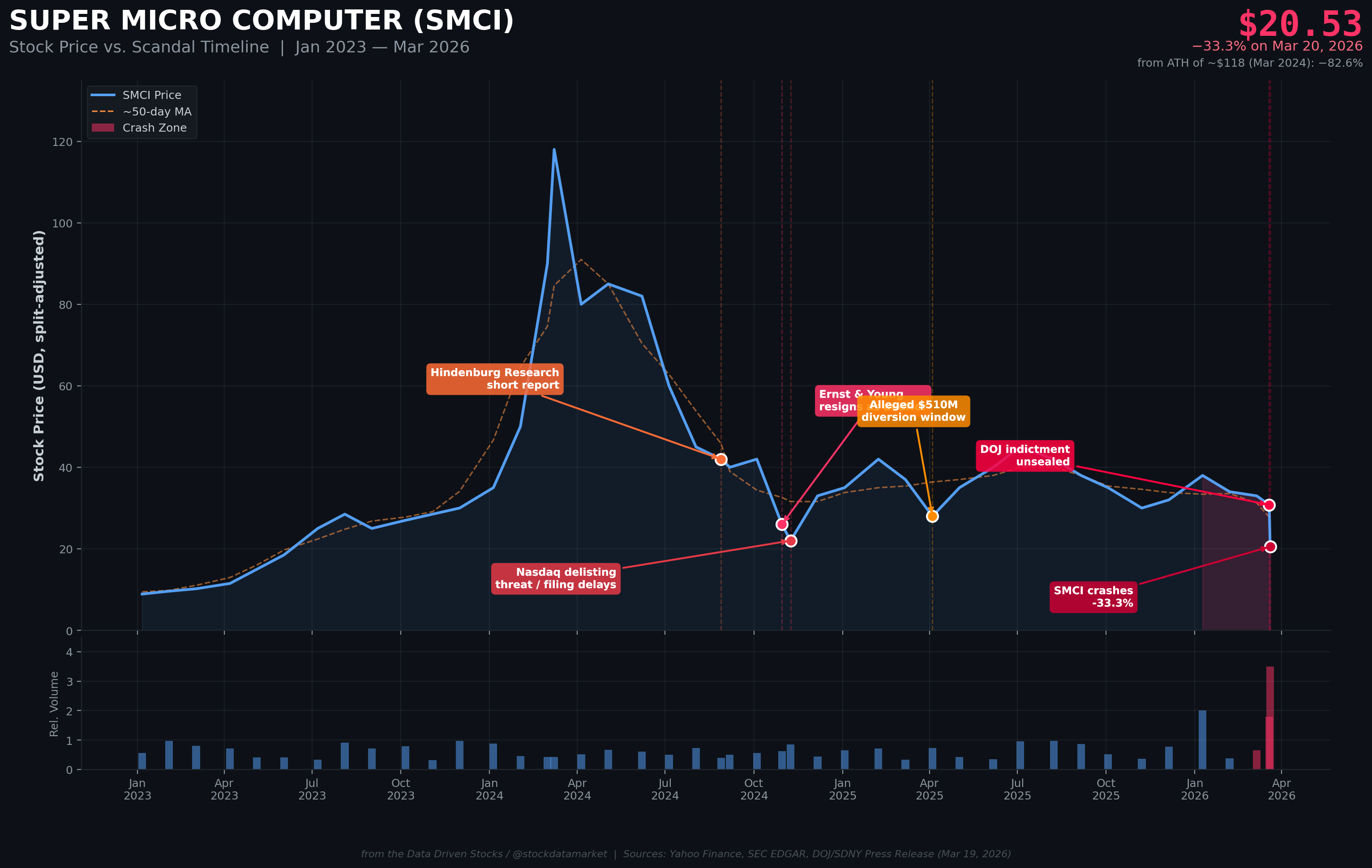
On March 19, 2026, the U.S. Attorney’s Office for the Southern District of New York dropped a bombshell. Three individuals connected to Super Micro Computer, Inc. (Nasdaq: SMCI) were charged with conspiring to illegally divert U.S.-assembled AI servers — packed with export-controlled GPUs — to end customers in China, without the required Commerce Department licenses. One of the three was a co-founder and board member of the company. The stock cratered 33% the next day.
This isn’t a story about a clerical error or a misunderstood regulation. According to the DOJ’s press release summarizing the indictment, prosecutors allege an elaborate, multi-layered conspiracy involving false documents, unmarked shipping boxes, encrypted messaging apps, and — most bizarrely — the staging of thousands of dummy servers to fool both company compliance teams and U.S. government inspectors. We’re talking about non-working physical replicas placed in a warehouse, complete with serial number stickers peeled off real boxes using a hair dryer and reattached to the fakes. Surveillance cameras caught it all.
Let’s unpack this entire case from the ground up.
Metric Value Total Alleged Purchases $2.5 billion Diverted in ~3 Weeks (Apr–May 2025) $510 million Stock Crash (Mar 20, 2026) −33.3% Max ECRA Penalty 20 years
The Accused: Who Are They?
The indictment names three defendants. Yih-Shyan “Wally” Liaw is described as a co-founder of Super Micro Computer, a member of its board of directors, and a Senior Vice President of business development. He’s a U.S. citizen who was arrested on March 19, 2026 and presented before a court in the Northern District of California. He reportedly resigned from SMCI’s board effective immediately on March 20. Ruei-Tsang “Steven” Chang, a Taiwan citizen, served as general manager of the company’s Taiwan office. As of today, Chang remains a fugitive. The third defendant, Ting-Wei “Willy” Sun, also a Taiwan citizen, was described as a third-party broker or “fixer” who helped arrange the deals. Sun was arrested alongside Liaw on March 19.
Super Micro itself was not named as a defendant in the indictment, though the DOJ’s press release describes the U.S. manufacturer involved only as a “publicly traded U.S. server maker.” Multiple news outlets — including Reuters, the Wall Street Journal, CNBC, and MarketWatch — identified the company as SMCI based on the details in the indictment. The company responded quickly, placing Liaw and another unnamed employee on leave and terminating a contractor associated with the alleged conduct. MarketWatch also reported that SMCI named DeAnna Luna as its acting chief compliance officer.
The Scheme: How $2.5 Billion in AI Servers Allegedly Ended Up in China
The alleged smuggling pipeline is surprisingly straightforward in concept, if remarkably elaborate in execution. According to the SDNY press release, here’s how it worked.

A Southeast Asia–based intermediary — referred to in the indictment as “Company-1” — would place purchase orders with the U.S. manufacturer for GPU-integrated servers. On paper, Company-1 appeared to be the legitimate end user. The servers were often assembled in the United States, shipped to Super Micro’s facilities in Taiwan, and then delivered to Company-1’s location in Southeast Asia. But Company-1 was allegedly just a waystation. From there, a shipping and logistics firm would repackage the servers into unmarked boxes — specifically to conceal their contents — and ship them onward to their actual destination: China.
The scale is staggering. Prosecutors allege that between 2024 and 2025, Company-1 purchased approximately $2.5 billion worth of servers from the U.S. manufacturer. In a single concentrated burst — between late April and mid-May 2025 — approximately $510 million worth of U.S.-assembled servers were diverted to China. That’s roughly half a billion dollars in controlled technology moved illegally in about three weeks.
“Between late April 2025 and mid-May 2025, approximately $510 million worth of U.S.-assembled servers were diverted to China.” — DOJ/SDNY Press Release
The Deception Playbook: Four Layers of Concealment
What makes this case extraordinary — and what will likely make it a landmark in export control enforcement history — is the sheer depth of the alleged deception. According to the DOJ, the defendants and their co-conspirators didn’t just mislabel some shipping documents. They built a layered system of concealment that escalated in complexity every time they faced scrutiny.

The first layer was pure documentary fraud. False documents and records were prepared to portray Company-1 as the end user of the servers. False communications were created and sent so that server allocations would be approved internally by the manufacturer’s compliance team. This is classic export control evasion — fake end-user certificates are the bread and butter of smuggling prosecutions.
The second layer was physical concealment. Once servers reached Company-1, a logistics firm would strip them from their original packaging and repackage them into unmarked boxes to hide their origin and contents before shipping to China. The multi-hop route itself — U.S. to Taiwan to Southeast Asia to China — served as geographic obfuscation.
The third layer is where it gets truly wild. When Super Micro’s own internal compliance team conducted an audit in August 2025, visiting a warehouse rented by Company-1, the defendants allegedly staged thousands of dummy servers — non-working, physical replicas — to make it look like the servers were still in storage and hadn’t been shipped onward. The DOJ describes surveillance camera footage showing Sun and an unnamed “Broker-1” preparing the dummy servers before a later Commerce Department inspection, including unboxing dummy servers, using a hair dryer to remove and reaffix labels and serial number stickers to server boxes, and repackaging the dummy servers into the manufacturer’s original boxes.
The fourth layer was digital concealment. Defendants and co-conspirators allegedly coordinated using encrypted messaging applications, discussing quantities, China-bound destinations, and methods to hide their activity from compliance personnel and government authorities.
⚠️ The Irony of Over-Engineering a Cover-Up
Here’s the enforcement paradox that makes this case so analytically interesting: every new layer of deception required more coordination, more physical infrastructure, more people, more digital communications, and more paper trails. The dummy servers needed warehouse leases, procurement orders, logistics help, and CCTV-monitored spaces. The encrypted chats left metadata. The repackaging left shipping records. Each “solution” to detection created fresh evidence. From a prosecution standpoint, a multi-layered conspiracy is harder to sustain but easier to prove once cracked.
Revenue Rocket, Margin Collapse: SMCI by the Numbers
To understand why this case matters so much for investors, you have to look at what SMCI had become by 2024 and 2025. This was a company riding the AI infrastructure wave harder than almost anyone. Revenue went from around $3.3 billion in fiscal year 2020 to a projected $40 billion in fiscal year 2026. That’s a twelve-fold increase in six years, driven almost entirely by surging demand for data center servers packed with Nvidia GPUs for AI workloads.

But the growth came at a cost — a literal one. Gross margins collapsed from roughly 17% in early fiscal 2024 to just 6.4% by the December 2025 quarter (Q2 FY26). The company was essentially buying market share at the expense of profitability, and the margin deterioration was stark enough to worry analysts even before the criminal charges dropped. For context, server peers like Dell Technologies typically run gross margins in the 20–22% range.

There’s an interesting question embedded in the data: how much of SMCI’s extraordinary revenue growth during 2024–2025 was driven by legitimate demand, and how much was inflated by purchases from “Company-1” that were really intended for China? If Company-1 accounted for $2.5 billion in purchases, that would represent roughly 11% of SMCI’s total fiscal year 2025 revenue of $22 billion. That’s a material amount. Investors and analysts will be poring over customer concentration disclosures in SMCI’s SEC filings to try to untangle this question in the weeks ahead. Notably, one analyst report already flagged that 63% of SMCI’s recent revenue came from a single customer — and if that customer’s exposure is linked to export-restricted markets, the revenue risk compounds.
The Broader Context: SMCI Was Already in Trouble
The March 2026 indictment didn’t land on a clean corporate record. SMCI had already been through a governance gauntlet that tested investor patience to its limit.
In August 2024, short seller Hindenburg Research published a report alleging accounting manipulation at SMCI. That report kicked off a chain of events that included delayed SEC filings, a DOJ investigation into separate accounting claims made by a former employee, and — most dramatically — the resignation of Ernst & Young as SMCI’s auditor on October 24, 2024. EY’s resignation letter was remarkable for its severity: the firm stated it was “unwilling to be associated with the financial statements prepared by management” and could “no longer rely on management’s and the Audit Committee’s representations.” EY had raised governance and internal control concerns to the audit committee months earlier, in July 2024.
The EY resignation sent SMCI’s stock plunging over 30% in a single day. The company subsequently faced a Nasdaq delisting threat due to delayed financial filings, struggled to find a replacement auditor (eventually retaining BDO), and was hit with a wave of shareholder class action lawsuits covering the 2024 disclosure period.
So when the export smuggling indictment landed in March 2026, it wasn’t the first crisis — it was the latest in a pattern that raises fundamental questions about the company’s internal controls, governance culture, and the degree to which leadership was willing to push boundaries for growth.
What This Costs: Financial Impact and Timeline to Recovery
The immediate financial impact was brutal. SMCI’s stock dropped from $30.79 to $20.53 on March 20 — a 33.3% single-day decline that wiped roughly $6 billion off the company’s market capitalization. From its all-time high of approximately $118 per share in March 2024, the stock has now lost about 82.6% of its value. As of March 21, 2026, the market cap sits around $12 billion, down from over $70 billion at the peak.

But the single-day crash is just the beginning of the cost ledger. Government fines and penalties under the Export Controls Reform Act (ECRA), which carries a maximum prison sentence of 20 years per count plus significant monetary penalties, could add hundreds of millions to billions. Legal defense costs and a forced compliance overhaul — including the appointment of a new chief compliance officer and likely a monitorship — will run into the hundreds of millions over several years. The loss of China-facing revenue is potentially enormous: if $2.5 billion in Company-1 purchases was really China-bound, that entire revenue stream is now at risk. And reputational damage with partners like Nvidia — whose export-controlled chips were allegedly being diverted — could have cascading effects on SMCI’s ability to secure GPU allocations going forward.
On the resolution timeline, the criminal case alone could take 12 to 36 months to reach trial or plea agreements. SEC investigations typically run 6 to 24 months. A full export compliance rebuild, including new screening processes, enhanced end-user verification, and auditing protocols, will take 6 to 12 months to design and implement. Customer trust and stock price recovery, if fundamentals hold, could take 18 to 48 months or longer.
The Charges, Briefly
Each of the three defendants faces three conspiracy charges: conspiracy to violate the Export Controls Reform Act (maximum 20 years imprisonment), conspiracy to smuggle goods from the United States (maximum 5 years), and conspiracy to defraud the United States (maximum 5 years). The case is assigned to U.S. District Judge Edgardo Ramos in Manhattan federal court. No pleas, trial dates, or sentencing outcomes have been announced as of March 21, 2026.
What Happens Next?
Several high-stakes dominoes are now in motion. First, the criminal case in SDNY will drive the near-term narrative: will Liaw or Sun cooperate? Will Chang be apprehended? Will the government pursue superseding indictments naming additional participants or, potentially, the company itself? The current indictment notably does not charge SMCI as an entity, but that doesn’t preclude future corporate charges or a deferred prosecution agreement.
Second, watch for BIS administrative enforcement actions. The Bureau of Industry and Security has its own enforcement tools — including denial orders that could bar SMCI from participating in export transactions entirely — and these often follow or run parallel to criminal proceedings. For a company whose entire business model depends on procuring and integrating controlled semiconductor technology, a BIS denial order would be existential.
Third, the SEC disclosure angle. SMCI’s last 10-Q was filed on February 6, 2026, and its last 8-K on February 3, 2026 — both before the indictment. The company will need to file current reports disclosing the material legal proceedings, board changes (Liaw’s resignation), and compliance actions. Investors should watch the next 8-K filing closely for any language about potential restatements, internal investigation findings, or changes to revenue guidance.
Fourth, Nvidia’s response. SMCI is one of the largest integrators of Nvidia’s AI GPUs. If Nvidia determines that its chips were being systematically diverted to China through SMCI’s supply chain, it could restrict allocations, tighten contractual controls, or pursue its own legal remedies. This hasn’t been publicly discussed yet, but it’s arguably the most important business risk factor on the table.
The Bottom Line
Super Micro Computer’s story has become a case study in how the AI boom’s enormous economic incentives can collide with national security export controls. A company that rode the AI wave from $3 billion to $40 billion in revenue now faces criminal charges alleging that part of that growth was built on illegally smuggling the very technology that made it valuable.
The alleged scheme was sophisticated — involving four distinct layers of deception across multiple countries, using both physical and digital concealment techniques. But sophistication cuts both ways. Every layer created more evidence, more witnesses, more records. The hair dryer that moved serial number stickers was captured on camera. The encrypted chat messages discussed China destinations by name. The dummy servers needed warehouse space, procurement budgets, and logistics coordination — all of which leave traces.
For investors, the question now is whether SMCI’s underlying AI server business is strong enough to survive the legal, regulatory, and reputational storm ahead. The company still has real technology, real demand (Nvidia’s GTC conference just happened), and real revenue. But it also has a co-founder under arrest, a fugitive former executive, a 2024 auditor resignation on its record, a stock down 83% from highs, and a DOJ indictment alleging one of the most elaborate export control evasion schemes in recent memory.
This is a stock that went from AI darling to cautionary tale in two years. The data tells the story. The courts will tell the rest.
Sources & Citations
[1] U.S. Attorney’s Office, Southern District of New York (SDNY), “Three Charged with Conspiring to Unlawfully Divert U.S. Artificial Intelligence Technology to China,” Press Release, March 19, 2026. https://www.justice.gov/usao-sdny/pr/three-charged-conspiring-unlawfully-divert-us-artificial-intelligence-technology-china
[2] SEC EDGAR, Super Micro Computer Inc. (CIK 0001375365), various filings including 10-Q (Feb 6, 2026), 8-K (Feb 3, 2026), and historical quarterly earnings releases (FY2024–FY2026). https://www.sec.gov/cgi-bin/browse-edgar?action=getcompany&CIK=0001375365
[3] SEC EDGAR, Super Micro 8-K filing (Oct 24, 2024) disclosing Ernst & Young resignation as auditor. https://www.sec.gov/Archives/edgar/data/0001375365/000137536524000036/smci-20241024.htm
[4] Supermicro, “Supermicro Announces Fourth Quarter and Full Fiscal Year 2025 Financial Results,” Aug 5, 2025, via SEC EDGAR and IR page. https://ir.supermicro.com/news/news-details/2025/Supermicro-Announces-Fourth-Quarter-and-Full-Fiscal-Year-2025-Financial-Results/
[5] Supermicro, “Supermicro Announces First Quarter Fiscal Year 2026 Financial Results,” Nov 4, 2025, via SEC EDGAR. https://www.sec.gov/Archives/edgar/data/0001375365/000137536525000029/exhibit991_20250930.htm
[6] Supermicro, “Supermicro Announces Second Quarter Fiscal Year 2026 Financial Results,” via SEC EDGAR. https://www.sec.gov/Archives/edgar/data/0001375365/000137536526000006/exhibit991_20251231.htm
[7] Reuters, reporting on Liaw’s board resignation, March 20, 2026 (via Investing.com).
[8] CNBC, “Super Micro shares plunge 33% as auditor resigns after raising concerns months earlier,” Oct 30, 2024. https://www.cnbc.com/2024/10/30/super-micro-auditor-resigns-after-raising-concerns-months-earlier.html
[9] Yahoo Finance, SMCI historical stock price data. Accessed Mar 21, 2026. https://finance.yahoo.com/quote/SMCI/history/
[10] Investing.com, SMCI stock data and news aggregation. Accessed Mar 21, 2026. https://www.investing.com/equities/super-micro-compu
[11] TipRanks, SMCI Earnings Dates and Q2 FY26 guidance summary. Accessed Mar 21, 2026. https://www.tipranks.com/stocks/smci/earnings
[12] Public.com, SMCI Stock Forecast: 13 analysts consensus Hold rating, $42.38 price target (as of Mar 20, 2026). https://public.com/stocks/smci/forecast-price-target
Note: All financial figures sourced from SEC EDGAR filings and official Supermicro earnings releases. Stock prices from Yahoo Finance. Legal case details from the DOJ/SDNY press release. Estimated financial impacts and timelines are based on analyst commentary, historical precedents in export control enforcement, and author estimates — not investment advice.