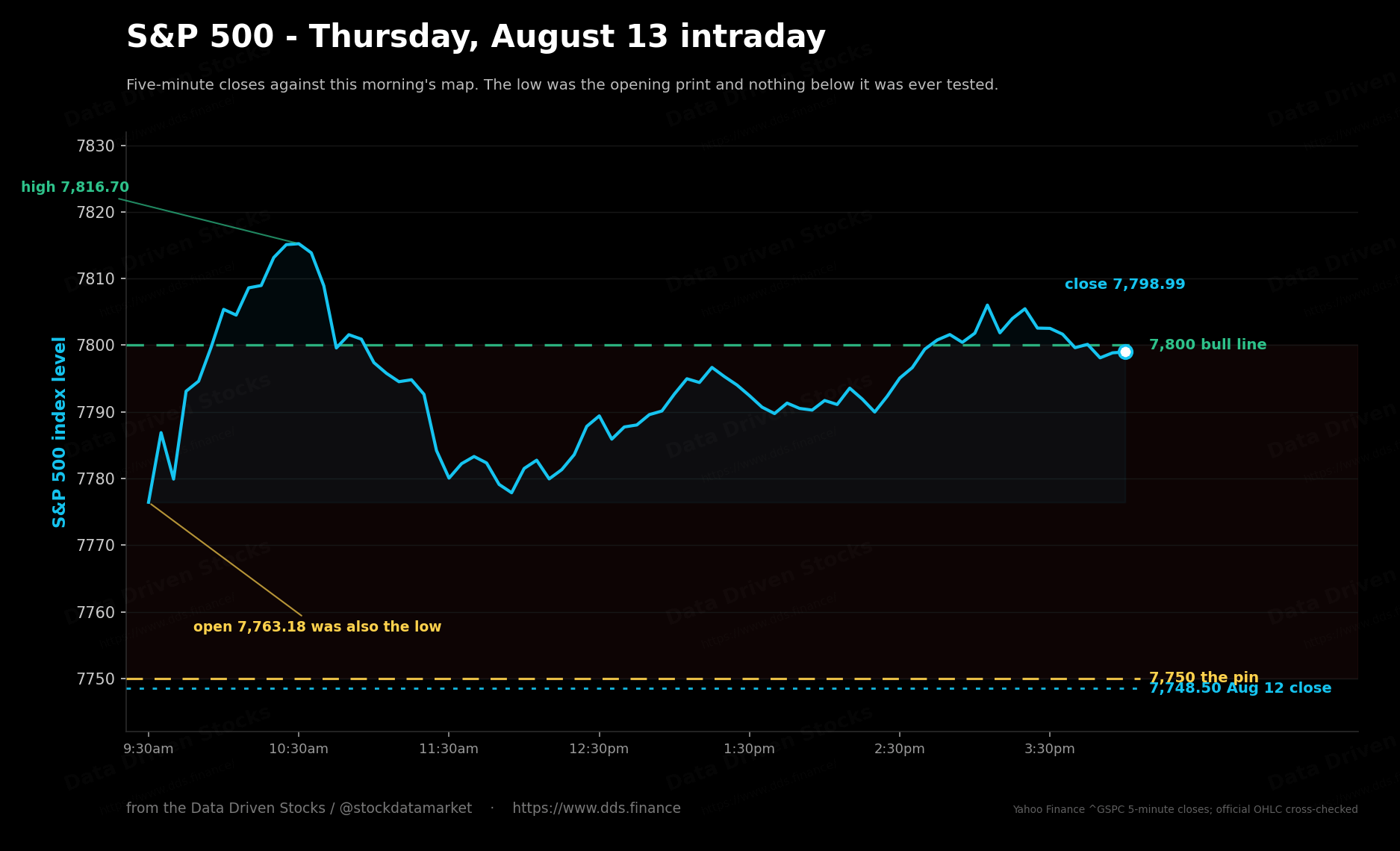
That was right about the mechanism and wrong about the direction. Fifty points of no dealer resistance works exactly as well going up. Though still not a lot since the last high of 7790.
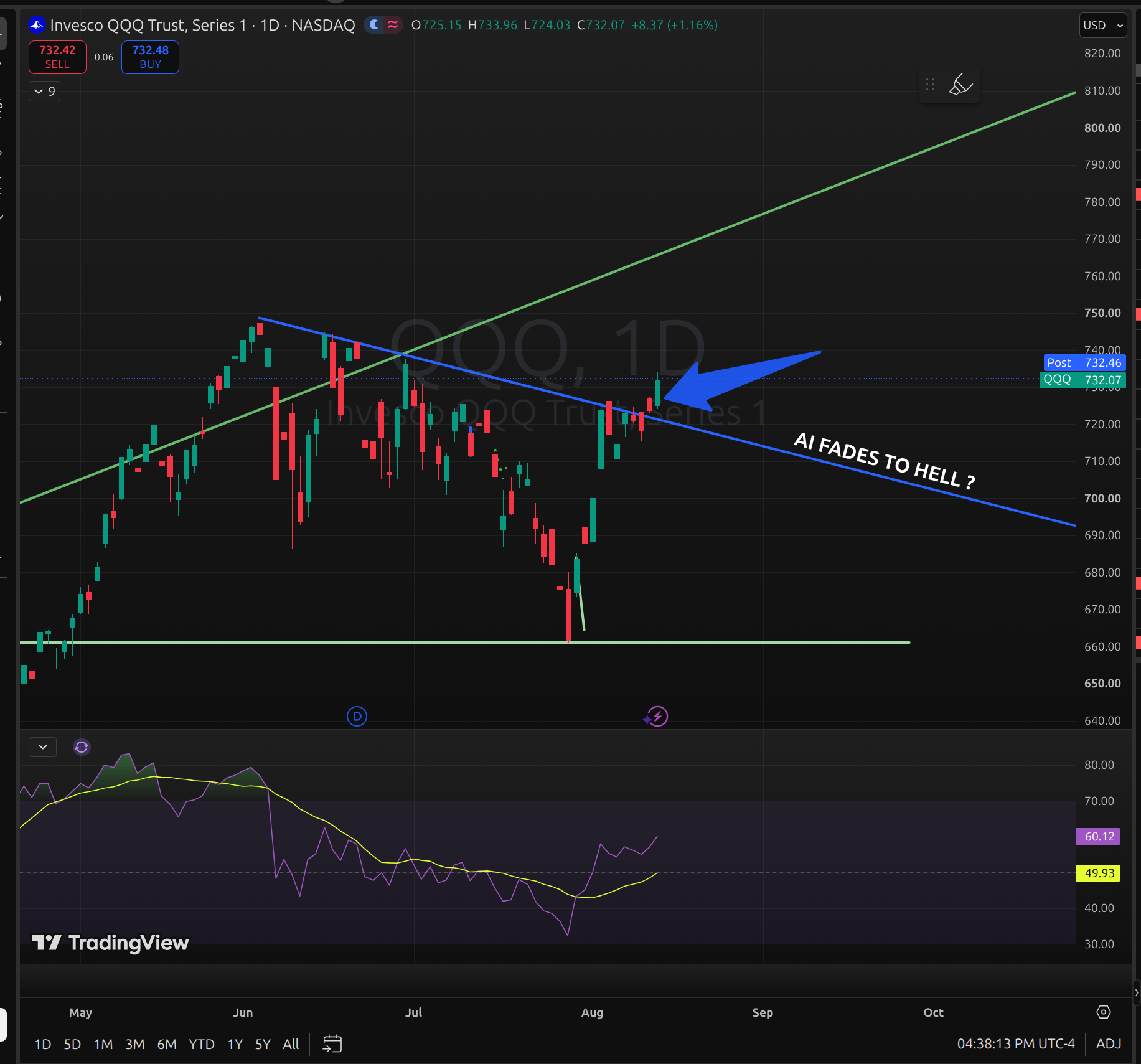
The Nasdaq is the one carrying this
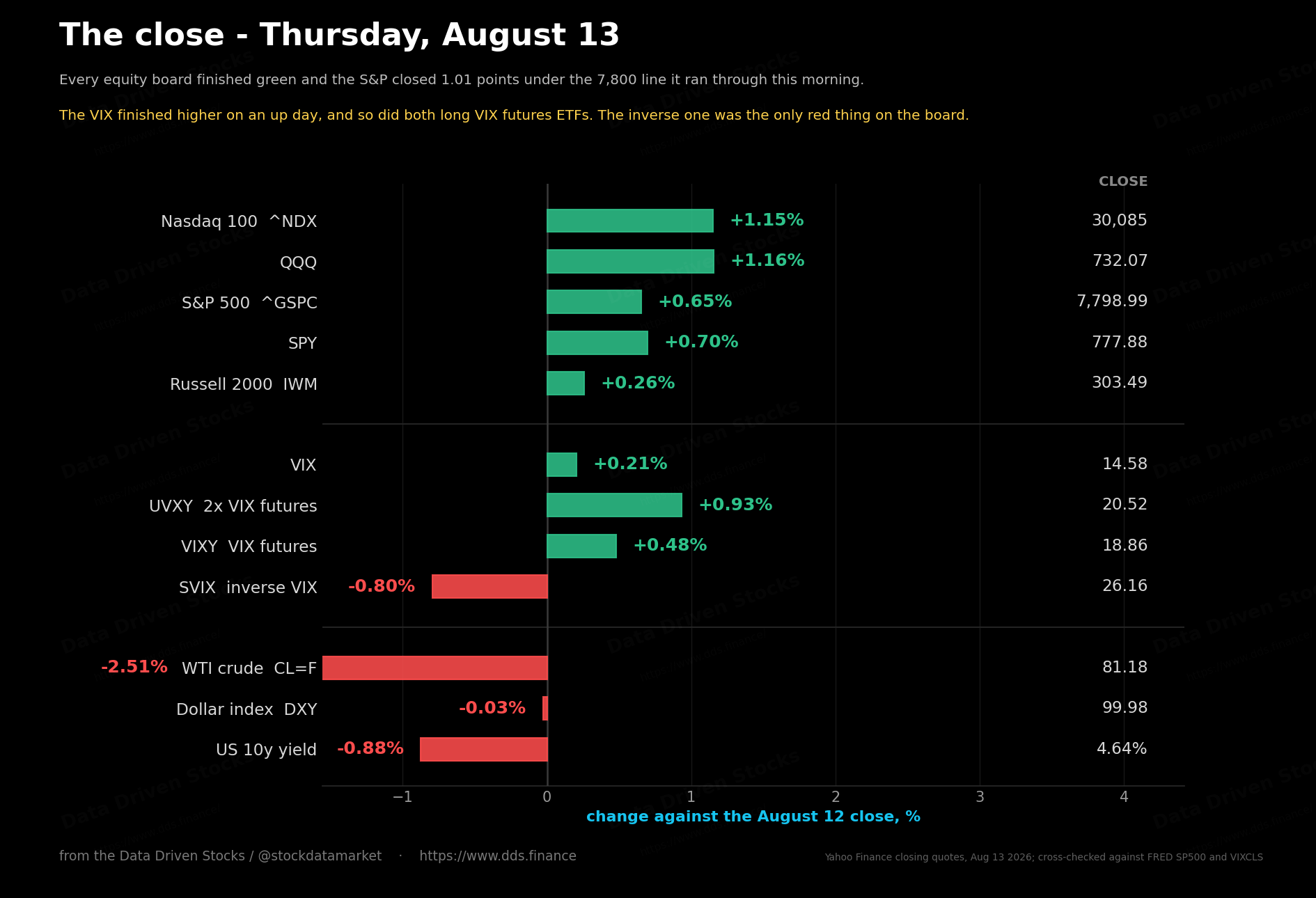
QQQ finished at 732.07, up 1.16%, and the Nasdaq 100 at 30,084.50, up 1.15%. That is the second close above the line that has turned the AI complex away since June, and unlike yesterday it did not get sold into. Yesterday QQQ closed 3.27 below its open on the day it broke out. Today it closed 6.92 above its open.
If it doesn’t go down tomorrow - QQQ comes back to the AI bull market. But I’d be careful with so low VIX.
t
Volatility went the wrong way again
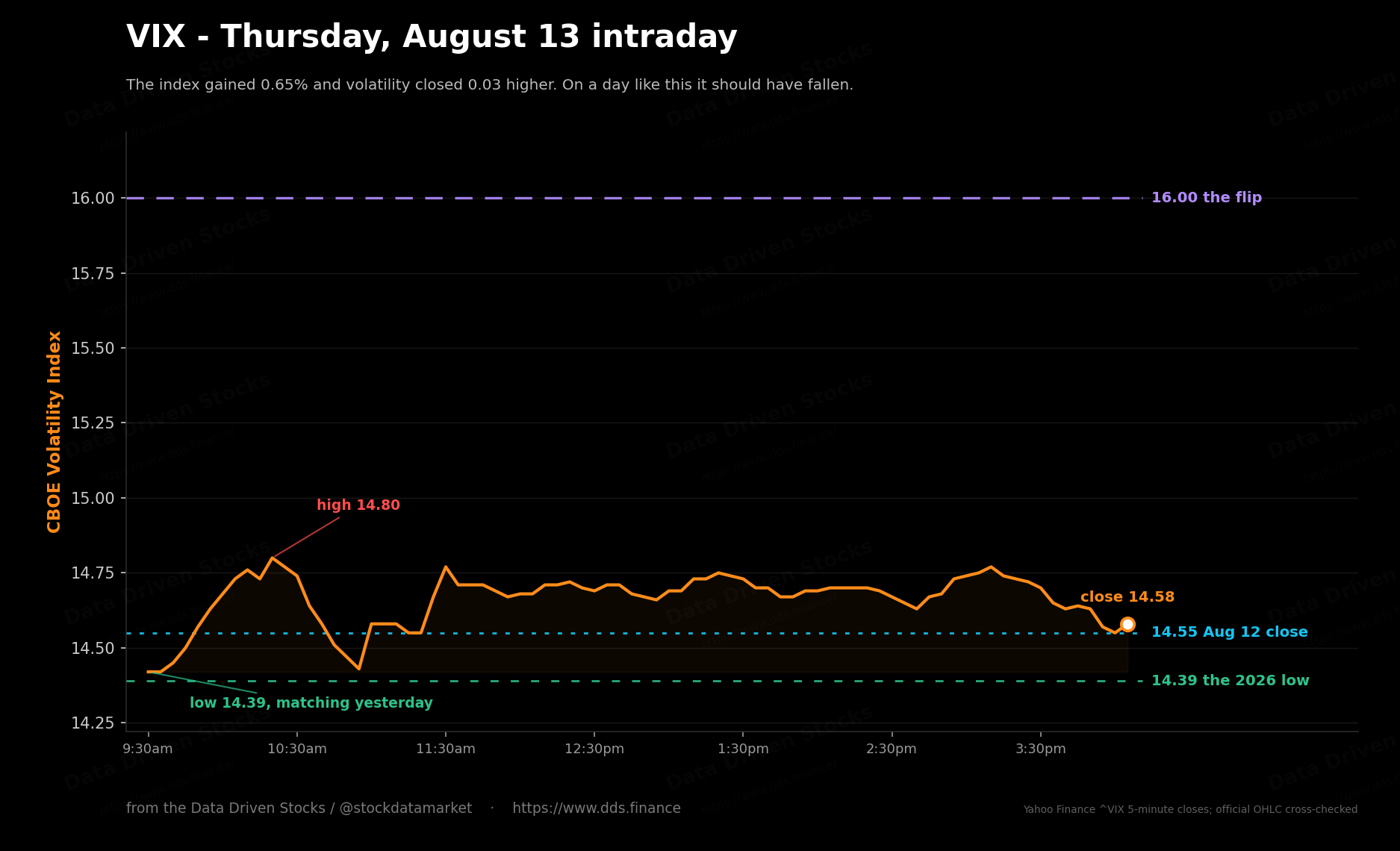
The VIX closed at 14.58, up 0.03. It printed 14.39 in the first minutes, matching yesterday’s 2026 low, made its high of 14.80 an hour into the session, and spent the rest of the day drifting sideways while the index climbed.
An index up 0.65% should take volatility down. This one took it up 0.21%.
The futures said the same thing louder. UVXY finished up 0.93%, VIXY up 0.48%, and SVIX, the inverse short-volatility vehicle, was the only red line on the whole board at minus 0.80%. Compare that with Monday, when spot volatility gained 3.6% and both long VIX futures ETFs fell, and I said the curve was pricing it as noise. Today spot barely moved and the curve bid it. That is the opposite signal from the same instruments four sessions apart.
The book finished at the record
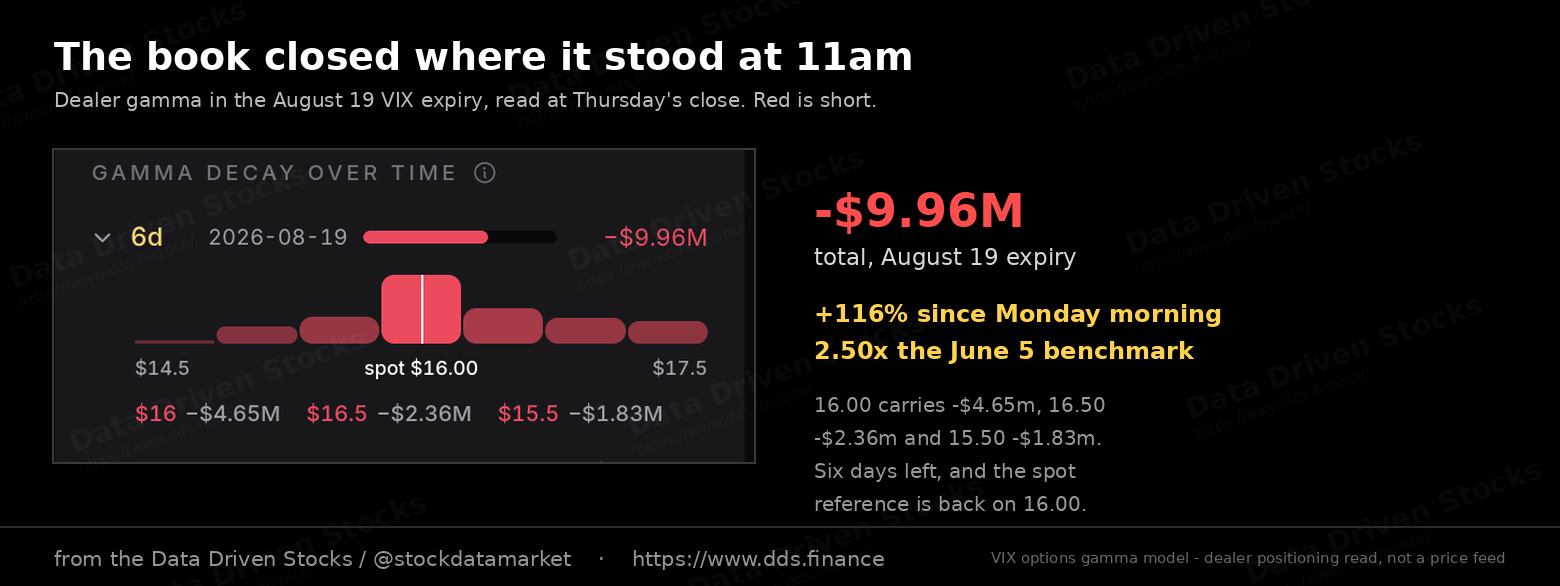
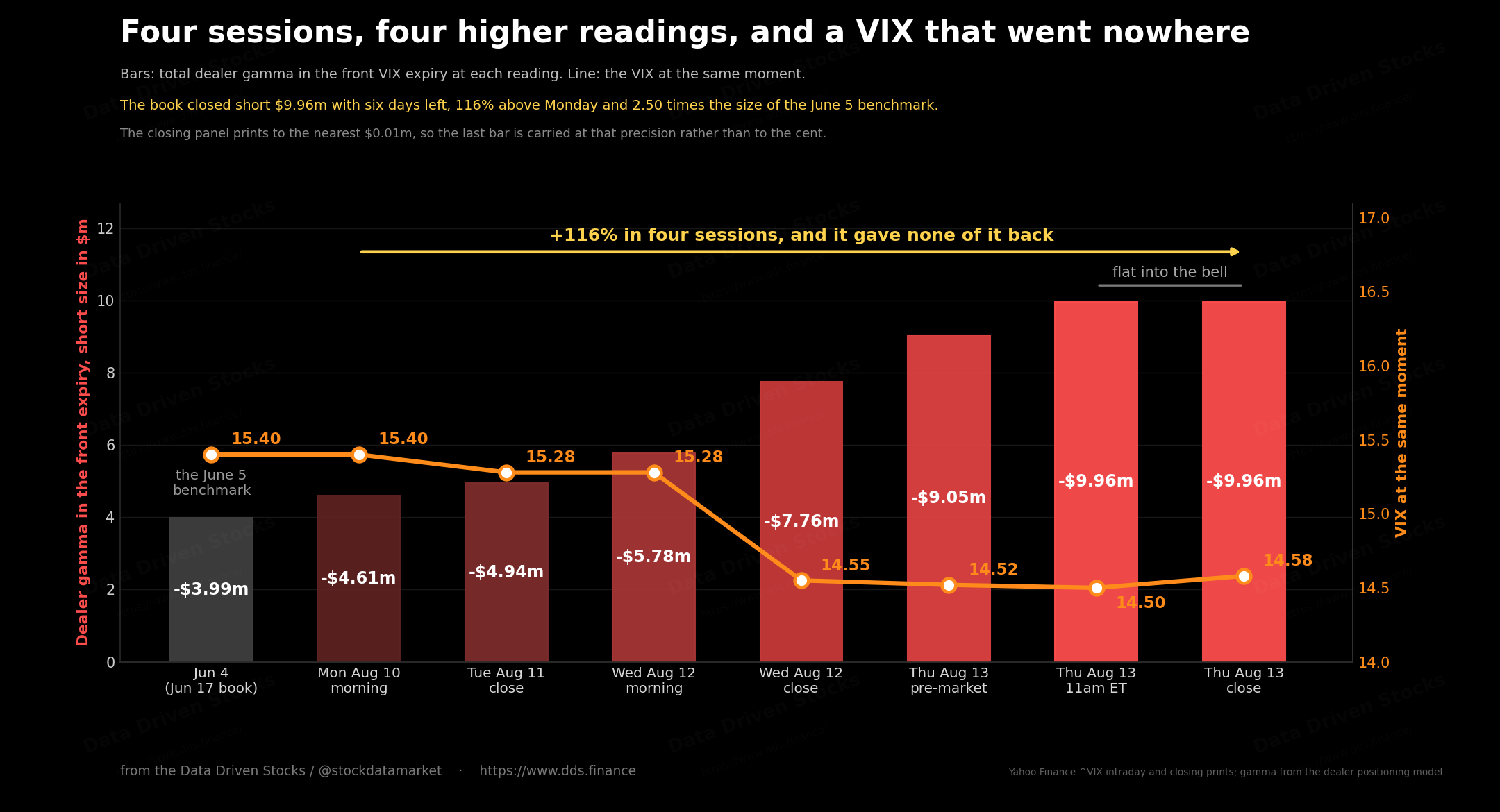
The August 19 dealer book closed short $9.96m, which is where it stood at 11am. It has six days left on it.
Monday morning it was $4.61m. That is 116% growth in four sessions. Against June 4, the day before the last real drop, it is 2.50 times the size with half the time left to bleed off harmlessly. The strikes sit where they sat this morning and carry more: 16.00 at $4.65m, 16.50 at $2.36m, 15.50 at $1.83m.
Three sessions now where the index went up or sideways and the short book went up with it. That is the whole week in one sentence.
Where it goes if it goes
Every note this week has ended on 16 being the flip. The question that follows is flip to what, and the board answers it.
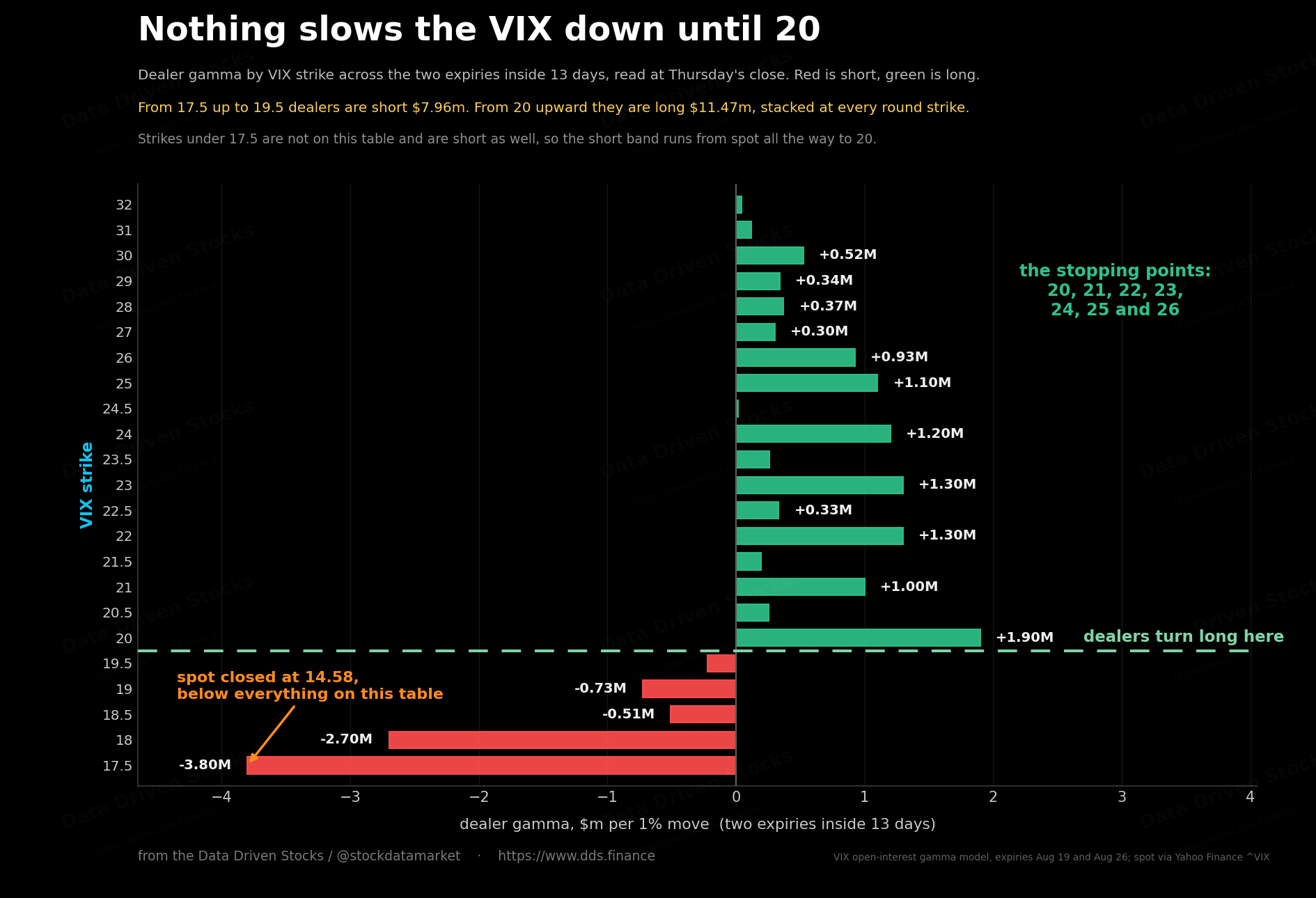
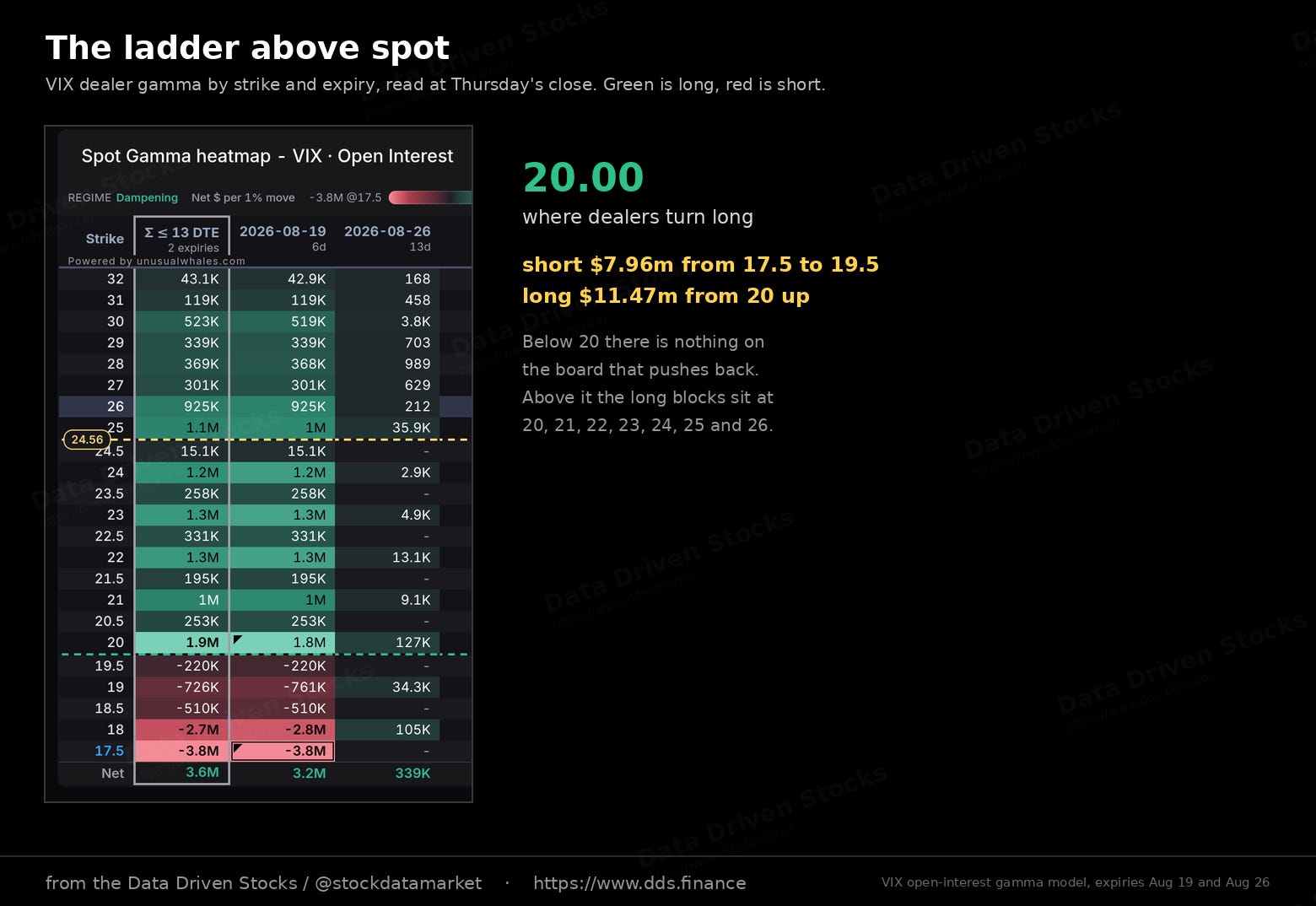
Take the two VIX expiries inside thirteen days and lay the dealer gamma out by strike. From 17.5 up to 19.5 dealers are short $7.96m, and everything below 17.5 is short too. From 20 upward they are long $11.47m, and it is stacked at every round number: $1.90m at 20, $1.00m at 21, $1.30m at 22, $1.30m at 23, $1.20m at 24, $1.10m at 25, $0.93m at 26.
Read that as a map rather than a forecast. Below 20 there is nothing on the board that pushes back against a rising VIX, so the whole span from spot to 20 is open ground. At 20 the sign changes and dealers start absorbing rather than amplifying. So if 16 goes, 20 is not a target somebody picked, it is the first place the hedging stops working in the same direction as the move. Above it, 21, 22, 23, 24 and 25 are where it would keep stalling.
Three days of puts
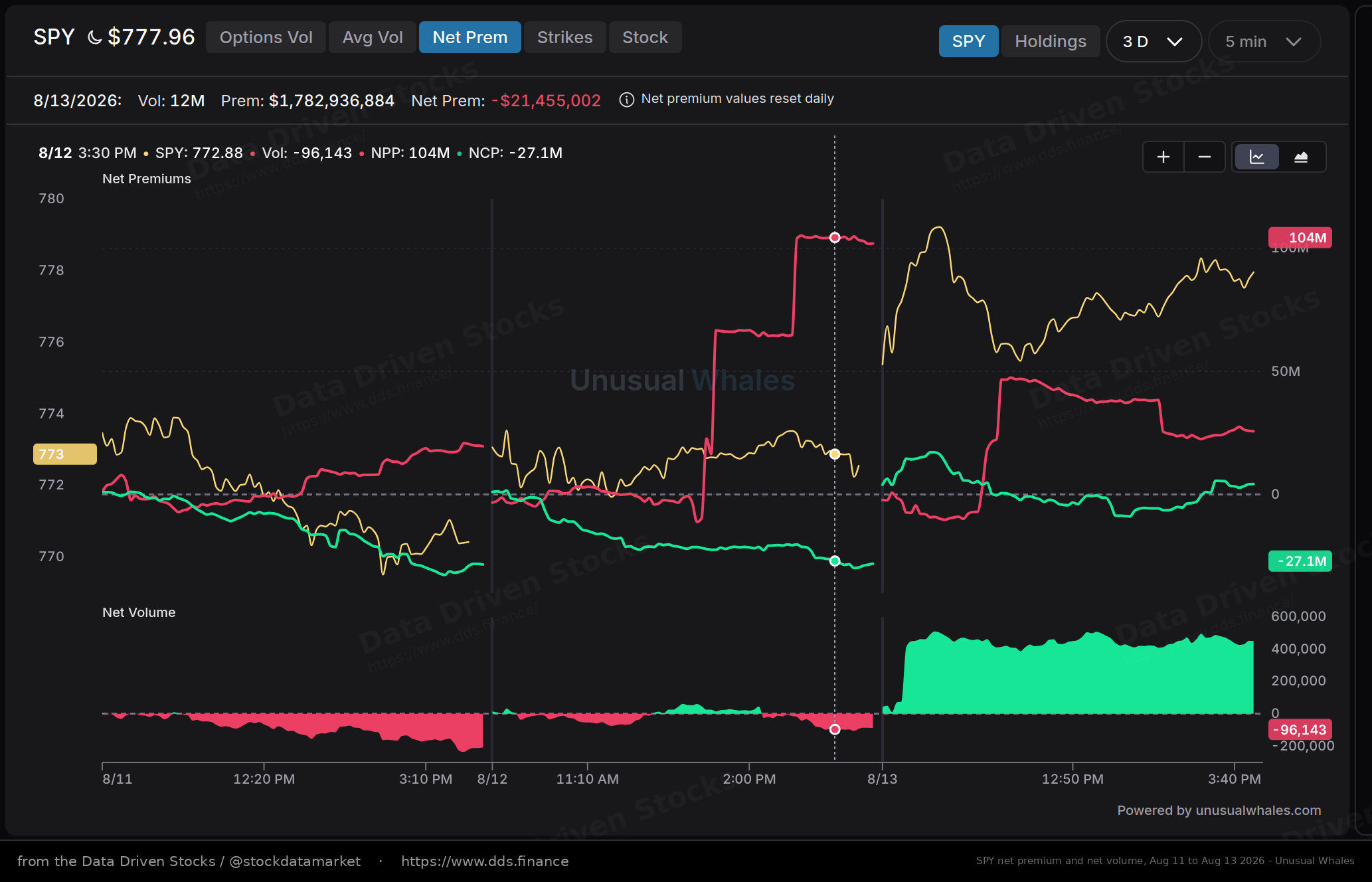
SPY closed at 777.88, up 0.70%, and the flow underneath finished positive on net put premium for the third session running.
Today ran 12 million contracts and $1,782,936,884 of premium, with net premium for the session at minus $21,455,002. Yesterday at half past three the reading was net put premium of $104m against net call premium of minus $27.1m. Today’s put premium peaked well under that and faded into the afternoon, and net volume ran strongly positive all day rather than negative, so the composition changed even though the direction did not.
The pattern that matters is the run. Three sessions of paying up for downside into a tape that keeps closing green.