
OpenAI’s $852 Billion Paradox: The Most Valuable Startup In History Burns $17 Billion A Year - And Just Raised $122 Billion More
OpenAI’s financial health as of May 1, 2026 - the revenue, the burn, the CAPEX, the changing projections, and whether the flywheel can actually pay for itself before the decade ends.

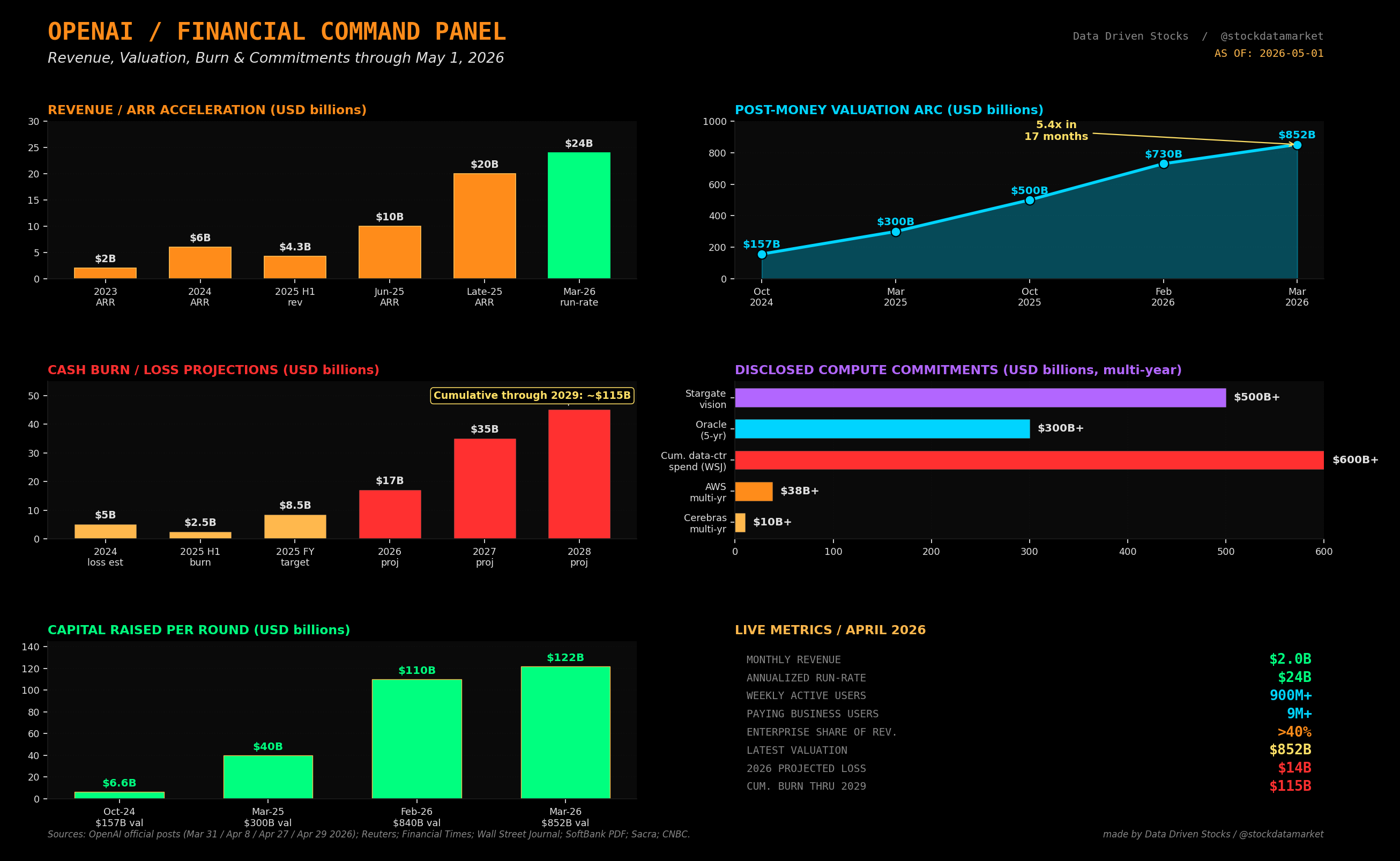
There is a number you have probably already heard. On March 31, 2026, OpenAI closed a $122 billion funding round at an $852 billion post-money valuation. That makes it the most valuable startup in history by a margin so wide it is no longer a meaningful comparison. The cap table now sits in the same neighborhood as Berkshire Hathaway. Above Visa. Above JPMorgan Chase. Above Samsung.
There is another number you have probably also heard, but separately. The Wall Street Journal, citing internal documents, reported on April 6 that OpenAI’s own projections show $121 billion of compute spending in 2028 alone, an $85 billion loss that same year, and break-even slipping past 2030.
Hold both numbers in your head at the same time. That is OpenAI as of May 1, 2026.
This is not a startup story anymore. It is an infrastructure story dressed up as a software company, financed by a casino of mega-rounds, running on the assumption that revenue will keep tripling for several more years. None of which is impossible. All of which is unprecedented.
Below is what the data actually says.
A short history of OpenAI’s money problem
OpenAI was founded as a non-profit research lab in 2015. The for-profit subsidiary came in 2019, the Microsoft money came along with it, and ChatGPT shipped at the end of 2022. From there the financial timeline reads less like a corporate history and more like a stack trace.
In September 2024, Reuters reported on internal documents showing OpenAI expected $3.7 billion of revenue for the year and losses of up to $5 billion. That implied an operating loss of roughly 135% of revenue. Three weeks later, in October 2024, OpenAI raised $6.6 billion at a $157 billion post-money valuation and added an undrawn $4 billion revolving credit facility.
In January 2025 came Stargate, an OpenAI / SoftBank / Oracle vehicle initially framed as a $500 billion long-term U.S. AI infrastructure ambition. In March 2025, Reuters reported that OpenAI did not expect to be cash-flow positive until 2029. That same month, OpenAI announced a $40 billion round at a $300 billion post-money valuation - more than double the prior valuation in five months.
By June 2025 the annualized revenue run rate had reached $10 billion. By September, internal-document reporting confirmed H1 2025 revenue of $4.3 billion alongside $2.5 billion of cash burn and a Financial Times-reported operating loss of $7.8 billion in that same half-year. A 2025 burn target of $8.5 billion was set, and Reuters later reported that projected cumulative burn through 2029 had been raised to $115 billion, including more than $17 billion in 2026 alone.
In October 2025 a secondary sale put the company at roughly $500 billion. In February 2026 OpenAI announced a $110 billion raise at a $730 billion pre-money valuation. By March 31, 2026, that round had grown into a $122 billion close at $852 billion post-money. Then on April 28, the Wall Street Journal reported that OpenAI had quietly missed several internal revenue and user goals, including its target of one billion weekly active users by year-end 2025. AI-linked stocks - Oracle, CoreWeave, Broadcom, AMD, Nvidia - all sold off on the news.
That is the seventeen-month arc, in one paragraph: from a $157 billion private valuation to an $852 billion private valuation, with revenue running 6x higher, losses running roughly the same magnitude, and the projected cost of getting to break-even getting bigger every time someone publishes new numbers.

The revenue story everyone is excited about
Let us start with what is genuinely working. On the March 31, 2026 funding announcement, OpenAI confirmed it was generating $2 billion in revenue per month. That is roughly a $24 billion annualized run rate. Sacra estimates put the actual annualized revenue at $25 billion in February 2026, which lines up. CFO Sarah Friar previously confirmed that 2025 ARR exceeded $20 billion, against $6 billion in 2024 and $2 billion in 2023. That is 3x year-over-year growth, sustained, at a scale where 3x means adding billions of dollars of revenue every quarter.
Here is the part that should genuinely surprise you. OpenAI says it is now growing revenue four times faster than the companies that defined the internet and mobile eras, including Alphabet and Meta. ChatGPT now has more than 900 million weekly active users. There are more than 50 million consumer subscribers, more than nine million paying business users, and more than one million business customers. Codex, the coding agent, hit two million weekly users and is growing more than 70% month over month. The APIs process more than 15 billion tokens per minute. The advertising pilot reached more than $100 million in annualized recurring revenue in less than six weeks.
And the mix is shifting in the right direction. Enterprise was around 30% of revenue in 2024, more than 40% by Q1 2026, and OpenAI’s own CRO Denise Dresser told the public on April 8 that enterprise is on track to reach parity with consumer by the end of 2026. That matters because enterprise revenue is stickier, churns less, and is the kind of revenue Wall Street learns to value at high multiples. Consumer subscription revenue can spike and disappoint quarter to quarter. Enterprise contracts compound.
So in the bull narrative, OpenAI is the fastest-monetizing technology platform ever built, with the biggest user base in software history, and the kind of mix shift that institutional investors love. That is a real story. That is the story OpenAI tells.
The burn story OpenAI does not lead with
Now let us look at the other side of the income statement. Or rather, the side OpenAI does not publish, because OpenAI is still private and does not file public-company-style audited financials. Everything here comes from shareholder disclosures filtered through Reuters, the Financial Times, the Wall Street Journal, and a handful of partner filings.
The 2024 loss profile, according to Reuters reporting on internal documents, was up to $5 billion on $3.7 billion of revenue. That is a -135% loss margin. In the first half of 2025, Reuters reported $4.3 billion of revenue, $2.5 billion of cash burn, and the Financial Times added a $7.8 billion operating loss in that same half. That is roughly -181% operating margin and -58% cash-burn intensity for the half-year.

Even if you have absorbed every Silicon Valley story about young companies torching cash to grab a market, these numbers should still register. Tesla in 2017, the year nearly everyone thought it would die, posted a -17% net margin. Amazon at the worst of the dot-com era was around -19%. OpenAI’s H1 2025 operating margin is roughly ten times that. The chart above puts the comparison side by side; the contrast is not subtle.
The forward burn projections are even more striking. The September 2025 Reuters reporting said cumulative burn through 2029 had been raised to $115 billion, including more than $17 billion in 2026, around $35 billion in 2027, and around $45 billion in 2028. A separate report in January 2026 cited internal documents projecting a $14 billion loss in 2026 specifically. And then on April 6, 2026, the Wall Street Journal published confidential financial documents from both OpenAI and Anthropic showing OpenAI projects $121 billion of compute spend in 2028 alone, an $85 billion loss that year, and no break-even before 2030.
Read that again. The newest projection - revealed less than a month ago - shows 2028 losses roughly twice the size of the older Reuters figure. And the projection is getting worse over time, not better.

That last point is the part that matters most for a financial-health discussion. It is one thing to lose a lot of money on the way to scale. It is another thing to keep raising your own internal estimate of how much money you are going to lose, every six months, even as your revenue is also growing fast. That second pattern is the one that makes investors nervous, because it suggests the underlying compute economics are not improving as quickly as anyone hoped. OpenAI’s own management is essentially saying: yes, we will keep growing revenue 3x a year, but our cost base will grow even faster than that, for several more years.
CAPEX: from a $6.6 billion raise to $600 billion in commitments
This is where the financial picture stops looking like a software company and starts looking like a small national infrastructure program.
OpenAI’s official strategy is to keep the balance sheet “light” - to partner rather than own, to commit capital in tranches against real demand signals, to let financing structures evolve as capacity comes online. Sarah Friar has said as much in writing. Sam Altman has reinforced it. The April 29, 2026 official post titled “Building the compute infrastructure for the Intelligence Age” frames the entire strategy as one of partner-funded scale.
That sounds disciplined. It is also, in practice, a way of moving CAPEX off the balance sheet by converting it into long-duration purchase commitments and minimum-consumption agreements with cloud and chip partners. The total scale of those commitments is staggering.
Stargate, the OpenAI / SoftBank / Oracle vehicle launched in January 2025, was originally framed as up to $500 billion of U.S. AI infrastructure spend. Sacra’s analysis puts the disclosed cloud-capacity commitments at over $500 billion across multiple providers as of early 2026, with more than $400 billion already deployed in the Stargate network alone. The OpenAI / Oracle partnership, which OpenAI itself disclosed, exceeds $300 billion over five years. The AWS commitment is $38 billion. The Cerebras multi-year deal is more than $10 billion. Per Decrypt’s reporting on the WSJ’s April 28 piece, OpenAI has locked in roughly $600 billion of cumulative future data-center spending under Altman’s thesis that compute scarcity is the true constraint on AI growth.
To translate that for non-finance readers: the company has, depending on how you count, between $500 billion and $1 trillion of forward compute and infrastructure obligations, against an $852 billion equity valuation. There is essentially no public software company in history whose forward purchase obligations have been a comparable multiple of its annual revenue. This is not the financial profile of Adobe or Salesforce. This is the financial profile of a regulated utility that is also, somehow, a venture-stage growth company.
The flywheel that connects all of this is OpenAI’s own narrative. Capital in, compute build-out, better models, more usage, more revenue, eventually internal cash to fund the next compute cycle. The whole thing only works if step six - cash generation - eventually catches up with the compute curve.

The Microsoft restructuring - and why it might be the most underrated story of the cycle
For most of OpenAI’s history, the financial relationship with Microsoft has been the elephant in every projection model. The Financial Times reported that in H1 2025, OpenAI was paying Microsoft 20% of revenue under the original revenue-share agreement that ran through 2030. That is a real margin drag.
The structure also originally restricted OpenAI to running on Azure, which limited bargaining leverage with other cloud providers and made cost optimization harder than it should have been. In October 2025 the partnership was restructured. In April 2026 it was amended again. The net effect of the April 27, 2026 update: Microsoft’s IP license became non-exclusive. OpenAI can serve products across any cloud. The OpenAI-to-Microsoft revenue share is now capped, although it continues through 2030. And OpenAI gained the freedom to diversify infrastructure across Oracle, AWS, NVIDIA-direct, Cerebras, Broadcom, and Stargate.
Microsoft, meanwhile, reported its own fiscal Q3 2026 results on April 29, 2026 - revenue of $82.9 billion (+18%), operating income of $38.4 billion (+20%), and crucially, the impact from investments in OpenAI in that quarter resulted in a decrease in net income of just $14 million, compared to a $583 million hit in the same quarter the prior year. Microsoft is also diversifying away from being purely an OpenAI distribution partner; its AI business surpassed an annualized revenue run rate of $37 billion. The two companies have, financially speaking, partly disentangled.
For OpenAI, that disentanglement is a structural margin upgrade. Whether it is enough of an upgrade to actually move the needle against $121 billion of compute spending in 2028 is a different question.
The $122 billion question: did the latest round actually buy enough runway?
Here is the simple version of the runway math, using assumptions taken directly from OpenAI’s own disclosures and the Reuters-reported burn projections.
Mid-2025 cash and securities were roughly $17.5 billion. The October 2024 revolving credit facility was originally $4 billion (now expanded to about $4.7 billion per the March 2026 announcement) and remained undrawn as of the latest disclosure. The March 2026 raise added $122 billion of committed capital. If you assume the 2025 full-year burn target of $8.5 billion was met, residual cash at year-end 2025 was around $11.5 billion. Add the new round, add the revolver, and you start Q2 2026 with somewhere between $126 billion (lower-bound) and $137.5 billion (mid-case) of available liquidity.
Against that, the public burn projection path is roughly $17 billion in 2026, $35 billion in 2027, and $45 billion in 2028 - cumulative $97 billion across the three-year window. That gives you a residual end-2028 figure of $29 billion in the lower-bound case and $40.5 billion in the mid-case. Both numbers cover the burn path. Neither leaves comfortable headroom for 2029, when the older Reuters reporting implied another roughly $17 billion of burn before break-even and the WSJ’s newer reporting implies the burn could be substantially higher.
Now stress that. If burn runs 20% over plan - which is, given the WSJ-reported worsening of internal projections, less of a stress than it sounds - cumulative 2026-2028 burn jumps to about $116 billion. That leaves just $9.6 billion of residual liquidity in the lower-bound scenario. That is not an emergency. It is also not enough to absorb a single bad year on top.

The simplest way to read this chart is: yes, the $122 billion raise covers the most likely 2026-2028 burn path. No, it does not cover the path under stress. No, it does not get OpenAI to confirmed positive cash flow under any of the public projections. And yes, OpenAI will almost certainly need to raise again before 2029, even if everything goes well from here.
The unspoken assumption in the bull case is that an IPO at some point in the next twelve to twenty-four months provides a different category of capital access. Friar has reportedly cautioned colleagues that the company is not yet ready to list. Altman has reportedly favored a faster timeline. That internal tension - between the CFO’s caution and the CEO’s drive for compute - is now visible to the market.
The April 28 cracks
The April 28, 2026 Wall Street Journal story changed the tone of the conversation. According to the report, OpenAI had missed several monthly sales targets earlier in 2026. The company also failed to reach its goal of one billion weekly active users for ChatGPT by the end of 2025 - a milestone it never publicly announced because it never hit it. Anthropic gained share in coding and enterprise, Gemini gained share late in the year, and OpenAI faced subscriber-defection rates that, per the WSJ, had not been disclosed before.
The market reacted immediately. Oracle, OpenAI’s largest infrastructure partner via the $300 billion+ multi-year deal, fell roughly 5.5% in pre-market trading. CoreWeave dropped 5.4%. Broadcom and AMD were off about 4% each. Nvidia became the worst-performing Magnificent 7 component on the day. Anthropic, separately, was reportedly trading at roughly $1 trillion of implied value on Forge Global - the first time it had quietly overtaken OpenAI’s then-roughly-$880 billion implied valuation on a secondary platform.
OpenAI pushed back hard, calling the framing “ridiculous” and saying it was “totally aligned on buying as much compute as we can.” Friar publicly aligned with that messaging in the joint statement. Oracle defended OpenAI’s growth trajectory. The denial was firm. But the share price reactions across the entire AI infrastructure complex told you what professional investors actually thought - which is that any sign OpenAI is not hitting “escape velocity” matters because so much of the rest of the AI capex cycle depends on its trajectory.
This is the central financial fragility, and it is not really about OpenAI at all. It is about the fact that an entire ecosystem - Oracle’s data-center capex, Nvidia’s GPU shipments, CoreWeave’s debt servicing, Broadcom’s custom-silicon roadmap, Crusoe’s Abilene Stargate site, even pieces of Microsoft’s enterprise AI revenue - has been built on OpenAI continuing to grow at its current rate. If OpenAI misses, the whole stack reprices.
Bull, base, bear
In the bull case, GPT-5.5 keeps OpenAI competitive on benchmarks, Codex compounds in the developer market, the ads pilot scales beyond $100 million ARR into a multi-billion-dollar revenue stream, the April 2026 Microsoft amendment plus multi-cloud access materially improves unit economics, enterprise reaches parity with consumer by year-end as management has guided, and inference costs keep falling on a per-token basis. In that case, OpenAI moves from “investor-funded sustainability” toward “partner-assisted operating sustainability.” The IPO eventually happens at a higher valuation than the current $852 billion. Public markets absorb the rest of the burn cycle. The flywheel closes.
In the base case, OpenAI remains revenue-rich and cash-hungry. It keeps raising at high valuations because the endpoint is still believable. Enterprise mix improves gradually. Compute costs improve gradually. None of it improves fast enough to neutralize the $121 billion 2028 spending profile. The company is not broken. It just operates more like infrastructure than software. Sustainability remains real in the short run but mediated by capital markets rather than internal cash generation. Investors keep funding it. The story continues.
In the bear case, the April 28 misses signal the start of a longer deceleration. Anthropic’s lead in coding and enterprise, Gemini’s late-2025 share gains, and the WSJ-reported subscriber defection rates compound. Compute commitments stay sticky because they are contractual. The 2028 burn of $85 billion has to be funded somehow, and the appetite for further mega-rounds at $1 trillion-plus valuations is finite. OpenAI survives, but only with a major dilutive raise, a slower buildout, more partner concessions, or a valuation reset. Stargate’s later phases get repriced or stretched. The companies that depend on OpenAI’s capex commitments - Oracle most visibly - take the largest hit.
None of those three scenarios is fanciful. None of them is the consensus. As of May 1, 2026, the consensus is essentially: we do not know yet, and the next two earnings cycles will tell us.
The bottom line
OpenAI is not in immediate liquidity danger. The $122 billion March 2026 raise plus the $4.7 billion revolver gives it enough runway to fund operations into the medium term under most disclosed burn paths. The consumer reach is real. The enterprise mix shift is real. The Microsoft restructuring genuinely improves the contribution economics. The flywheel narrative is internally coherent.
But OpenAI is also not yet sustainably self-financing. By its own internal projections, that does not happen this decade. The company will need to either accelerate revenue faster than compute costs rise, or reduce infrastructure costs materially, or continue shifting infrastructure financing to partners without surrendering too much economics. Realistically it needs to do at least two of those three things between now and 2029. None of them are guaranteed.
The most useful framing is the one Sarah Friar herself has used internally: the central question is no longer “Can OpenAI raise money?” - that has been answered, repeatedly, with an emphatic yes - but “Can OpenAI turn scale into durable positive cash generation before fixed infrastructure economics overwhelm flexibility?”
As of May 1, 2026, the honest answer is that nobody knows. The data says the runway is funded. The data also says the loop does not yet close. Both things are true at once. That is the $852 billion paradox.
Sources
OpenAI, “OpenAI raises $122 billion to accelerate the next phase of AI” - March 31, 2026: openai.com/index/accelerating-the-next-phase-ai/
OpenAI, “The next phase of enterprise AI” - April 8, 2026: openai.com/index/next-phase-of-enterprise-ai/
OpenAI, “The next phase of the Microsoft OpenAI partnership” - April 27, 2026: openai.com/index/next-phase-of-microsoft-partnership/
OpenAI, “Building the compute infrastructure for the Intelligence Age” - April 29, 2026: openai.com/index/building-the-compute-infrastructure-for-the-intelligence-age/
OpenAI, “A business that scales with the value of intelligence”: openai.com/index/a-business-that-scales-with-the-value-of-intelligence/
OpenAI, “Scaling AI for everyone” - February 27, 2026: openai.com/index/scaling-ai-for-everyone/
OpenAI, “The state of enterprise AI 2025 report”: openai.com/index/the-state-of-enterprise-ai-2025-report/
OpenAI, “New funding to scale the benefits of AI” - October 2, 2024: openai.com/index/scale-the-benefits-of-ai/
OpenAI, “New Credit Facility Enhances Financial Flexibility” - October 3, 2024: openai.com/index/new-credit-facility-enhances-financial-flexibility/
OpenAI / SoftBank, “Announcing The Stargate Project” - January 21, 2025: openai.com/index/announcing-the-stargate-project/
OpenAI, “Evolving OpenAI’s structure” - May 5, 2025: openai.com/index/evolving-our-structure/
OpenAI, “The next chapter of the Microsoft-OpenAI partnership” - October 28, 2025: openai.com/index/next-chapter-of-microsoft-openai-partnership/
Reuters, “OpenAI sees $5 billion loss in 2024 and soaring sales” (September 2024): republicworld.com/tech/openai-sees-116-billion-revenue-by-the-end-of-2025
Reuters, “OpenAI does not expect to be cash-flow positive until 2029” (March 2025): finance.yahoo.com/news/openai-does-not-expect-cash-191503007.html
Reuters, “OpenAI’s annualized revenue hits $10 billion” (June 2025): finance.yahoo.com/news/openais-annualized-revenue-hits-10-194345858.html
Reuters, “OpenAI generated $4.3 billion in revenue in first half of 2025” (September 2025): finance.yahoo.com/news/openais-first-half-revenue-rises-043012507.html
Reuters, “OpenAI expects business to burn $115 billion through 2029” (September 2025): tech.yahoo.com/ai/articles/openai-expects-business-burn-115-022035319.html
Financial Times, “OpenAI’s era-defining money furnace” (October 2025): ft.com/content/908dc05b-5fcd-456a-88a3-eba1f77d3ffd
Wall Street Journal coverage as reported by SaaStr, “Anthropic Just Passed OpenAI in Revenue. While Spending 4x Less to Train Their Models” (April 6, 2026): saastr.com/anthropic-just-passed-openai-in-revenue-while-spending-4x-less-to-train-their-models/
CNBC, “OpenAI reportedly missed revenue targets. Shares of Oracle and these chip stocks are falling” (April 28, 2026): cnbc.com/2026/04/28/openai-reportedly-missed-revenue-targets-shares-of-oracle-and-these-chip-stocks-are-falling.html
Bloomberg, “OpenAI Misses Its Own User and Sales Goals, WSJ Reports” (April 28, 2026): bloomberg.com/news/articles/2026-04-28/openai-misses-its-own-user-and-sales-goals-wsj-reports
Yahoo Finance / Decrypt, “OpenAI Fell Short of Its Own Targets as Compute Costs Piled Up” (April 28, 2026): finance.yahoo.com/sectors/technology/articles/openai-fell-short-own-targets-111454840.html
Sherwood News, “Technology stocks suffer after WSJ reports that OpenAI has missed key revenue and user targets” (April 28, 2026): sherwood.news/markets/openai-linked-stocks-suffer-after-wsj-reports-that-the-company-has-missed-key-revenue-and-user-targets/
Sacra, “OpenAI revenue, valuation & funding”: sacra.com/c/openai/
TechCrunch, “OpenAI, not yet public, raises $3B from retail investors in monster $122B fund raise” (March 31, 2026): techcrunch.com/2026/03/31/openai-not-yet-public-raises-3b-from-retail-investors-in-monster-122b-fund-raise/
CoinDesk, “OpenAI raises a record $122 billion as revenue crosses $2 billion per month” (April 1, 2026): coindesk.com/tech/2026/04/01/openai-raises-a-record-usd122-billion-at-as-revenue-crosses-usd2-billion-per-month
Microsoft Investor Relations, FY26 Q3 press release (April 29, 2026): microsoft.com/en-us/investor/earnings/fy-2026-q3/press-release-webcast
SoftBank Group, “Announcement Regarding Follow-on Investments in OpenAI”: group.softbank/media/Project/sbg/sbg/news/press/2025/20250401/pdf/20250401_0_en.pdf
Associated Press, “OpenAI now worth $500 billion” (October 2025): apnews.com/article/53dffc56355460a232439c76d1ccf22b
Associated Press, “ChatGPT maker OpenAI raises $6.6 billion” (October 2024): apnews.com/article/bc9ab24c7affb601d5f650e4aca1b988


Great article man, very interesting
Subscribed, would love to have you along too🙂🙌