OPEC’s 66-Year Empire Just Cracked: The UAE Exit, $113 Brent, and the New World Energy Order
So as May 1 - UAE is going to exit OPEC and OPEC+

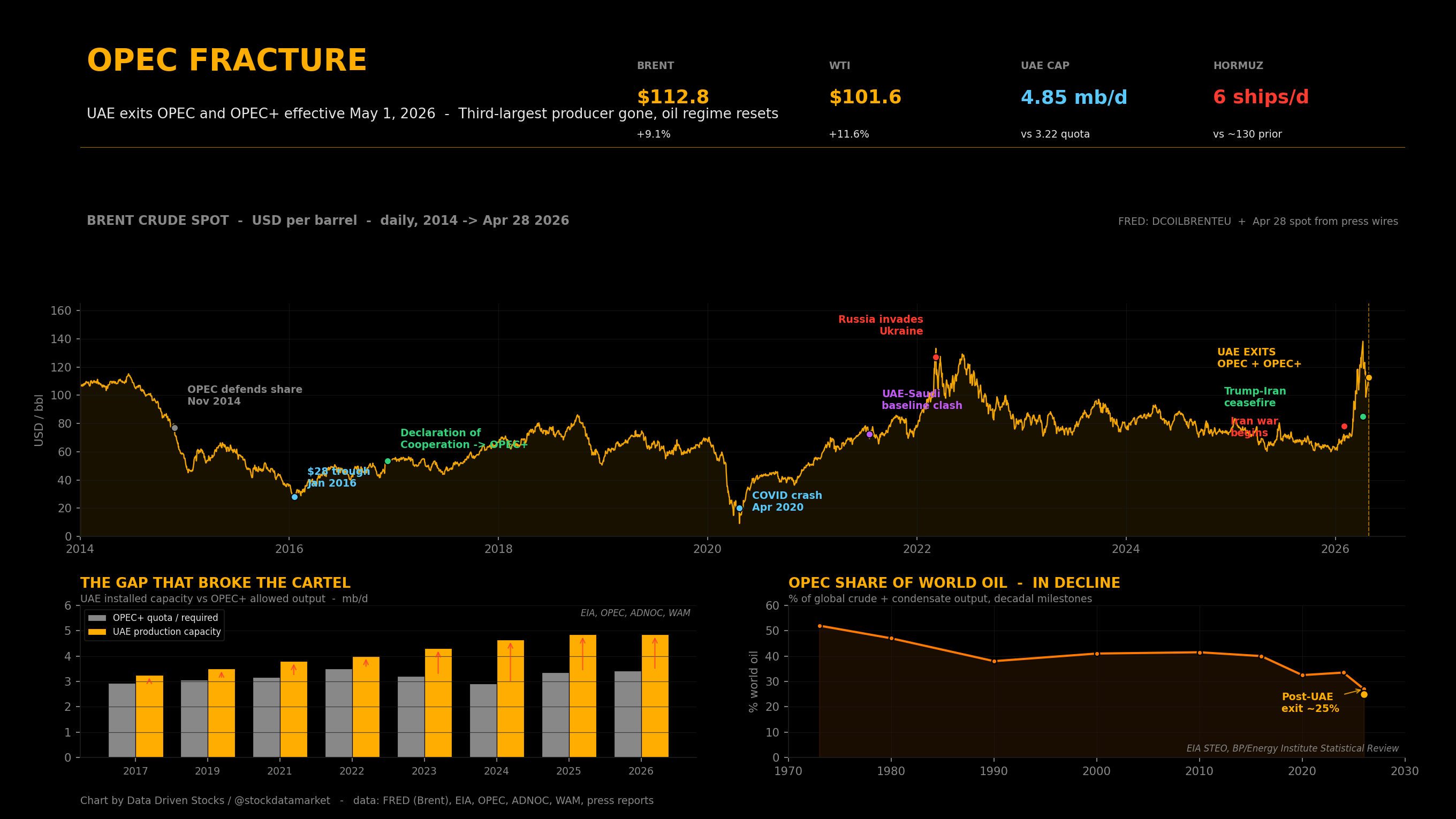
At 8:46 in the morning New York time on Tuesday, April 28, 2026, a single press release from the UAE state news agency WAM cracked open an institution that had survived four wars in the Persian Gulf, two oil embargoes, the entire Cold War, the 2014 to 2016 price collapse, the 2020 pandemic crash, and a Saudi-Russia price war. The Emirates announced that it will leave both OPEC and OPEC+ effective May 1. The third-largest producer in the cartel, the holder of more than four million barrels a day of installed capacity, the country that more than any other has been throwing money at oil-and-gas expansion while everyone else talked about transition, walked out the door.
Brent crude immediately ripped from the high 90s to nearly $113 a barrel. WTI broke past $100 for the first time since April 10. The AAA national average for regular gasoline in the United States hit $4.18, the highest level of the year. The Vienna meeting that OPEC had scheduled for the next day suddenly looked less like a routine production review and more like a wake.
This piece walks through what just happened and why it matters. Not the headline price spike - that part is obvious. The deeper part: how a 1960 cartel born in Baghdad ended up losing its most important Gulf member in 2026, why the trigger was the Iran war but the cause was a $150 billion ADNOC investment program, and what the new world energy order will look like when the dust settles.
A 66-year cartel, in 90 seconds
OPEC was born in Baghdad over five days in September 1960. Five founding members - Iran, Iraq, Kuwait, Saudi Arabia, and Venezuela - signed an agreement to coordinate petroleum policy, push back against the unilateral price-cuts the major Anglo-American oil companies had imposed in 1959 and 1960, and assert what OPEC’s own historical materials still call “the growing sovereignty of oil producing countries over their natural resources.” The organization was registered with the United Nations Secretariat in November 1962. Abu Dhabi, then a still-independent emirate, joined in 1967. When the United Arab Emirates federated in 1971, the membership rolled over. By the early 1970s, OPEC controlled around 52 percent of world oil production and was strong enough to weaponize that share twice - in 1973 and again in 1979.
Then came the slow erosion. North Sea oil. Alaskan oil. Mexican oil. Russian oil. American shale. By the 2010s OPEC’s global market share had drifted into the high 30s and low 40s and the cartel needed help. That help arrived in three steps. First the Algiers Accord of September 28, 2016, which set up a high-level committee to talk to non-OPEC producers. Then the Vienna Agreement of November 30, 2016. Then - the document that actually matters - the Declaration of Cooperation, signed in Vienna on December 10, 2016. The Declaration is the birth certificate of “OPEC+.” It is a producer cooperation framework that bound the OPEC members to ten non-OPEC countries: Russia, Kazakhstan, Mexico, Oman, Azerbaijan, Bahrain, Brunei, Malaysia, Sudan, and South Sudan, alongside Equatorial Guinea, which later became a full OPEC member. In July 2019 the participating countries signed a Charter of Cooperation that made the dialogue permanent.
The institutional point is worth emphasizing because most readers conflate the two organizations and most headlines do not bother to distinguish them. OPEC is the 1960 intergovernmental organization. OPEC+ is the 2016 cooperation framework that wraps OPEC and a Russian-led periphery. The UAE was a member of both. As of last week, the UAE will be a member of neither.

The UAE’s long road to the door
The Emirates did not wake up on Tuesday and decide to quit. The exit is the end-state of a long, well-documented strategic divergence between Abu Dhabi and Riyadh that began roughly a decade ago and reached open conflict in July 2021.
Through the 2010s, ADNOC, the Abu Dhabi National Oil Company, became one of the most ambitious capacity-expanders in the global oil industry. The original target was five million barrels per day by 2030. That target was pulled forward to 2027, then nearly hit ahead of schedule. By mid-2024 the UAE was telling reporters that installed capacity had reached 4.85 million barrels a day, up from 4.65 million a year earlier, on the back of a $150 billion spending program covering rig fleet expansion, AI-driven well optimization, and unconventional drilling. The country was building output it could not, under existing OPEC+ rules, actually produce.
In July 2021 the contradiction blew open. The UAE refused to extend the prevailing OPEC+ cuts unless its baseline was revised upward to reflect that capacity. The standoff dragged on for weeks, briefly threatened the cohesion of the entire group, and ended with a compromise on July 18, 2021: the UAE’s reference baseline was lifted from 3.168 million barrels a day to 3.5 million barrels a day effective May 2022. That was a one-time win, not a peace treaty. The UAE returned to the negotiating table at the 35th OPEC+ ministerial meeting in June 2023 and walked out with a 2024 target of 3.219 million barrels per day. It returned again at the 37th ministerial in June 2024 and was granted a new reference production level of 3.519 million barrels a day, an additional 300 thousand barrels above its prior allowed output. By the December 2024 meeting, that 300 thousand barrel increase was rephased, stretched out from April 2025 through September 2026.

This is the staircase that broke OPEC+. Each renegotiation lifted the UAE’s allowed share, and each renegotiation took longer to extract. The country was running ahead of every quota the group could agree on. Robin Mills of Qamar Energy told CNN on Tuesday that quotas had capped UAE output at around 3.2 million barrels a day while it sat on capacity that would let it produce close to double that. There comes a point at which the negotiating cost of staying inside the cooperation framework exceeds the value of the cooperation itself. April 28, 2026, was that point.
Why now: the Iran war catalyst
The strategic divergence is the cause. The geopolitical earthquake of February through April 2026 is the catalyst.
The Iran war that began in February 2026 wiped out 7.88 million barrels per day of OPEC production in March, according to industry data reported by The National. OPEC output collapsed 27 percent to 20.79 million barrels a day, the largest monthly supply drop the producer group has ever recorded - larger than the 6.28 million barrel cut from May 2020 after COVID, larger than the disruption from the 1991 Gulf War, larger than the 1970s oil crisis. The Strait of Hormuz, the narrow channel through which roughly one-fifth of the world’s seaborne crude and LNG normally moves, went from carrying around 130 ships per day to roughly six on the worst day, according to MarineTraffic data cited by CNN.
The April 7 Trump-Iran ceasefire was supposed to fix this. It did not fully. By April 17 the Strait was back open in some directions, oil prices had retraced about 17 percent off their highs, and Brent was back near $80. Then negotiations stalled, Iran rejected what it called an inadequate revised proposal, the Strait closed again, and the price spiked back. The UAE, a US ally that had been hit repeatedly by Iranian-linked drone and missile attacks during the war, criticized fellow Arab states for what it described as inadequate protection.

UAE Energy Minister Suhail Al Mazrouei told Reuters on Tuesday that the UAE did not consult Saudi Arabia before announcing the exit. The framing in the WAM statement was straightforward: a comprehensive review of UAE production policy and current and future capacity led to the decision; the country’s “long-term strategic and economic vision and evolving energy profile” required it. Mazrouei told CNN that the timing was deliberately chosen because the Strait closure meant the UAE could not actually flood markets immediately even if it wanted to. The political cost of walking out, in other words, was lower today than it would be in a normal market.
There is a fourth thread here. Days before the announcement, US Treasury Secretary Scott Bessent publicly backed an emergency dollar swap line for Abu Dhabi before the Senate. The petrodollar architecture that has knitted the Gulf to the US financial system since the 1970s appears to be evolving, not collapsing - Gulf Cooperation Council sovereign wealth funds still hold more than $2 trillion in US assets and Gulf currencies remain pegged to the dollar - but the bilateral US-UAE security and financial relationship is clearly strengthening relative to the wider OPEC framework. President Trump has openly accused OPEC of “ripping off the rest of the world” and explicitly tied US military protection of Gulf states to oil prices. The UAE has chosen to be useful to Washington rather than disciplined by Riyadh.
What it actually means - by region
For consumers in the United States, the immediate translation is on the gasoline pump. Regular gasoline averaged $4.18 a gallon nationally on Tuesday, the highest of the year. The Federal Reserve’s Energy CPI index ripped to 314 in March 2026, up from 281 in January, after a long period of sideways drift. With oil now structurally back above $100 and possibly higher if Hormuz stays partially closed, the Fed’s path back to its inflation target gets harder. Five-year breakeven inflation expectations, which spent most of 2024 and 2025 in the low to mid 2 percent range, were pushing 2.62 percent on the latest reading. Headline CPI prints over the next six months will run hot.

For Europe, the immediate impact is more nuanced. The European Union, having already largely replaced Russian crude over 2022 to 2024, has become structurally more dependent on Middle Eastern barrels. Refiners on the Mediterranean and the Atlantic coast take only around 5 percent of UAE crude exports directly, but European complex refineries - the ones that turn medium-sour Gulf grades into diesel and jet fuel - are price-takers in a globally tight market. A UAE that can eventually pump an extra 1.4 million barrels per day above its old quota, once Hormuz reopens, would actually be a long-term tailwind for European refining margins. In the immediate window, though, every European inflation forecast has to be rebuilt around triple-digit Brent.
For Asia, the picture is the most consequential. Roughly 91 percent of UAE crude oil exports go to Asia. Japan alone takes about 21 percent. India takes 18 percent. China takes 17 percent. South Korea, Thailand, Taiwan, and Singapore round out the bulk of the rest. India and China have been the strategic prize for ADNOC for the past five years and the UAE government’s energy strategy is built around delivering molecules into those two markets at scale. A UAE outside OPEC+ that can produce closer to 4.5 million barrels a day rather than 3.2 million is structurally bullish for Indian and Chinese refining; it weakens the bargaining position of Saudi Aramco against ADNOC; and it gives Asian buyers a credible alternative to Russian Urals barrels that come with sanctions risk.

For Russia, the consequences are more delicate than headline-writers admit. Russia is not an OPEC member; it joined OPEC+ via the Declaration of Cooperation in 2016. The Saudi-Russian partnership inside OPEC+ has been the load-bearing wall of the entire group since then. The UAE’s exit forces a question Riyadh has been able to defer: will Russia stay disciplined inside a cooperation framework that has just lost a major Gulf voice and gained nothing? Or does the precedent now invite other producers - Kazakhstan in particular, which Robin Mills explicitly named on CNN as a potential follower - to walk away too? Rystad Energy analyst Jorge Leon described the UAE exit on Tuesday as making OPEC “structurally weaker.” The longer-term implication is not that one producer left. It is that the option of leaving has been put on the table.
For Saudi Arabia, the picture is the worst. Saudi Arabia has been the de facto leader of OPEC since 1960 and the de facto leader of OPEC+ since 2016. It has run the cartel through a combination of market discipline, diplomatic pressure, and willingness to use its own spare capacity as a swing producer. Losing the UAE - the only other Gulf member with meaningful spare capacity - reduces Riyadh’s leverage over the world oil market by roughly the size of the Emirates’ incremental output: 1 to 1.5 million barrels per day, possibly more by 2027. The relationship between the two countries was already strained by competing investments in southern Yemen, opposing positions in regional politics, and the underlying economic competition over which Gulf city becomes the financial capital of the region. The exit confirms what was already true privately: Riyadh and Abu Dhabi are no longer aligned.
What OPEC+ looks like without the UAE
On May 1, OPEC will fall from 12 members to 11. The 11 are Saudi Arabia, Iraq, Iran, Kuwait, Venezuela, Libya, Algeria, Nigeria, Gabon, Equatorial Guinea, and Congo. The non-OPEC partners in the broader OPEC+ Declaration of Cooperation framework remain Russia, Kazakhstan, Mexico, Oman, Azerbaijan, Bahrain, Brunei, Malaysia, Sudan, and South Sudan, with Brazil joining the Charter of Cooperation in January 2024 in an observer-style role. Qatar left in 2019 because it wanted to focus on LNG. Ecuador left in 2020. Angola left in January 2024 over quota disputes that, in retrospect, look like a smaller dress rehearsal for the UAE situation.
The combined OPEC+ alliance still produces, on paper, roughly 40 percent of global crude oil. The number that matters is not membership count but credible coordination capacity. With the UAE outside the framework, the group’s ability to enforce discipline on the producers who actually want to expand - Iraq, Kazakhstan, in some scenarios Iran post-war - becomes mathematically harder. The cartel does not collapse. It frays.
The Baker Institute warned in earlier research that a UAE departure would be “the most high-profile departure from the group to date, overshadowing Qatar’s 2019 exit.” Qatar’s exit barely moved markets because Qatar had already pivoted to gas. The UAE leaves while still expanding oil. That is the difference.
Three scenarios for oil through 2027
The honest framing is that the UAE exit is a structural shift but the immediate price level is being set by the Iran war and the Strait of Hormuz. Three scenarios are reasonable.
In the bear case, the Hormuz situation is resolved within a quarter, oil shipping normalizes, the UAE actually executes its long-promised gradual ramp from 3.4 to closer to 4.5 million barrels per day, Saudi Arabia chooses share over price, and Brent retraces toward the high $60s as the market repriced glut. This is the scenario that consumers, the Federal Reserve, and the White House would all prefer. It is also the scenario in which OPEC+ functionally ceases to be a price-supporting institution.
In the bull case, the ceasefire fails, Hormuz stays partially closed through 2026 and into 2027, Iranian production stays offline, the UAE’s spare capacity is irrelevant because tankers cannot move, Saudi Arabia tries to defend prices alone with a smaller coalition, and Brent stabilizes in a $110 to $130 range. Inflation in the United States and Europe re-accelerates. The Fed’s pivot back to cuts is delayed. Risk assets struggle.
In the middle path, the most probable outcome, Hormuz reopens partially, Saudi Arabia and Russia hold an OPEC+ minus UAE coalition together, the UAE adds barrels to global supply gradually as it always promised, and Brent oscillates in the $80 to $95 range while the market reprices the structurally weaker cartel against the structurally tight Middle East security environment.
In all three cases, one thing is clear. The UAE’s exit makes oil prices more volatile, not less. The cooperation framework that has dampened oil price swings since 2016 just lost a meaningful share of its enforcement power. Whatever oil price you assumed for the next two years, you should widen the confidence interval.
The bottom line
April 28, 2026, will be remembered the way September 14, 1960, the original Baghdad Conference, is remembered - as a turning point in the institutional architecture of the global oil market. The 1960 founding marked producer states asserting sovereignty against the Anglo-American oil majors. The 2016 Declaration of Cooperation marked the integration of Russia into a Saudi-led market management framework. The 2026 UAE exit marks the first time since 1960 that a major Gulf producer has decided that its national interests are better served outside OPEC than inside it.
The UAE has spent the past decade building capacity that the cooperation framework would not let it sell. It has spent the past four years repeatedly renegotiating that constraint upward. It has now decided that the constraint itself is the problem. ADNOC will move toward five million barrels a day on its own timeline. Asia will buy the molecules. The petrodollar will adjust. OPEC will continue to exist and Saudi Arabia will continue to lead it. But the era when OPEC could plausibly claim to coordinate the global oil market with one voice ended this morning at 8:46 New York time, in a press release from a state news agency in Abu Dhabi.
For investors, the practical reading is this. Oil price volatility is structurally higher than the 2022 to 2025 baseline. Inflation is more sensitive to Middle East shocks than at any point in the last decade. The Federal Reserve’s reaction function gets harder. US E&P producers and Gulf-of-Mexico independents are clear winners. European refiners are conditional winners once Hormuz fully reopens. Saudi Aramco is structurally weakened. ADNOC is structurally stronger. And every OPEC+ meeting from now on will be less interesting because the most important question - who else might leave - will be the one nobody is allowed to ask out loud.
Sources
WAM (UAE state news agency), “UAE announces decision to exit OPEC and OPEC+,” April 28, 2026: https://www.wam.ae/en/article/bzxzuh7-uae-announces-decision-exit-opec-opec%2B
Bloomberg, “UAE to Leave OPEC and OPEC+ Next Month to Pursue New Strategy,” April 28, 2026: https://www.bloomberg.com/news/articles/2026-04-28/uae-to-leave-opec-and-opec-next-month-to-pursue-new-strategy
The National, “UAE announces it will leave Opec,” April 28, 2026: https://www.thenationalnews.com/business/2026/04/28/uae-announces-it-will-leave-opec/
Reuters via US News & World Report, “UAE Leaves OPEC and OPEC+ in Major Blow to Global Oil Producers’ Group,” April 28, 2026: https://www.usnews.com/news/world/articles/2026-04-28/uae-leaves-opec-and-opec-in-huge-blow-to-global-oil-producers-group
The Washington Post, “UAE to leave OPEC amid Hormuz oil crisis, a blow to Saudi Arabia,” April 28, 2026: https://www.washingtonpost.com/world/2026/04/28/uae-opec-iran-hormuz-trump-saudi/
NPR, “The UAE is leaving OPEC on Friday,” April 28, 2026: https://www.npr.org/2026/04/28/nx-s1-5802735/uae-leaves-opec-oil
NBC News, “United Arab Emirates quits OPEC as Iran war raises Gulf tensions,” April 28, 2026: https://www.nbcnews.com/business/energy/uae-quits-opec-oil-iran-talks-rcna342465
CNN, “UAE to quit OPEC in blow to world’s leading oil exporters,” April 28, 2026: https://www.cnn.com/2026/04/28/world/live-news/iran-war-trump-israel
CNBC, “United Arab Emirates to leave OPEC May 1, energy chief says still committed to oil price stability,” April 28, 2026: https://www.cnbc.com/2026/04/28/uae-opec-oil-iran.html
Fortune, “OPEC shocker as UAE leaves oil cartel days after negotiating swap lines with Scott Bessent’s Treasury,” April 28, 2026: https://fortune.com/2026/04/28/uae-leaves-opec-bessent-swap-line-petrodollar-iran-war/
Associated Press, “OPEC member UAE says it is leaving the cartel,” April 28, 2026: https://apnews.com/article/opec-united-arab-emirates-leaving-cartel-4966108c3fafacb67181152216deda14
Wall Street Journal, “UAE to Leave OPEC, OPEC+,” April 28, 2026: https://www.wsj.com/world/middle-east/u-a-e-to-leave-opec-opec-2368bbd6
OilPrice.com, “UAE Quits OPEC and OPEC+ as Hormuz Crisis Drags On,” April 28, 2026: https://oilprice.com/Latest-Energy-News/World-News/UAE-Quits-OPEC-as-Hormuz-Crisis-Drags-On.html
OPEC, “Brief History”: https://www.opec.org/brief-history.html
OPEC, “Member Countries”: https://www.opec.org/member-countries.html
OPEC, “Declaration of Cooperation”: https://www.opec.org/declaration-of-cooperation.html
OPEC, “Charter of Cooperation”: https://opec.org/charter-of-cooperation.html
OPEC, 38th OPEC and non-OPEC Ministerial Meeting press release, December 5, 2024: https://www.opec.org/pr-detail/28-05-dec-2024.html
EIA, “United Arab Emirates Country Analysis Brief”: https://www.eia.gov/international/analysis/country/ARE
EIA, “United Arab Emirates invests to meet 2027 crude oil production capacity goal,” Today in Energy, February 5, 2024: https://www.eia.gov/todayinenergy/detail.php?id=61365
Baker Institute (Rice University), “Should Abu Dhabi Quit OPEC? Reconsidering the UAE’s Membership”: https://www.bakerinstitute.org/research/should-abu-dhabi-quit-opec-reconsidering-uaes-membership
Oxford Institute for Energy Studies, “OPEC in 2025: Navigating an Uncertain Environment,” January 2025: https://www.oxfordenergy.org/wpcms/wp-content/uploads/2025/01/OPEC-in-2025-Navigating-an-uncertain-environment.pdf
FRED data series used: WTI Crude Oil Spot Price (DCOILWTICO), Brent Crude Oil Europe Spot Price (DCOILBRENTEU), US Regular Conventional Gasoline Prices (GASREGW), Consumer Price Index for All Urban Consumers: Energy (CPIENGSL), 5-Year Breakeven Inflation Rate (T5YIE). Federal Reserve Economic Data, Federal Reserve Bank of St. Louis: https://fred.stlouisfed.org/
This article is for informational purposes only and does not constitute investment advice. Data Driven Stocks / @stockdatamarket.