

Microsoft Put In $11.9 Billion. It Billed $24.1 Billion Back - A circular economy of Open AI and Microsoft
When your revenue is basically your investment money back

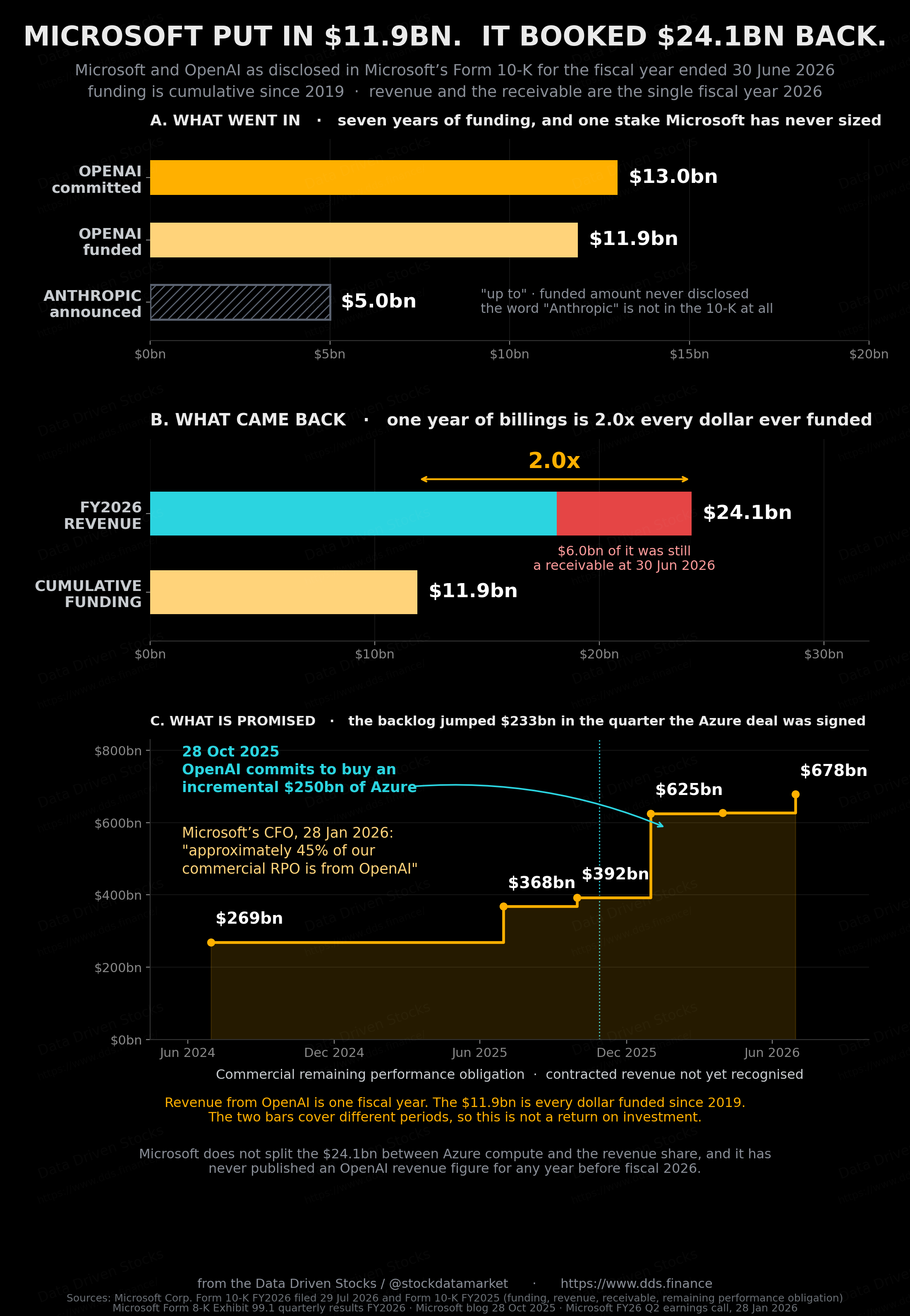
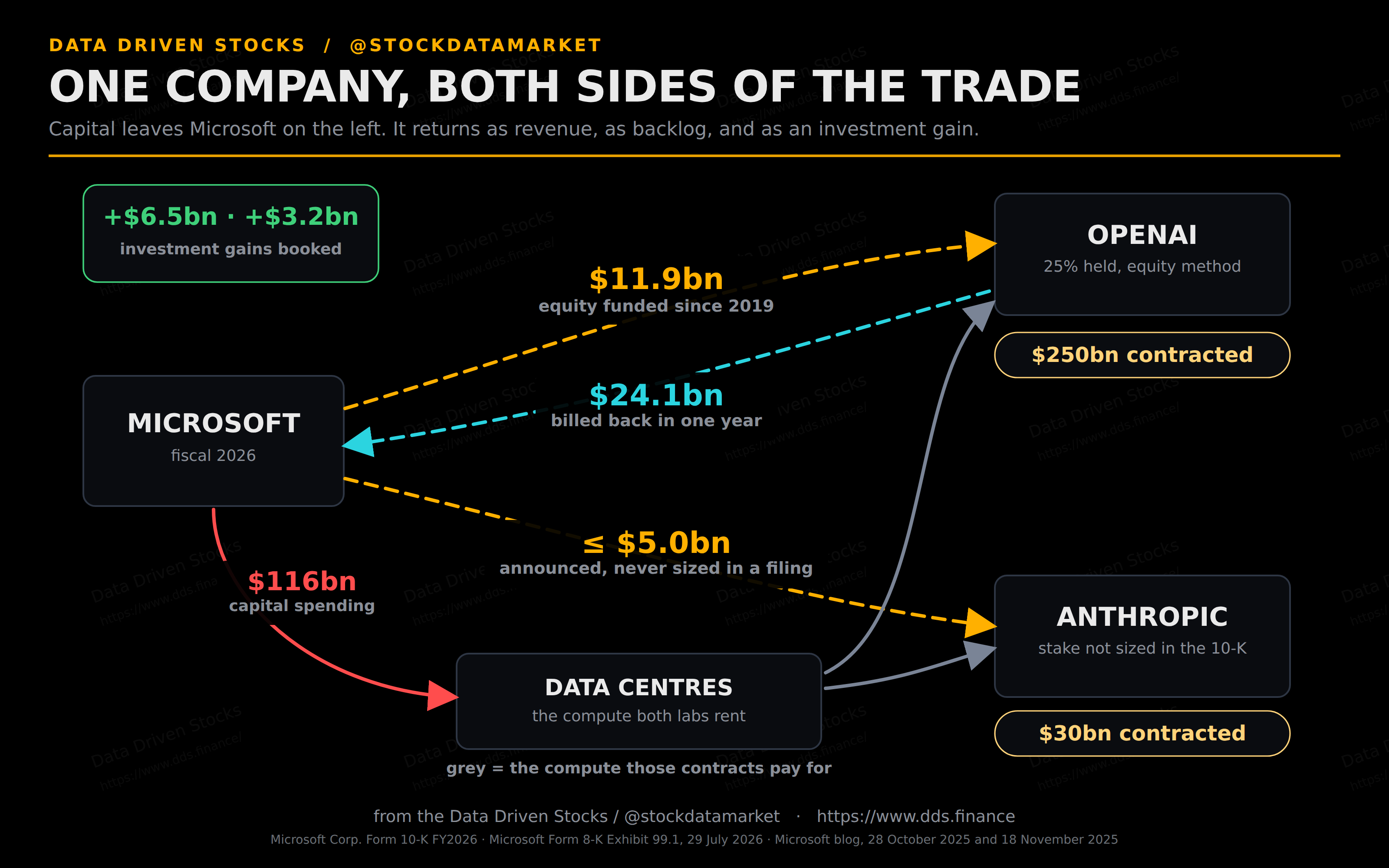
On 29 July 2026, Microsoft filed its annual report for the year ended 30 June. Buried in the accounting-policy note, in a paragraph that reads like housekeeping, is the first number the company has ever published for what OpenAI pays it. Twenty-four point one billion dollars. In the same paragraph, Microsoft says it has funded 11.9 billion dollars into OpenAI since 2019, against a total commitment of 13 billion.
One year of billings. Roughly twice everything ever invested.
That is the sentence people will screenshot. It also needs the most care, because those two numbers do not cover the same period and putting them side by side is not a return on investment. But it counts as a revenue, which is not …
What Microsoft actually put in
Microsoft first told the SEC about the OpenAI money on 30 October 2024, in a quarterly filing that said it had “made total funding commitments of $13 billion” and was accounting for the stake under the equity method. For close to two years before that, the figure lived in press reports and nowhere else.
The fiscal 2026 annual report goes further. It says 11.9 billion of the 13 billion has actually been funded. It says the investment represents an approximate 25 percent interest on an as-converted basis. And it explains, for the first time, that Microsoft uses hypothetical liquidation at book value to work out its share of OpenAI’s profits and losses, because its liquidation rights are not the same as its ownership percentage. That last detail sounds like a footnote. It is the reason Microsoft’s reported OpenAI gains and losses swing so violently from quarter to quarter.
Microsoft’s own blog, from October 2025, puts the stake at about 27 percent on an as-converted diluted basis and values it at approximately 135 billion dollars. Both numbers can be right. They are measured on different bases, and only one of them was audited.
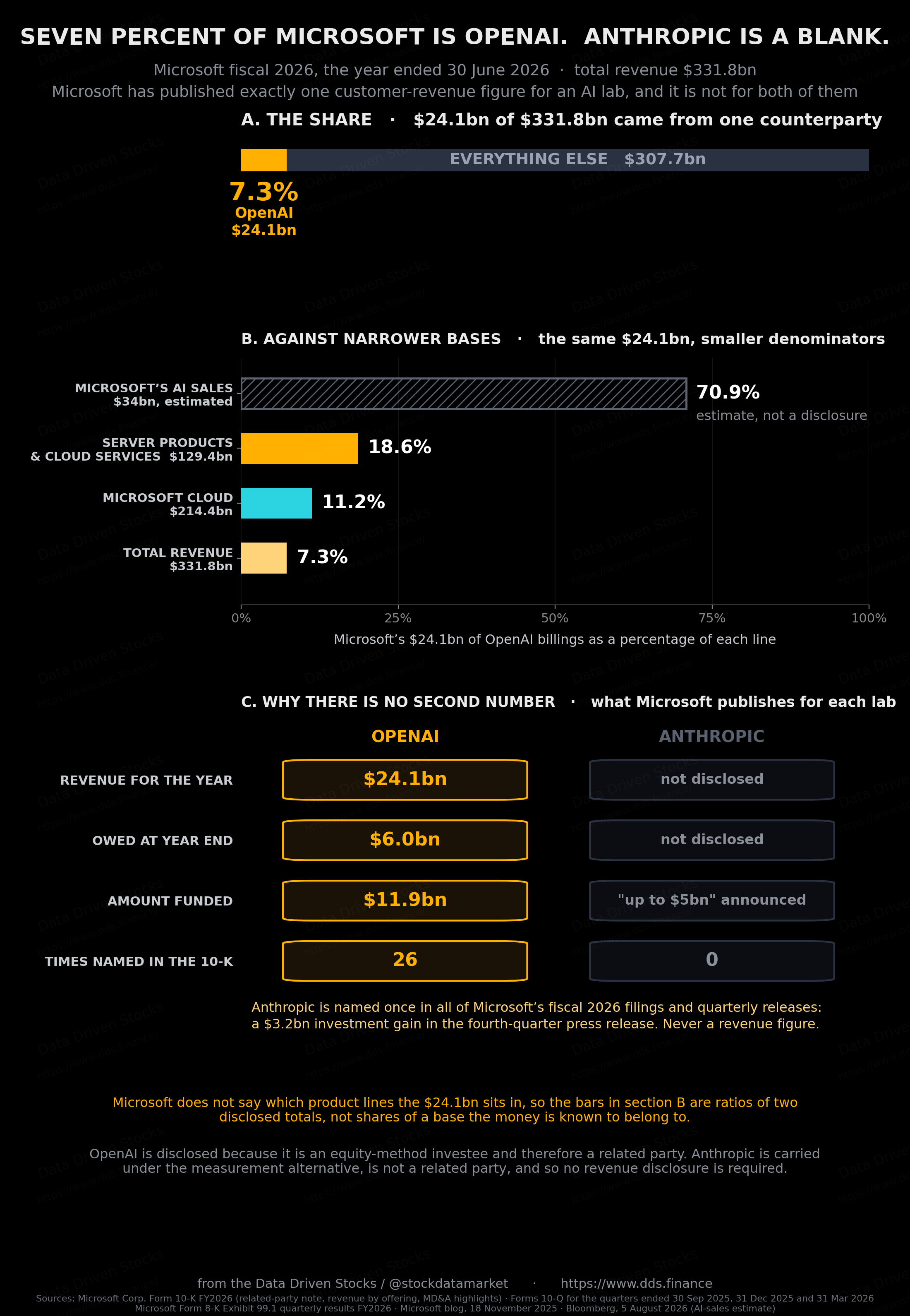
Anthropic is a stranger case. In November 2025 Microsoft and NVIDIA announced they would invest up to 5 billion and up to 10 billion dollars respectively, and Anthropic committed to buy 30 billion dollars of Azure compute with an option on up to a gigawatt of capacity. Nine months later, the word Anthropic does not appear anywhere in Microsoft’s annual report. Not once. The only place it turns up is the fourth-quarter press release, which mentions a 3.2 billion dollar gain from the investment as one of the reasons earnings beat guidance.
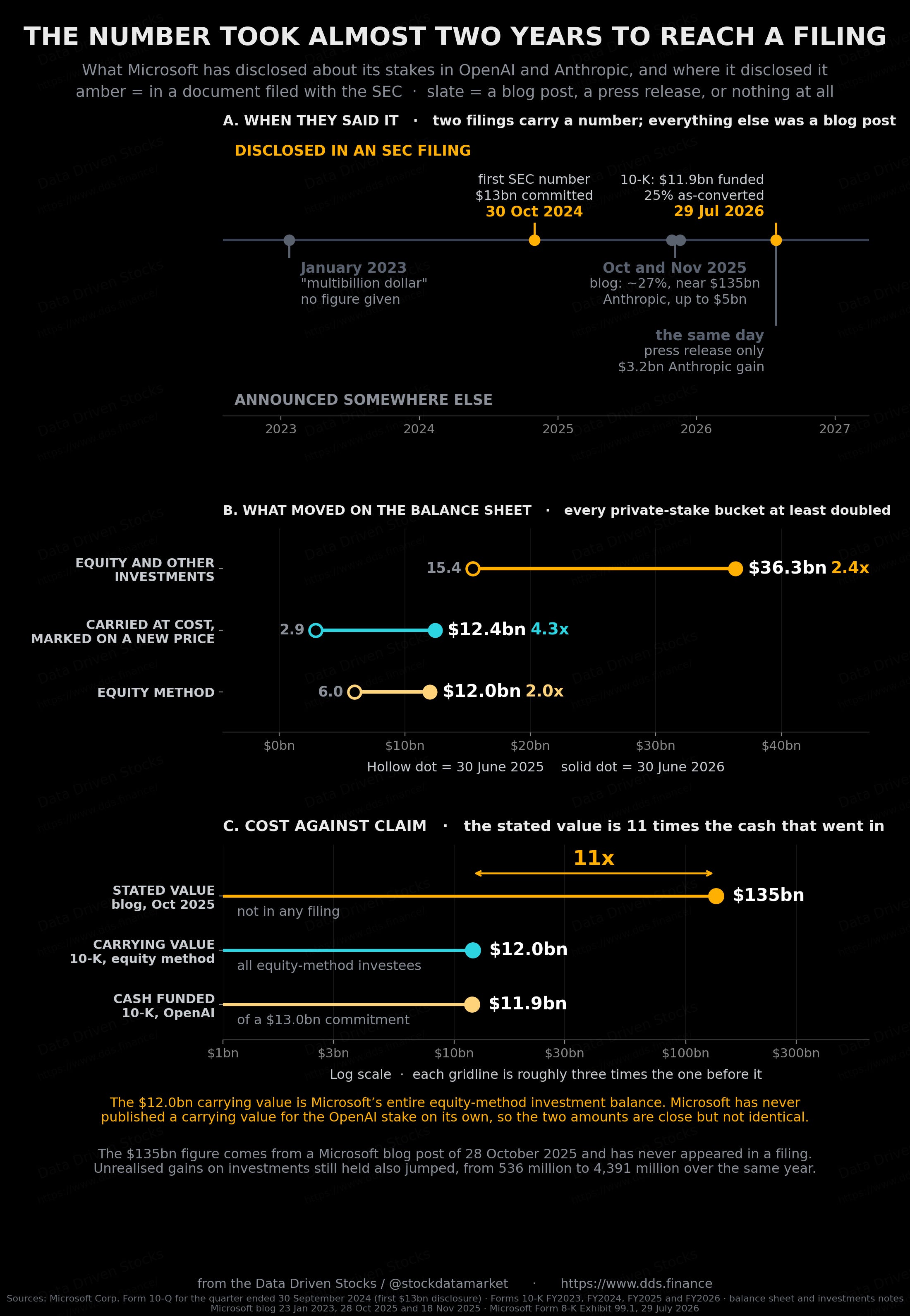
You can still see the money even if you cannot see the name. The bucket Microsoft uses for private stakes it does not control, carried at cost and marked when a new price appears, went from 2.9 billion dollars to 12.4 billion in a single year. Over the same twelve months unrealised gains on investments still held jumped from 536 million to 4,391 million, and equity-method investments doubled to 12.0 billion. Anthropic raised at a 965 billion dollar valuation in May, which falls inside Microsoft’s fourth quarter. The arithmetic is not hard.
What Microsoft earns
Now the other side.
Microsoft’s fiscal 2026 revenue was 331.8 billion dollars, up 18 percent. Operating income was 155.2 billion, up 21. Net income was 133.7 billion, up 31. That gap between the top line growing 18 and the bottom line growing 31 is almost entirely about investments.
Almost all of the growth came from one place. Server products and cloud services, the line that contains Azure, grew from 98.4 billion to 129.4 billion. That is 31.0 billion dollars of the 50.1 billion the whole company added. Microsoft 365 Commercial added another 14.2. Everything else together contributed less than five billion, and XBOX went backwards.
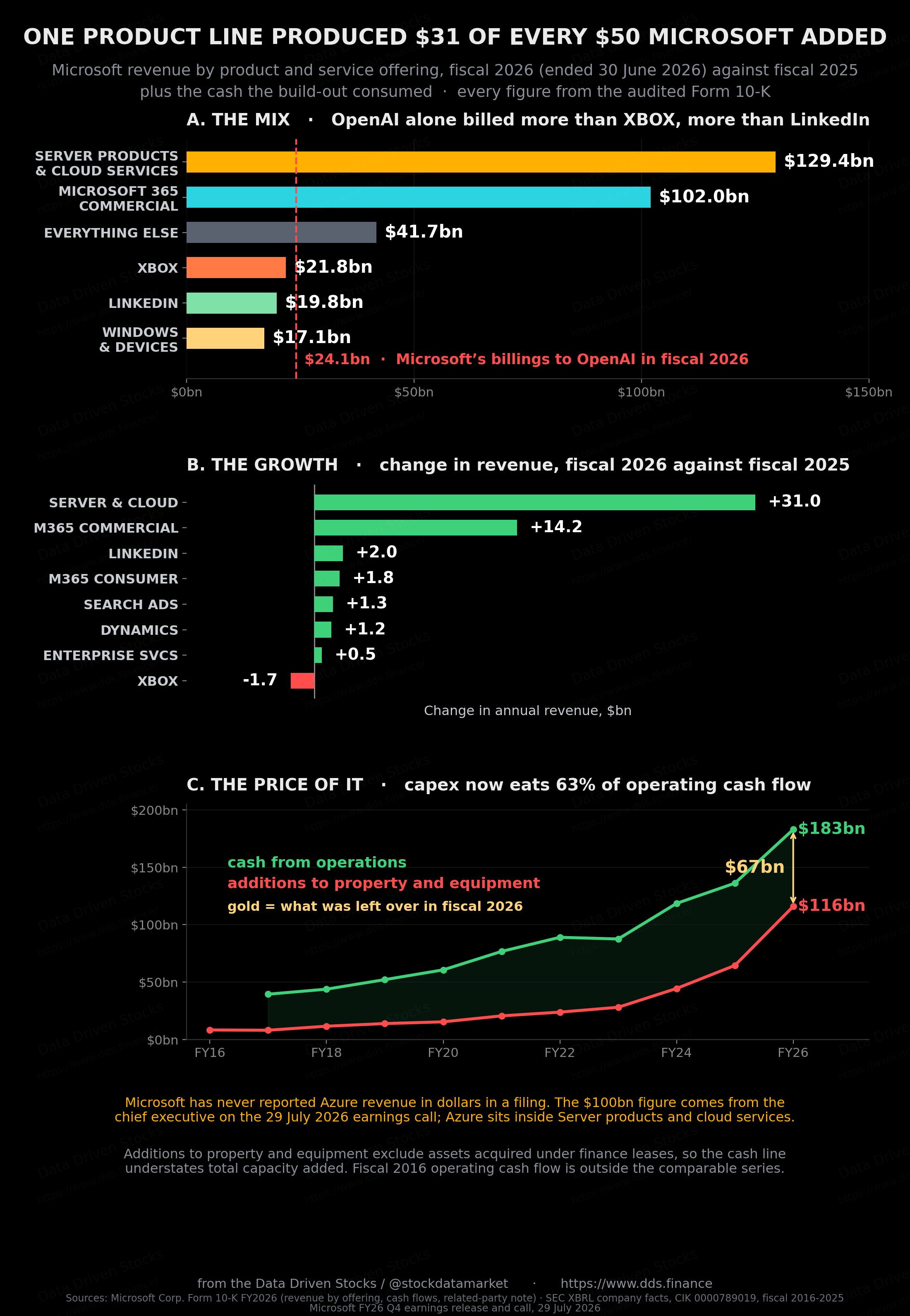
Against that, 24.1 billion dollars from a single counterparty is 7.3 percent of company revenue. Put differently, OpenAI bought more from Microsoft last year than the entire XBOX franchise sold, and more than LinkedIn.
Microsoft used to publish an AI run-rate figure. In January 2025 it was 13 billion dollars. In April 2026 Satya Nadella said the AI business had passed 37 billion on an annualised basis, up 123 percent. Then in July the company simply stopped giving the number. Bloomberg, working backwards from the growth rate, put Microsoft’s AI revenue for the year at roughly 34 billion and concluded OpenAI accounts for something like 70 percent of it. That is an estimate and should be read as one. It is not far off what the disclosed figures imply.
For Anthropic there is no revenue disclosure at all. What exists is the 30 billion dollar Azure commitment, which flows into backlog rather than into any line you can see today. Money also travels the other way: Microsoft has been buying Claude to run inside Copilot, reportedly at a rate approaching 500 million dollars a year. There is a reason for the asymmetry rather than a conspiracy. OpenAI is an equity-method investee, which makes it a related party and forces the disclosure. Anthropic sits in the bucket carried at cost, is not a related party, and so nothing has to be said.
So is it circular?
Yes, in the sense that the same counterparty appears on both sides of Microsoft’s accounts. No, in the sense that most people mean when they say circular, which is that a company is funding its own revenue.
Structurally it goes like this. Microsoft holds equity in OpenAI. OpenAI buys Azure. Microsoft books that as revenue. OpenAI’s valuation rises, and Microsoft books a gain on the stake. Microsoft spends the cash on data centres, which is the capacity OpenAI rents. Round and round.
The accounting side of that loop is easy to underrate. Microsoft’s other income line swung from minus 4.9 billion dollars in fiscal 2025 to plus 10.7 billion in fiscal 2026. Two components did most of it. “Other, net” contributed 4.7 billion dollars, and Microsoft says that is where the OpenAI equity-method result and the dilution gain from the October recapitalisation sit. “Net recognized gains on investments” contributed another 4.4 billion, against a 349 million dollar loss the year before. Microsoft never says which line the 3.2 billion dollar Anthropic gain landed on, but a mark-up on a private stake belongs in the second one and nothing else in it is that size.
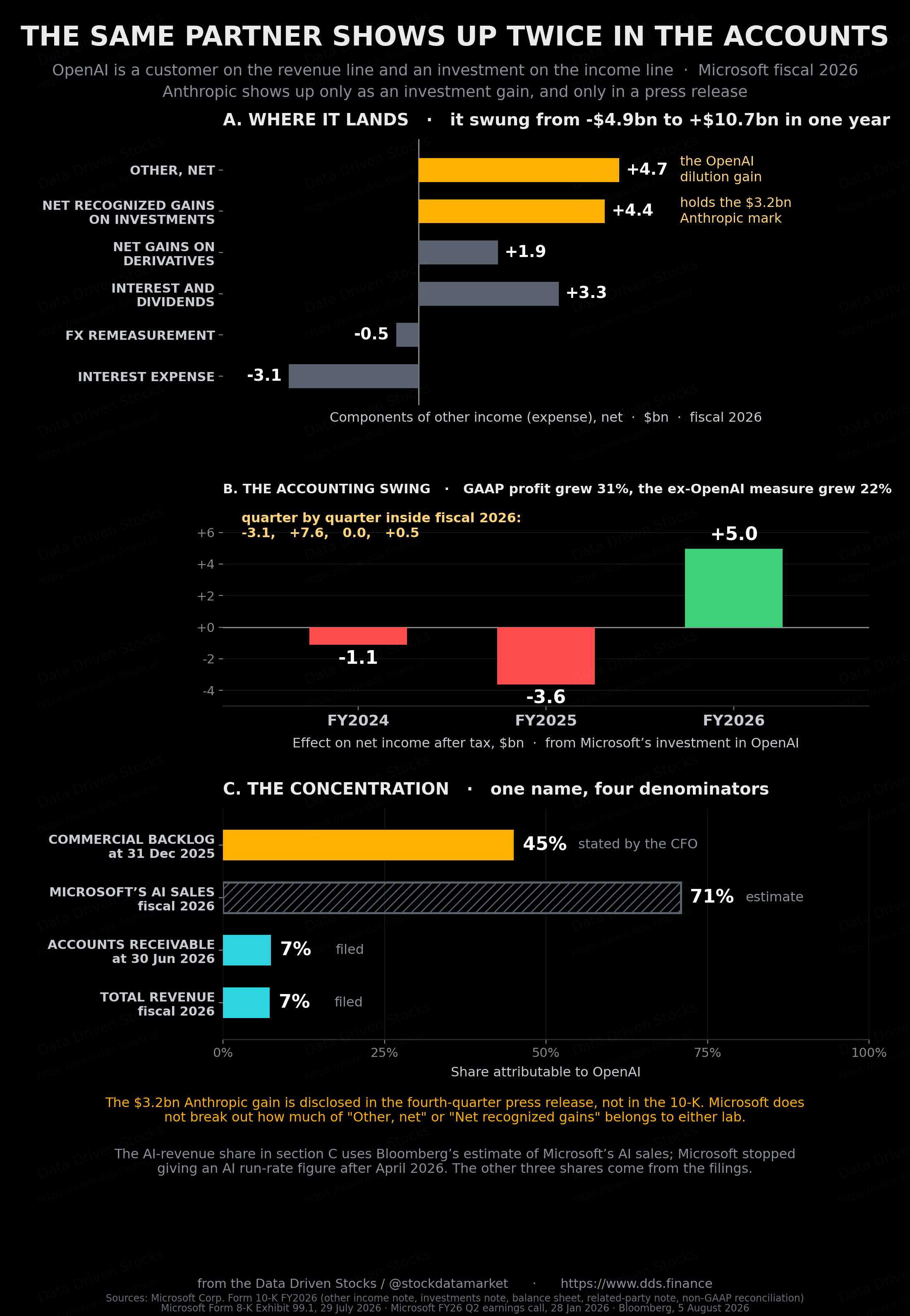
Microsoft is not hiding this. It publishes an adjusted net income figure that removes OpenAI gains and losses entirely, and the difference is stark. Reported profit grew 31 percent. The ex-OpenAI measure grew 22. Inside the year, the quarterly path was minus 3.1 billion, plus 7.6 billion, zero, plus 0.5 billion. A company that reports that kind of series has effectively told you where to stop reading its headline earnings.
Then there is the backlog. Commercial remaining performance obligation, which is contracted revenue not yet recognised, was 368 billion dollars in June 2025. By December it was 625 billion. The jump of 233 billion dollars in a single quarter arrived in the quarter OpenAI committed to buy an incremental 250 billion dollars of Azure services. On the January earnings call, chief financial officer Amy Hood put a number on it. Approximately 45 percent of the commercial RPO balance is from OpenAI.
By June 2026 the balance was 678 billion dollars. Hood said the figure grew 25 percent excluding OpenAI, and that all of the sequential growth in the quarter came from customers outside the frontier labs. Both of those are true at the same time, which is exactly why the argument never settles.
Where the circularity argument gets weaker is on the cash. OpenAI is not paying Microsoft with Microsoft’s money. By the end of March 2026 it had closed a 122 billion dollar funding round at a valuation of 852 billion, with SoftBank, NVIDIA and Amazon among the names attached to it. Microsoft’s 11.9 billion is a small part of a very large pool. And the leaked 2025 financials, verified by the Financial Times in June, show OpenAI paid Microsoft 17.2 billion dollars that year while losing money heavily. The payments are real and they are large, and somebody other than Microsoft is funding them.
The parts that actually matter
Start with whether the customer pays. So far it does. Microsoft was owed 6.0 billion dollars by OpenAI at year end, against 24.1 billion of billings. That works out to about 91 days. Across all of Microsoft’s customers the same calculation gives 89 days. OpenAI is settling up on roughly the same clock as everyone else, which is not what you would expect from a counterparty being propped up.
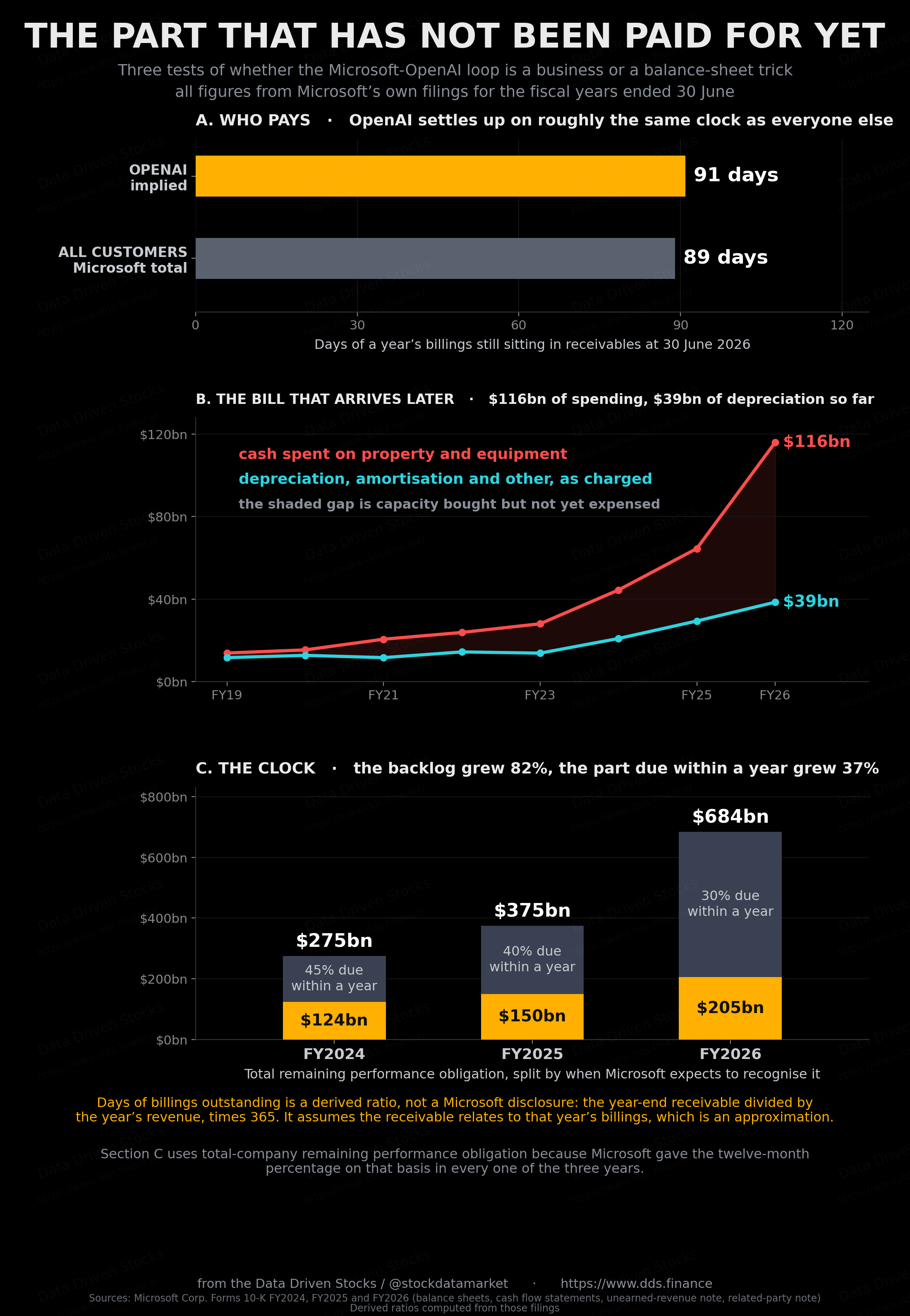
Depreciation is the uglier one. Microsoft spent 115.9 billion dollars on property and equipment last year and charged 38.5 billion of depreciation and amortisation. Servers get written off over two to six years under Microsoft’s own policy. The expense from this year’s spending has barely started to land, and it will land whether or not the revenue does.
Then there is the clock on the backlog. Microsoft expects to recognise about 30 percent of the 684 billion dollar total within twelve months. Two years ago that share was 45 percent. The weighted average duration is now 2.3 years. A backlog that grows while its near-term slice shrinks as a proportion has become a promise about 2028 rather than a forecast for next quarter.
Then there is the April 2026 amendment. Microsoft’s licence to OpenAI’s intellectual property runs through 2032 but is no longer exclusive. OpenAI’s revenue-share payments continue through 2030 at the same percentage, but now with a total cap. Microsoft no longer pays OpenAI a revenue share at all. And OpenAI can serve its products on any cloud, which it promptly did, signing a 100 billion dollar arrangement with AWS in February. Microsoft is still the primary cloud partner. It is no longer the only one.
This has happened before
The parallel is structural, and it is not a comfortable one.
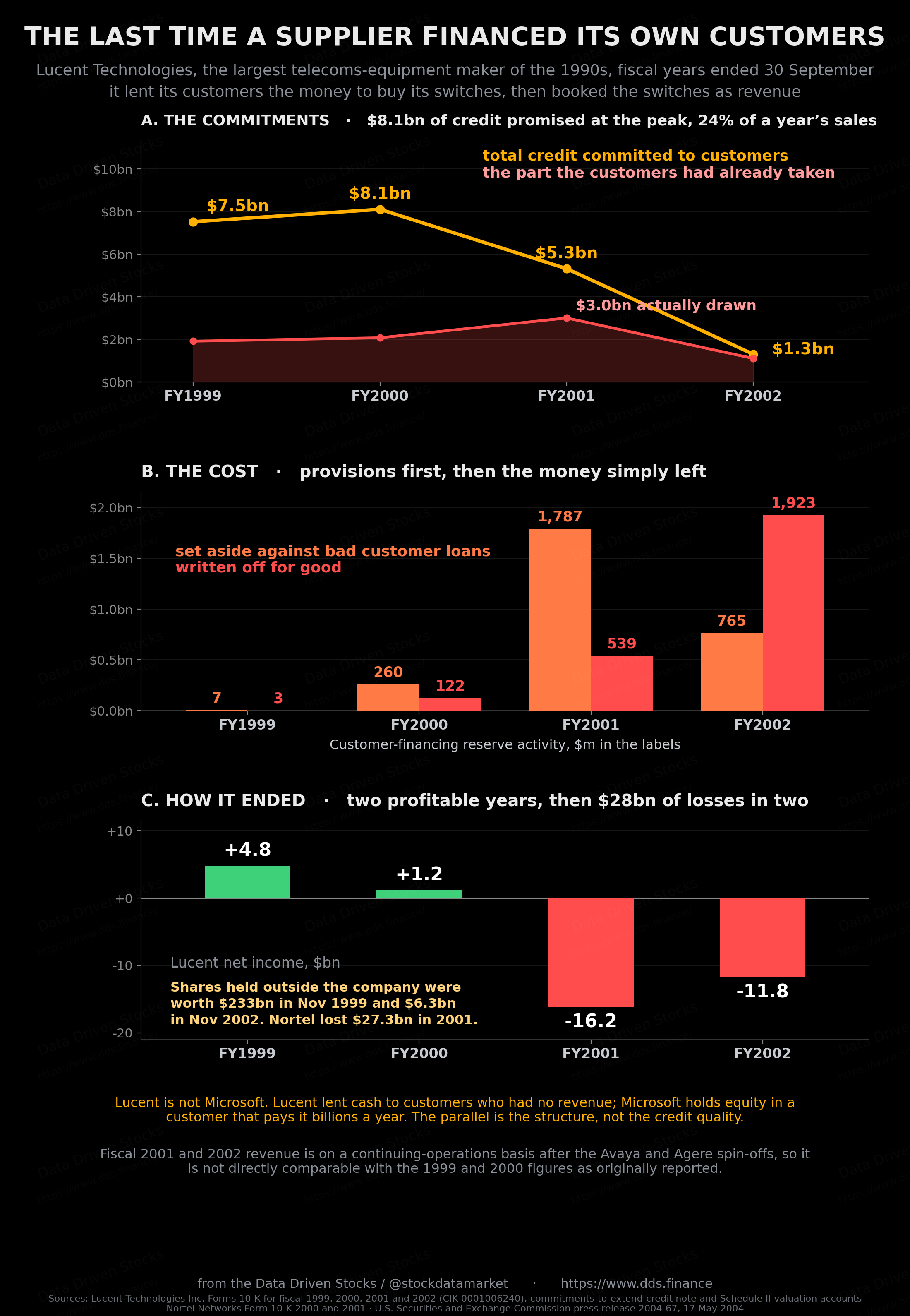
In the late 1990s the biggest telecoms-equipment maker in the world was Lucent Technologies. Its customers were new carriers with fibre plans and no cash flow, and Lucent solved that the obvious way. It lent them the money. By September 2000, Lucent had committed 8.1 billion dollars of credit and guarantees to the companies buying its switches, against annual sales of 33.8 billion. Roughly a quarter of a year’s revenue was riding on the creditworthiness of its own customer base.
One customer, Winstar Communications, had a two billion dollar credit line from Lucent and a supply agreement requiring it to buy most of its equipment from Lucent. Winstar filed for Chapter 11 in April 2001. The bankruptcy court later ordered Lucent to pay roughly 244 million dollars, and the Third Circuit, affirming in 2009, held that Lucent had been a non-statutory insider and that the parties were not dealing at arm’s length.
The rest followed quickly. Lucent’s customer-financing reserve took a 1,787 million dollar charge in fiscal 2001 and wrote off 1,923 million in 2002. The company lost 16.2 billion dollars in 2001 and 11.8 billion in 2002. Shares held outside the company were worth 233 billion dollars in November 1999 and 6.3 billion in November 2002.
Nortel ran the same playbook with about 4.1 billion of undrawn customer-financing commitments at the end of 2000, lost 27.3 billion dollars in 2001, and filed for bankruptcy in 2009. Motorola advanced more than two billion dollars to a single Turkish carrier and spent years in court trying to get it back. And in 2004 the SEC fined Lucent 25 million dollars, finding it had improperly recognised about 1.148 billion of revenue in fiscal 2000 alone. The Nasdaq closed at 5,048.62 on 10 March 2000 and at 1,114.11 on 9 October 2002.
What is different this time
What separates the two stories is proportion, and who is actually solvent.
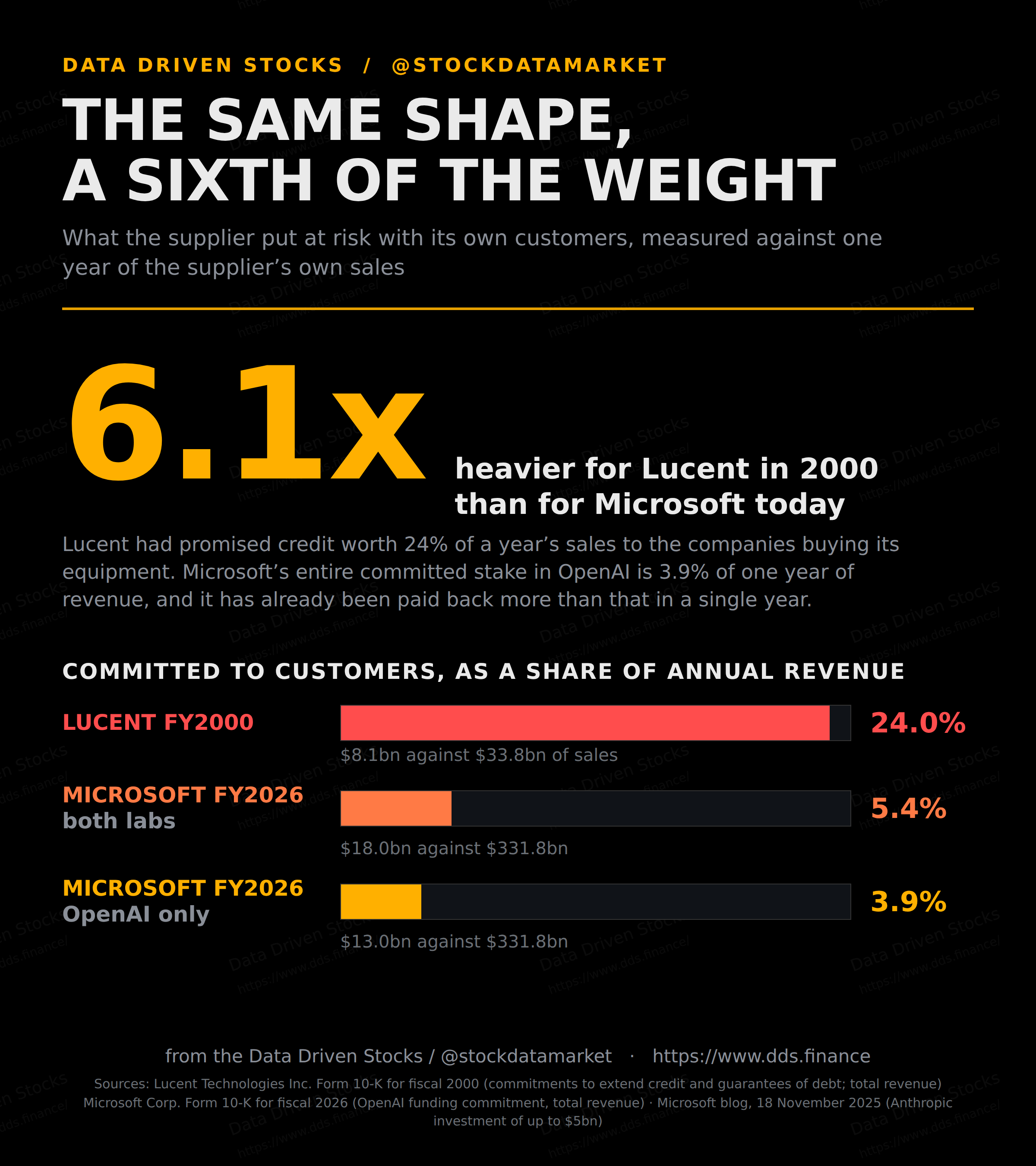
Lucent had put 24 percent of a year’s revenue at risk with its customers. Microsoft’s entire committed stake in OpenAI is 3.9 percent of one year of revenue, or 5.4 percent if you add the announced Anthropic investment. Microsoft generated 182.9 billion dollars of operating cash flow last year and still had 67 billion left after spending 116 billion on property and equipment.
There is also the small matter that Lucent’s customers had no revenue. OpenAI’s revenue is disputed at the margin but not in kind. Its chief financial officer said annualised revenue passed 20 billion dollars in 2025, up from 6 billion in 2024. Anthropic said in May 2026 it had crossed a 47 billion dollar run rate. These are not shell carriers waiting on a fibre build.
The risk is different too. Lucent’s risk was credit. Microsoft’s risk is demand. If AI spending slows (or its costs goes down), nobody defaults on Microsoft. What happens instead is that a 678 billion dollar backlog gets renegotiated, and 431 billion dollars of gross property and equipment keeps depreciating on schedule against revenue that arrives later than planned. That is a slower, duller failure than a bankruptcy court. It is also much harder to see coming, because the backlog will still look enormous the whole way down.
The one line to keep
Microsoft is not funding OpenAI’s payments to Microsoft. Third parties are, at valuations that assume a great deal. The loop is real but it is not closed, and the open end of it runs through private markets that have shown no interest in slowing down. But doesn’t mean they may slow down at some point.
If OpenAI or Anthropic slows down at some point or their models become much cheaper to operate. Microsoft will lose a great share of revenue.
Sources
Microsoft Corporation, Form 10-K for the fiscal year ended 30 June 2026, filed 29 July 2026. https://www.sec.gov/Archives/edgar/data/789019/000119312526323660/msft-20260630.htm
Microsoft Corporation, Form 10-K for the fiscal year ended 30 June 2025, filed 30 July 2025. https://www.sec.gov/Archives/edgar/data/789019/000095017025100235/msft-20250630.htm
Microsoft Corporation, Form 10-K for the fiscal year ended 30 June 2024, filed 30 July 2024. https://www.sec.gov/Archives/edgar/data/789019/000095017024087843/msft-20240630.htm
Microsoft Corporation, Form 8-K Exhibit 99.1, fourth-quarter fiscal 2026 results, 29 July 2026. https://www.sec.gov/Archives/edgar/data/789019/000119312526323632/msft-ex99_1.htm
Microsoft Corporation, Form 8-K Exhibit 99.1, second-quarter fiscal 2026 results, 28 January 2026. https://www.sec.gov/Archives/edgar/data/789019/000119312526027198/msft-ex99_1.htm
Microsoft Corporation, Form 10-Q for the quarter ended 30 September 2024, filed 30 October 2024 (first disclosure of the $13 billion commitment).
Microsoft Investor Relations, FY26 Q4 press release and webcast, 29 July 2026. https://www.microsoft.com/en-us/investor/earnings/fy-2026-q4/press-release-webcast
Microsoft, “The next chapter of the Microsoft-OpenAI partnership”, 28 October 2025. https://blogs.microsoft.com/blog/2025/10/28/the-next-chapter-of-the-microsoft-openai-partnership/
OpenAI, “The next phase of the Microsoft partnership”, 27 April 2026. https://openai.com/index/next-phase-of-microsoft-partnership/
Microsoft, “Microsoft, NVIDIA and Anthropic announce strategic partnerships”, 18 November 2025. https://blogs.microsoft.com/blog/2025/11/18/microsoft-nvidia-and-anthropic-announce-strategic-partnerships/
Reuters, “Anthropic commits $30 billion to Microsoft Azure compute”, 18 November 2025. https://www.reuters.com/technology/anthropic-commits-30-billion-microsoft-azure-compute-2025-11-18/
Microsoft FY26 Q2 earnings call transcript, 28 January 2026 (Amy Hood on OpenAI’s share of commercial RPO). https://www.fool.com/earnings/call-transcripts/2026/01/28/microsoft-msft-q2-2026-earnings-call-transcript/
Microsoft FY26 Q4 earnings call transcript, 29 July 2026. https://news.alphastreet.com/microsoft-corporation-msft-q4-2026-earnings-call-transcript/
Bloomberg via Yahoo Finance, “Microsoft AI sales mostly come from OpenAI”, 5 August 2026. https://finance.yahoo.com/technology/ai/articles/microsoft-ai-sales-mostly-come-180651710.html
Microsoft, FY26 Q3 results and AI run-rate statement, 29 April 2026. https://news.microsoft.com/source/2026/04/29/microsoft-cloud-and-ai-strength-fuels-third-quarter-results/
Fortune, “OpenAI leaked financials”, 16 June 2026 (2025 revenue, losses and payments to Microsoft; documents independently verified by the Financial Times). https://fortune.com/2026/06/16/openai-financials-leaked-losses-revenue-profit/
Reuters via Yahoo Finance, OpenAI CFO Sarah Friar on annualised revenue, 19 January 2026. https://finance.yahoo.com/news/openai-cfo-says-annualized-revenue-173519097.html
Bloomberg, “OpenAI valued at $852 billion after completing $122 billion round”, 31 March 2026. https://www.bloomberg.com/news/articles/2026-03-31/openai-valued-at-852-billion-after-completing-122-billion-round
Anthropic, Series H announcement, 28 May 2026. https://www.anthropic.com/news/series-h
GeekWire, “Amazon invests $50B in OpenAI, deepens AWS partnership with expanded $100B cloud deal”, 27 February 2026. https://www.geekwire.com/2026/amazon-invests-50b-in-openai-deepens-aws-partnership-with-expanded-100b-cloud-deal/
PYMNTS, “Microsoft spending on Anthropic approaches $500 million a year”, 2026. https://www.pymnts.com/artificial-intelligence-2/2026/microsoft-spending-on-anthropic-approaches-500-million-a-year/
Lucent Technologies Inc., Form 10-K for fiscal 1999. https://www.sec.gov/Archives/edgar/data/1006240/000095012399011082/0000950123-99-011082.txt
Lucent Technologies Inc., Form 10-K for fiscal 2000. https://www.sec.gov/Archives/edgar/data/1006240/000095012300011855/y43690e10-k405.txt
Lucent Technologies Inc., Form 10-K for fiscal 2001. https://www.sec.gov/Archives/edgar/data/1006240/000095011701501896/a31752.txt
Lucent Technologies Inc., Form 10-K for fiscal 2002. https://www.sec.gov/Archives/edgar/data/1006240/000095011702003045/0000950117-02-003045.txt
U.S. Securities and Exchange Commission, “SEC Sues Lucent Technologies and Ten Individuals”, Press Release 2004-67, 17 May 2004. https://www.sec.gov/news/press/2004-67.htm
In re Winstar Communications, Inc., United States Court of Appeals for the Third Circuit, decided 3 February 2009. https://caselaw.findlaw.com/court/us-3rd-circuit/1316426.html
Nortel Networks Corporation, Form 10-K for 2000. https://www.sec.gov/Archives/edgar/data/1119664/000095014401003502/t26081ke10-k405.txt
Nortel Networks Corporation, Form 10-K for 2001. https://www.sec.gov/Archives/edgar/data/72911/000113031902000168/t06646e10-k.htm
U.S. Securities and Exchange Commission, “SEC Charges Nortel Networks”, Press Release 2007-217, 15 October 2007. https://www.sec.gov/news/press/2007/2007-217.htm
Motorola, Inc., Form 10-K for 2001 (Telsim vendor financing). https://www.sec.gov/Archives/edgar/data/68505/000091205702012645/a2074699z10-k.htm
Federal Reserve Bank of St. Louis, FRED series NASDAQCOM (Nasdaq Composite daily closes). https://fred.stlouisfed.org/series/NASDAQCOM
SEC XBRL company facts, Microsoft Corporation, CIK 0000789019 (revenue, capital expenditure and operating cash flow, fiscal 2016 to 2025). https://data.sec.gov/api/xbrl/companyfacts/CIK0000789019.json