
Is the ECB Facing Another 2008? Lagarde’s Crisis Playbook Meets the Worst Energy Shock Since the 1970s
The European Central Bank just froze rates, slashed growth forecasts, and warned of “significantly more uncertain” times. The 2008 comparisons are flying.

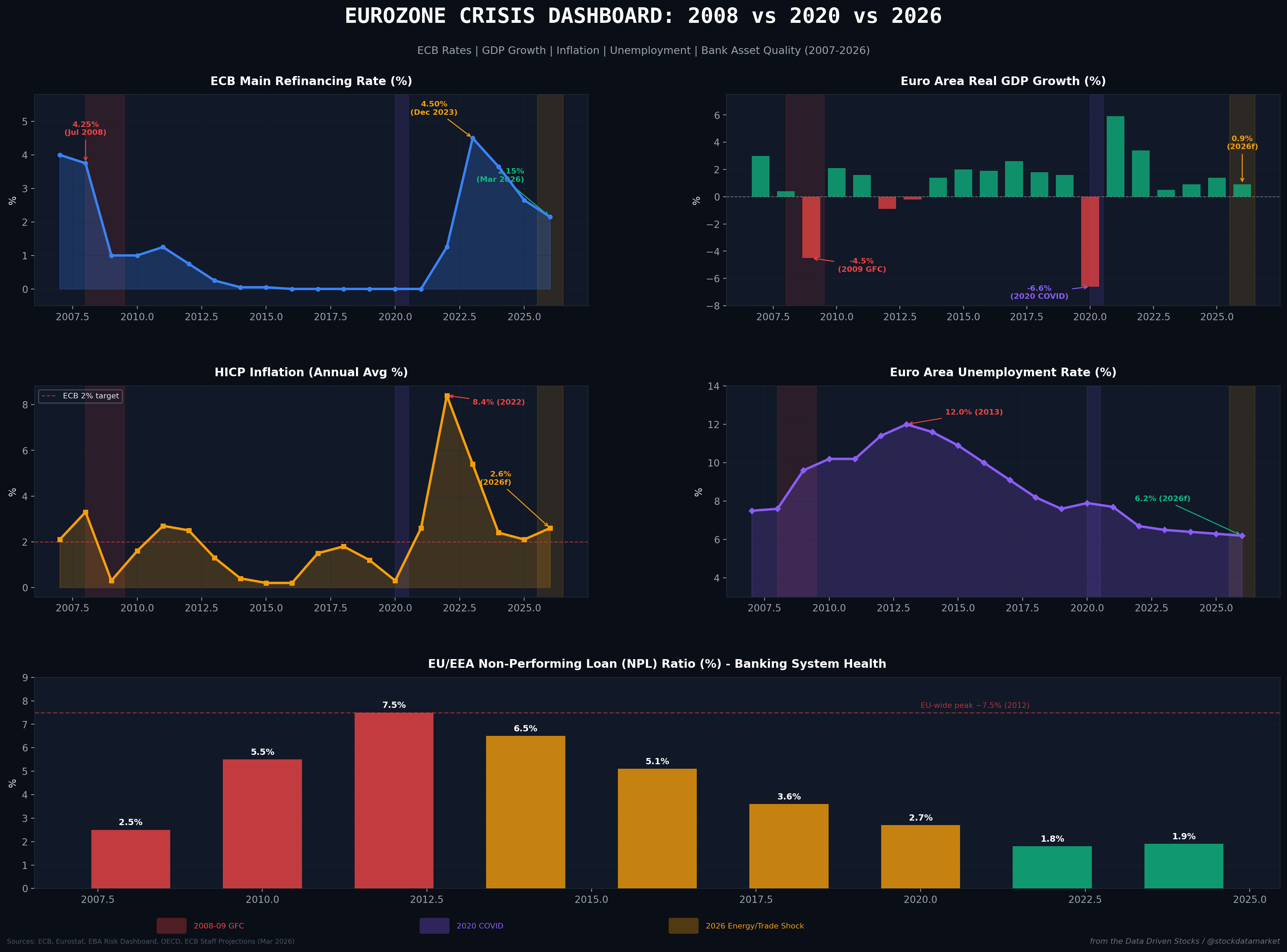
On March 19, 2026, the European Central Bank held its three key interest rates unchanged - the deposit facility at 2.0%, the main refinancing rate at 2.15%, and the marginal lending facility at 2.40%. What made this particular hold different from the quiet holds of late 2025 was the tone. ECB President Christine Lagarde stood at the Frankfurt podium and declared that the war in the Middle East had made the outlook “significantly more uncertain,” creating “upside risks for inflation and downside risks for economic growth.”
One week later, the OECD took a machete to the eurozone growth forecast, chopping it by 0.4 percentage points to a miserable 0.8% for 2026 and hiking the inflation projection by 0.7 points to 2.6%. The S&P Global flash PMI for March fell to 50.5, barely above the contraction line. The word that keeps echoing through trading desks and analyst notes is one that makes central bankers lose sleep: stagflation.
And in the background, a question that keeps surfacing in the financial press and on ECB watchers’ feeds: is this 2008 all over again?
The Ghost of 2008
Lagarde has a complicated relationship with 2008 comparisons. Across three major stress events - the COVID-19 onset in March 2020, the SVB/Credit Suisse turbulence in March 2023, and the current multi-front shock of energy disruption plus lingering trade tensions - she has repeatedly reached for the 2008 benchmark, only to argue that the current moment is fundamentally different.
During the ECB press conference on March 12, 2020, as COVID was shutting down Italy and markets were in freefall, Lagarde explicitly framed the pandemic as something “different from the great financial crisis.” The shock, she argued, was a supply shock feeding into a demand shock, not a systemic banking collapse. In an interview with Le Parisien published on April 9, 2020 and reproduced by the Bank for International Settlements, she contrasted the origins directly: 2008 was a “financial” crisis, while the pandemic was a “healthcare” crisis. She emphasized that euro area banks had capital ratios that had “practically doubled” since 2008.
Three years later, when Silicon Valley Bank collapsed and Credit Suisse was absorbed by UBS, the question came up again at the March 16, 2023 press conference. Lagarde pointed to Basel III reforms, stronger capital positions, and improved liquidity as reasons why Europe was not reliving 2008. The data backed her up: EU/EEA non-performing loan ratios sat at roughly 1.8% in mid-2022, according to the EBA Risk Dashboard, compared with the EU-wide peak of approximately 7.5% reached in 2012 during the post-GFC euro area sovereign crisis.
The pattern is clear. Every time a new crisis emerges, the first instinct is to measure it against the catastrophe of 2008. And every time, the ECB’s answer has been some version of: this is bad, but the banks are stronger, the tools are better, and the nature of the shock is different.
But here is where 2026 gets complicated. Because the nature of the current shock is not just one thing.
A Triple Threat in March 2026
The eurozone in March 2026 is absorbing three overlapping pressures simultaneously.
The first and most acute is the energy shock from the war in the Middle East. The conflict, which escalated in late February 2026 with strikes on Iran, led to the functional closure of the Strait of Hormuz - the chokepoint through which roughly 20% of global crude oil and a significant share of global LNG trade flows. Iranian strikes hit energy infrastructure including Qatar’s Ras Laffan Industrial City, the world’s largest LNG export hub. Brent crude surged past $120 per barrel. European TTF gas benchmarks nearly doubled, jumping above 60 EUR/MWh by mid-March - their highest level in over three years. European gas storage was already historically low at around 30% capacity after a harsh winter.

The second pressure is the lingering trade friction with the United States. While the US Supreme Court struck down the original broad tariff strategy as unconstitutional, a replacement 10% global tariff was imposed. ECB staff analysis estimates that 25% US tariffs on EU imports would reduce euro area growth by approximately 0.3 percentage points in the first year. Lagarde herself, speaking on CBS’s Face the Nation on February 22, 2026, warned that shaking up the existing trade equilibrium would bring “disruptions in business for sure.” She also stressed that uncertainty alone inflicts more economic damage than the tariff rates themselves, because businesses delay investment and hiring when they cannot forecast trade conditions.
The third is the structural weakness in Europe’s industrial base. Germany, once the engine of eurozone growth, has been struggling for years with high energy costs, the EV transition, and competition from China. The Conference Board’s March 2026 forecast noted that euro area PMI had been improving into early 2026 before the war struck, with manufacturing sentiment turning positive for the first time since 2022. The war has now thrown all of that fragile recovery into question.
By the Numbers: 2026 vs the Past
The ECB’s March 2026 staff projections - which exceptionally incorporated information up to March 11, a later cut-off than usual - tell a sobering story. GDP growth for 2026 was revised down to 0.9%, a 0.3 percentage point cut from the December forecast. Headline inflation was revised up to 2.6% for 2026, driven by higher energy prices. Core inflation was also bumped to 2.3%. The projections assume oil peaks around $90 per barrel and gas peaks near 50 EUR/MWh in Q2, then declines. If the disruption persists longer, the numbers get significantly worse.

Let’s put this in context. During the 2008-09 Global Financial Crisis, euro area GDP contracted by 4.5% in 2009. During COVID, the contraction was even deeper at 6.6% in 2020. The 2026 projection of 0.9% growth is not a contraction at all - it is near-stagnation. This is a crucial distinction. The eurozone is not collapsing. It is stalling. It is running on fumes with the handbrake partially engaged.
On the inflation front, the comparison is equally nuanced. The 2008 crisis initially featured moderately elevated inflation (3.3% in 2008) that collapsed into near-deflation (0.3% in 2009) as demand evaporated. The 2022 energy crisis produced a massive 8.4% inflation spike. The 2026 forecast of 2.6% sits above the ECB’s 2% target but nowhere near the 2022 extreme. The concern is not about runaway prices - it is about inflation being just sticky enough to prevent the ECB from cutting rates to support growth. That is the definition of a policy trap.

The Banking Angle: Why 2026 Is NOT 2008
Here is where the 2008 comparison falls apart most dramatically, and it is worth spending real time on this because the banking system is the difference between a recession and a catastrophe.
In 2008, the crisis was born in the financial system. Overleveraged banks held toxic assets. Interbank lending froze. Lehman Brothers collapsed. European banks were deeply intertwined with the US mortgage market and with each other through sovereign debt exposures. The EU-wide non-performing loan ratio climbed relentlessly, peaking at approximately 7.5% around 2012. Bank capital was thin. The ECB’s toolkit was limited - it did not even start cutting rates until October 2008, months after the Fed had already slashed aggressively.
In 2026, European banks are in a fundamentally different position. CET1 capital ratios sit around 15% - roughly double what they were pre-2008. NPL ratios were 1.8% as of mid-2022 and remain in the low single digits. Basel III regulations have imposed far stricter liquidity and capital requirements. The EBA risk dashboards consistently show a banking system that is well-capitalized and liquid. When Lagarde was asked in March 2023 about systemic risk, she pointed to exactly these metrics and argued that the post-2008 regulatory architecture was doing its job.
The current shock is hitting Europe through the commodity channel and the trade channel, not through the banking channel. Banks are not the problem this time. They are actually one of the few sources of stability.
How the ECB Responded: Then vs Now
The contrast in rate policy between the two eras is striking.

In 2008, the ECB was widely criticized for being too slow. While the Fed had been cutting since September 2007, the ECB waited until October 2008 to make its first cut. It then moved with what it called “the largest cut ever decided over such a short period in Europe” - 325 basis points from 4.25% to 1.0% between October 2008 and May 2009. But the criticism, echoed by CEPR researchers and others, was that this reactive approach was “too little, too late.” The ECB was building its shelter in a raging storm.
The 2023-2026 cycle looks very different. The ECB hiked to 4.50% by September 2023 to combat post-pandemic inflation, waited until June 2024 to begin cutting, and then moved gradually - stepping the main refinancing rate down from 4.25% through 3.65%, 3.40%, 3.15%, 2.90%, 2.65%, 2.40%, and finally to 2.15% by June 2025. The larger September 2024 step reflected both a rate cut and a narrowing of the spread between the refinancing rate and the deposit facility under the ECB’s revised operational framework. Then it stopped. And it has held at 2.15% through six consecutive meetings.
The March 2026 hold was not a policy choice made from panic. It was a deliberate pause in the face of uncertainty. Lagarde emphasized being “data-dependent” and proceeding “meeting-by-meeting.” She is not pre-committing to any direction. The ECB still has room to cut if growth collapses, or room to hike if energy-driven inflation spirals. That optionality is itself a form of policy strength that did not exist in 2008, when rates were already near the floor and the unconventional toolkit was still being invented.
The Scorecard: Crisis by Crisis
So how does 2026 actually stack up against the past?

The 2008 GFC was a banking-system crisis with devastating labor market consequences. It took the euro area until 2013 to reach peak unemployment at 12.2%, and the scarring persisted for years afterward. The 2020 COVID shock was an output collapse - the deepest annual GDP contraction in modern European history - but it was met with unprecedented fiscal and monetary support, and the banking system held. The 2022 energy crisis was an inflation crisis, pure and brutal, hitting 8.4% as Russian gas supplies were weaponized.
The 2026 shock is harder to categorize because it is moderate across multiple dimensions rather than extreme in one. Growth is weak but not contracting. Inflation is above target but not spiraling. Unemployment is at a record low of 6.1% as of January 2026. Banks are solid. The energy shock is severe but the ECB’s March projections assume it peaks in Q2 and moderates. The real danger is not any single metric hitting a catastrophic level - it is the combination of mediocre growth, sticky inflation, and external shocks eroding confidence over time. This is a slow grind, not a sudden collapse.
What Could Go Wrong
The ECB’s March projections come with scenario analysis for exactly this reason. A prolonged disruption in oil and gas supply would push inflation above and growth below the baseline. The Conference Board estimates that sustained oil prices above $100/barrel could cut euro area growth by 0.1 to 0.3 percentage points while adding a similar amount to inflation. The IEA has described the current disruption as the “greatest global energy and food security challenge in history.”
If the Strait of Hormuz blockade persists through summer, Europe faces a severe problem refilling gas storage for the 2026-27 winter. Chemical and steel manufacturers in the EU have already imposed surcharges of up to 30% to offset surging electricity costs. Urea fertilizer prices have risen over 40% since mid-February, threatening crop yields into 2027.
And there is a political dimension. Reports suggest ECB President Lagarde may step down before her term ends, raising concerns about political influence on the bank’s future direction. The Trump administration’s Justice Department investigation into Federal Reserve Chair Jerome Powell has also put central bank independence into the global spotlight. In that environment, any hint that the ECB is losing its autonomy would be destabilizing.
The Bottom Line
Is this 2008? No. It is not even close in the banking dimension, and that is what made 2008 truly dangerous. European banks are not failing. The interbank market is not frozen. There is no Lehman moment on the horizon.
But “not 2008” is not the same as “not dangerous.” What the eurozone faces in 2026 is a slow-moving convergence of energy disruption, trade uncertainty, geopolitical risk, and structural industrial weakness that could trap the ECB between inflation that is too high to ignore and growth that is too weak to survive tightening. The PMI readings are flashing stagflation warnings. The OECD just slashed forecasts. The energy crisis is real and ongoing.
Lagarde has spent six years telling markets that the current crisis is not as bad as 2008. She has been right every time - on the banking metrics that matter most. But the question is not whether 2026 looks like 2008. The question is whether the eurozone can navigate a genuinely novel kind of stress - where the problem is not a system-breaking shock, but a relentless accumulation of medium-sized ones - with the tools and the political will available.
The data says this is survivable. The trend says it is going to hurt.
Sources
ECB Press Conference Transcript, March 19, 2026 - https://www.ecb.europa.eu/press/press_conference/monetary-policy-statement/2026/html/ecb.is260319~93b1cbad97.en.html
ECB Monetary Policy Decision, March 19, 2026 - https://www.ecb.europa.eu/press/pr/date/2026/html/ecb.mp260319~3057739775.en.html
ECB Staff Macroeconomic Projections, March 2026 - https://www.ecb.europa.eu/press/projections/html/ecb.projections202603_ecbstaff~ebe291cd3d.en.html
ECB Press Conference Transcript, March 12, 2020 - https://www.ecb.europa.eu/press/press_conference/monetary-policy-statement/2020/html/ecb.is200312~f857a21b6c.en.html
Lagarde Interview, Le Parisien, April 9, 2020 (BIS Reproduction) - https://www.bis.org/review/r200414a.pdf
ECB Press Conference Transcript, March 16, 2023 - https://www.ecb.europa.eu/press/press_conference/monetary-policy-statement/2023/html/ecb.is230316~6c10b087b5.en.html
EBA Risk Dashboard, Q2 2022 - https://eba.europa.eu/sites/default/files/document_library/Risk%20Analysis%20and%20Data/Risk%20dashboard/Q2%202022/1040158/EBA%20Dashboard%20-%20Q2%202022.pdf
European Banking Federation, Non-Performing Loans Facts and Figures - https://www.ebf.eu/facts-and-figures/non-performing-loans/
Eurostat Unemployment Releases (Sep 2013: 12.2%) - https://ec.europa.eu/eurostat/documents/2995521/5164586/3-31102013-BP-EN.PDF
OECD Interim Economic Outlook, March 2026 (via Euronews) - https://www.euronews.com/business/2026/03/26/oecd-cuts-eurozone-growth-forecast-as-energy-prices-surge
CNBC, “Stagflation alarm bells ring in the euro zone,” March 24, 2026 - https://www.cnbc.com/2026/03/24/euro-zone-pmi-staglation-risks-critical-energy-crunch-vdl-iran-war.html
Bloomberg, “Lagarde Says US Tariff Moves Risk Upsetting Equilibrium with EU,” February 22, 2026 - https://www.bloomberg.com/news/articles/2026-02-22/lagarde-says-us-tariff-moves-risk-upsetting-equilibrium-with-eu
The Dupree Report, “Lagarde Warns US Tariff Shakeup Threatens EU Trade Balance,” February 22, 2026 - https://www.thedupreereport.com/2026/02/lagarde-warns-tariff-upheaval-eu-trade/
World Economic Forum, “The global price tag of war in the Middle East,” March 2026 - https://www.weforum.org/stories/2026/03/the-global-price-tag-of-war-in-the-middle-east/
The Conference Board, Euro Area Economic Forecast, March 2026 - https://www.conference-board.org/publications/eur-forecast
ECB Lagarde Speech, “Trade wars and central banks: lessons from 2025,” September 30, 2025 - https://www.ecb.europa.eu/press/key/date/2025/html/ecb.sp250930~c973459788.en.html
Wikipedia, “Economic impact of the 2026 Iran war” - https://en.wikipedia.org/wiki/Economic_impact_of_the_2026_Iran_war
Statistics Netherlands (CBS), “Decreasing ECB interest usually leads to lower mortgage rate” (ECB rate history 2008-2009) - https://www.cbs.nl/en-gb/background/2009/34/decreasing-ecb-interest-usually-leads-to-lower-mortgage-rate
ECB Key Interest Rates (official page) - https://data.ecb.europa.eu/key-figures/ecb-interest-rates-and-exchange-rates/key-ecb-interest-rates
CNBC, “ECB, BOE, Swiss National Bank, Riksbank interest rate decisions,” March 19, 2026 - https://www.cnbc.com/2026/03/19/ecb-boe-swiss-national-bank-riksbank-interest-rate-decisions.html
CEPR/VoxEU, “The ECB and the Fed: A comparative narrative” - https://cepr.org/voxeu/columns/ecb-and-fed-comparative-narrative
Eurostat, “Euro area unemployment at 6.1%,” January 2026 Release - https://ec.europa.eu/eurostat/web/products-euro-indicators/w/3-04032026-ap

