Iran Just Built a Tollgate on 20% of the World’s Oil. Here’s What Happens Next.
The Strait of Hormuz has never been closed. It has never been controlled. It has never charged a single cent.

For forty years the Strait of Hormuz has been the world’s loudest bluff. Iranian generals would threaten to shut it, oil would twitch for a day, and then everything would go back to normal. Tanker captains kept sailing, insurers kept writing policy, and the dollar kept getting paid. Every crisis since 1979 followed the same script: rhetoric from Tehran, naval drills, a couple of seized ships, some op-eds in the Financial Times, and then silence.
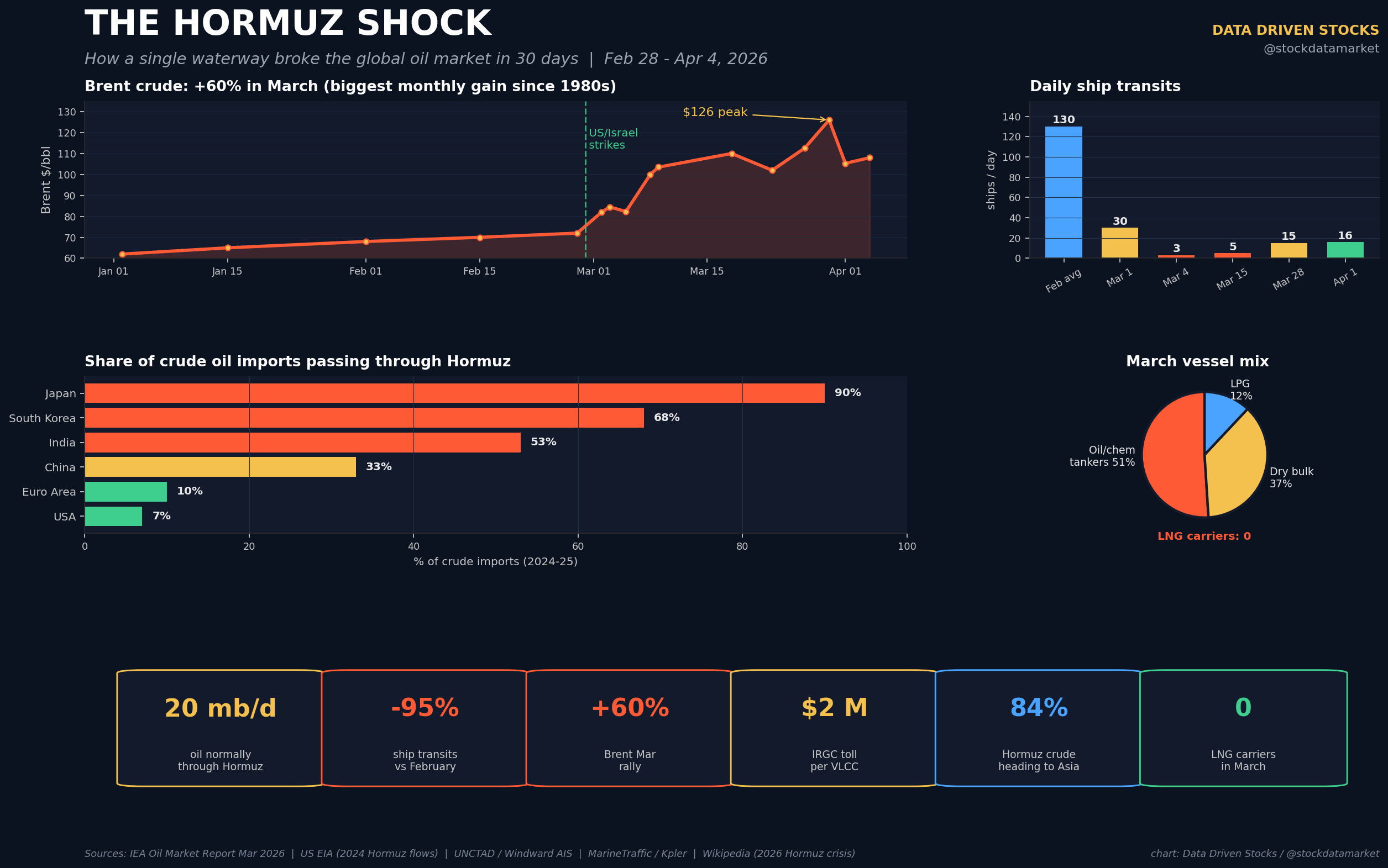
That script is now dead. On February 28, 2026, US and Israeli forces launched joint strikes on Iran. Within 72 hours the 130-ships-per-day artery through Hormuz had collapsed to single digits. Within three weeks, Iran’s Revolutionary Guard was charging tankers roughly a million dollars a trip to use an improvised corridor north of Larak Island, payable in yuan, rial or stablecoin. And within a month, Tehran had quietly done something no Iranian government - Pahlavi or Islamic Republic - had ever managed to pull off. It turned the world’s most important chokepoint into a toll road. And it got Oman to help administer it.
This is the story of how that happened, what it means for the countries on the receiving end, and why the spread between “paper” Brent and the barrels actually being delivered to Asia just told us something very important about the next phase of this crisis.
Has Iran ever actually controlled the Strait of Hormuz? No. Not once.
Let’s kill the myth before it metastasizes. Until 2026, the Strait of Hormuz had never been closed, never been tolled, and never been effectively controlled by any single state. Britannica’s historical record is blunt: “The Strait of Hormuz has never been truly closed, but shipping has been disrupted in the past.” The most famous disruption came during the 1980-88 Iran-Iraq War, the so-called Tanker War, when 283 Iraqi and 168 Iranian attacks damaged hundreds of merchant ships and killed more than 400 civilian sailors. The Strauss Center’s review of the conflict found that even at its most intense, the Tanker War disrupted less than two percent of Gulf traffic, and Iran itself lowered the price of its oil in the 1980s to offset insurance premiums - a tell that Tehran desperately wanted ships to keep coming. As the Strauss Center notes: “Despite repeated Iranian threats to close the Strait of Hormuz during the Tanker War, Iran did not follow through with this threat, as they themselves depended on the sea-lanes for vital oil exports.”
The geography has always worked against any would-be gatekeeper. The strait is 21 miles wide at its narrowest point, its shipping lanes sit mostly in Omani territorial waters, and it is governed by UNCLOS - the UN Convention on the Law of the Sea - which guarantees transit passage even through contested waters. Iranian naval bases on Bandar Abbas, Qeshm and Larak give Tehran the ability to harass, but the waterway’s depth (200-330 feet) and width make a permanent closure technically very hard to sustain. That is why, when Iran’s parliament authorized closure in June 2025 after an earlier round of US strikes on its nuclear sites, the Supreme National Security Council never signed off and the order died quietly.
What makes 2026 different is that the pretext changed. Iranian deputy foreign minister Kazem Gharibabadi, briefing state media, explicitly framed the new protocol as a wartime exception: Iran is “now in a state of war” and therefore “normal rules don’t apply.” And for the first time in the Islamic Republic’s 47-year history, Tehran isn’t trying to close the strait. It’s trying to monetize it. That distinction is the entire story.
The tollgate: how it actually works
Iran’s new regime is not a blockade. It’s a screening desk. In late March 2026, the Islamic Consultative Assembly’s security committee approved a bill imposing transit fees on all vessels using Hormuz. An earlier IRGC-managed proposal, leaked via the Seoul Economic Daily from Bloomberg reporting, set the rate at roughly one dollar per barrel, meaning a loaded VLCC carrying 2 million barrels would owe around $2 million just to cross the water. Wikipedia’s chronology of the crisis confirms the first VLCC to pay that exact $2 million did so on the Larak corridor in mid-March. Lloyd’s List reported that payments were being assessed by the Revolutionary Guards in Chinese yuan. The bill explicitly bars US-, Israeli- and sanctioning-state-linked vessels from the route altogether.
The mechanics are a ladder. Iran ranks every ship approaching the strait from Grade 1 (”friendly,” meaning Iran, China, Russia and a few others) all the way to Grade 5 (”hostile,” meaning the United States, Israel, the UK and anyone with obvious sanction entanglement). Grade 1 ships glide through on a token fee. Grade 5 ships don’t get through at all. Everyone else gets a rate card depending on flag, cargo, owner history and AIS footprint. Oman, which shares the southern bank of the strait via its Musandam exclave, has quietly indicated support for a “safe passage corridor” while publicly insisting on open transit under international law - the diplomatic fig leaf that lets the draft Iran-Oman protocol limp forward without anyone in Muscat having to admit they’re helping run a customs post.

The result is the most dramatic collapse in chokepoint traffic ever recorded. Before the war, UNCTAD clocked around 130 vessels a day crossing Hormuz - the background noise of the global oil economy. In the first week of March, that number fell to three. For an entire week the busiest maritime artery on Earth was processing fewer ships than a mid-sized river ferry. MarineTraffic and Kpler, cited by Anadolu Agency, counted just 220 vessel movements in all of March 2026 against a normal monthly baseline of roughly 4,000. Of those 220, 51% were oil and chemical tankers, 37% were dry bulk carriers, 12% were LPG vessels, and - for the first time in the data series - zero were LNG carriers. Qatar’s entire LNG export fleet, which under normal conditions moves about a fifth of global gas, simply stopped.

Why this matters: the physical vs paper divergence nobody is talking about
Here is the part of the story Wall Street keeps underreacting to. When you see “Brent at $108” on CNBC you are looking at a futures contract. That number reflects financial trading, positioning, hedging and crucially, the expectation that this crisis will resolve. Futures are a confidence poll, not a price of physical delivery. The actual price at which Asian refiners have been buying real barrels of Middle Eastern crude to put through their crackers - the Dubai benchmark - tells a much uglier story.
On March 19, Dubai crude touched an intraday high of $166 per barrel, an all-time record. By the following week Fortune was reporting Dubai prints above $150. CNBC’s coverage of CERAWeek in Houston quoted Chevron’s Mike Wirth and Shell’s Wael Sawan describing a wave of “physical manifestations” of the closure moving from South Asia into Northeast Asia and then toward Europe through April. Ben Cahill of the University of Texas at Austin summarized the disconnect perfectly to CNBC: paper prices have remained lower than physical prices “especially in Asia, the main buyer of crude from the Middle East.” In normal conditions, Dubai trades within a dollar or two of Brent. In March 2026 that spread blew out to more than $40.

Why should anyone outside the oil trading desk care? Because that gap is the real cost of the Hormuz closure, and it is being paid entirely by Asian importers. The IEA, in its March 2026 Oil Market Report, called this “the largest disruption to the global oil market in its history” and estimated that Gulf countries had cut at least 10 million barrels per day of production - “more than two” of the 1970s oil shocks put together, in the words of IEA director Fatih Birol on a Norges Bank podcast. Roughly 17.8 million barrels per day of oil and fuel flows through the strait have been disrupted according to Rystad, with nearly 500 million barrels of total liquids lost. Paola Rodriguez-Masiu, Rystad’s chief oil analyst, told CNBC the global oil system had shifted “from buffered to fragile” - early stocks, strategic reserves and crude-on-water kept the paper price somewhat contained through most of March, but that buffer is done.
Asia: the primary casualty
If you want to know who gets hurt first when Hormuz closes, read an EIA tanker-tracking study. The answer is simple and brutal. In 2022-2024, the EIA estimated that 82% of the crude moving through Hormuz went to Asian buyers. The IEA’s own 2025 data puts the figure at 84%, with China and India alone absorbing 44% of all Hormuz crude exports. Japan and South Korea together take another big slice, and both are among the most Hormuz-dependent major economies on Earth.
The regional dependency is not uniform, and that matters. Japan imports roughly 90% of its crude oil from the Middle East, almost all of it via Hormuz - the highest structural exposure of any major economy. South Korea isn’t far behind at around 68-70%. India’s Hormuz exposure sits around 53%, with well over half its crude coming from Gulf producers. Bangladesh and Pakistan are in a worse spot than their headline oil-import numbers suggest, because they depend on the strait not primarily for crude but for liquefied natural gas. Per the IEA’s country breakdown, Bangladesh, India and Pakistan together imported almost two-thirds of their LNG supplies through Hormuz in 2025, with gas-fired generation producing 50% of Bangladesh’s electricity and 25% of Pakistan’s. Close the strait and those grids start flickering within weeks.
The immediate economic channel is fertilizer. The Gulf accounts for 30-35% of global urea exports and 20-30% of global ammonia exports - products that also move through Hormuz. Brazil, the soybean king of the world and holder of about 60% of global soy exports, imports nearly half its fertilizer through the strait. A sustained disruption flows directly into planting decisions, then into yields, then into global food prices 12-18 months out. You can see why the IMF and IEA have both warned explicitly about secondary food shocks riding on the back of this oil shock. The Gulf Cooperation Council states themselves, which rely on the strait for over 80% of their caloric intake, saw a “grocery supply emergency” in mid-March with staple prices jumping 40-120% as Lulu Retail and others began airlifting food.
China: quietly winning, obviously exposed
China is the country whose position is most misunderstood in this crisis. On the surface, Beijing looks like the big beneficiary of the Iranian regime. China is Iran’s largest oil customer - Atlantic Council researchers estimate it buys over 80% of Iran’s seaborne exports, usually routed through shell intermediaries and priced in yuan. When Iran decided to charge Hormuz tolls in yuan rather than dollars, it effectively extended the “petroyuan” corridor that already existed between Tehran and Beijing. CIPS - China’s alternative to SWIFT - registered a spike in yuan settlement volume to record highs in mid-March.
But China gets roughly a third of its total crude oil imports through Hormuz, which means the disruption is also a hit to Chinese refiners. Two Chinese container vessels were actually turned back from the strait in late March despite being “friendly,” suggesting Iran’s screening is messier in practice than the rhetoric implies. Beijing has responded the way it always does in an energy crunch: by accelerating Russian oil purchases, tapping the roughly one billion barrels in its strategic reserve (a few months of supply, per Wikipedia), and using its leverage as Iran’s economic lifeline to quietly push for a ceasefire that restores normal flow without dismantling the new tolling regime. In other words, China would happily keep a petroyuan corridor as long as actual barrels keep arriving. Iran’s tollgate is useful to Beijing as a geopolitical lever against the West - but only up to the point where Chinese refineries start running dry.
Russia: the only pure winner
Russia is the one major country that benefits from the Hormuz crisis on every dimension. Higher oil prices directly fund Moscow’s budget, which had been squeezed by the long war in Ukraine and by the Western price cap. Brent at $110 versus Brent at $75 is worth something in the order of $50 to $100 billion in annual revenue for Russia at its current export volumes. Every barrel Iran cannot ship creates demand for Russian Urals, which is why US Treasury - per Wikipedia’s crisis chronology - actually suspended its embargo on Russia-connected tankers for 30 vessels carrying 19 million barrels through April 11. That is an extraordinary policy reversal and tells you exactly how desperate the situation became: Washington is essentially paying Vladimir Putin to keep European gas stations open.
Russia also benefits strategically. A petroyuan corridor through Iran reduces global dollar usage at the margin. It validates the “multipolar currency” thesis Moscow and Beijing have been pushing since 2022. And it forces the US Navy to spread even thinner across the Gulf at exactly the moment NATO is trying to consolidate support for Ukraine. For Russia, the Iranian gambit is a strategic gift, and one it did not have to pay for.
The EU and the United Kingdom: furious but toothless
Europe gets about 12-14% of its LNG from Qatar, nearly all of it via Hormuz. QatarEnergy, per Reuters reporting cited in Wikipedia’s crisis chronology, declared force majeure on all contracts once the strait closed. European LNG spot prices spiked, and the competition for alternative cargoes - primarily US Gulf LNG - pushed prices up for everyone. Pakistan and Bangladesh, which buy at the margin in the spot market, were priced out almost immediately. UK Foreign Minister Yvette Cooper declared that Britain would “comprehensively reject” any Iranian toll scheme. France echoed the line. But the practical response so far has been a joint statement from the UK, France, Germany, Italy, the Netherlands, Japan and Canada “to contribute to appropriate efforts to ensure safe passage through the Strait,” with nobody specifying what those efforts might actually be. No minesweepers have been dispatched. No European navy has escorted a tanker. Unlike the 1987-88 Operation Earnest Will, when Belgium, France, Italy, the Netherlands and the UK all sent warships into the Gulf alongside the US, this time Europe is watching.
The reason is simple: escalation risk is much higher now than it was in 1988. Iran’s missile arsenal has gone from Chinese Silkworms to modern anti-ship cruise missiles and drones. The USS Stark tragedy of 1987, when 37 American sailors died to an accidental Iraqi Exocet strike, would look mild against what the IRGC could do to a frigate in 2026. European foreign ministries know this. Cooper’s rhetoric is cover for inaction.
The United States: stuck between war premium and the pump
President Trump ordered the Navy on March 3 to “begin escorting tankers through the Strait of Hormuz” if necessary, while also instructing the US International Development Finance Corporation to underwrite political risk insurance for Gulf shipping. Neither order has produced meaningful results yet. Energy Secretary Chris Wright told reporters on March 8 that escorts “might be” needed but predicted that degradation of Iranian military capability would restore normal traffic “in the relatively near term.” A month later, traffic is not restored. US gasoline prices cleared $4.50 per gallon in March, with California topping $5 per gallon, according to Wikipedia’s chronology of the crisis and corroborated by The Middle East Insider. The IEA coordinated its largest emergency stock release in history - 400 million barrels - and the US committed 172 million barrels from the Strategic Petroleum Reserve over 120 days. Rystad’s analysts warned this only buys time. The cure is reopening Hormuz.
The United States imports only about 7% of its crude via Hormuz, so the direct physical exposure is small. The problem is that oil is a global price. A $10 move in Brent flows through to roughly $0.25 per gallon at the pump, according to Goldman Sachs. Gasoline at $4.50 to $5.00 is a very real political problem for an administration eight months into a term. More importantly, American allies in Asia - Japan, South Korea, Taiwan - are experiencing the crisis at full intensity because of their Hormuz dependency, and Washington is already fielding urgent requests for strategic reserve coordination and fuel sharing.
The Gulf states: the richest victims
Here is the surprise of the crisis. The Gulf Arab states, on paper the immediate beneficiaries of a Hormuz closure (they sell the oil!), are hurting badly. Saudi Arabia, the UAE, Kuwait and Iraq have collectively cut production by at least 10 million barrels per day because they physically cannot move the oil. Only Saudi Arabia and the UAE have pipelines that bypass the strait, with a combined effective capacity around 2.6 million barrels per day per the EIA - a drop in the bucket against a normal 20 mb/d flow. Iraq, Kuwait, Qatar and Bahrain have no bypass at all. Their tank farms filled up within two weeks. Aramco was shutting in wells by mid-March.
Worse, Iran did not stop at closing the waterway. The IRGC targeted desalination plants in Kuwait and Qatar, the source of 99% of drinking water in both countries. A Kuwaiti VLCC, Al Salmi, was struck by an Iranian drone while anchored at the Port of Dubai on March 31, causing a fire. Qatar’s LNG exports went to zero. The Gulf Cooperation Council in early April was simultaneously watching its oil revenue collapse, its desalination capacity get bombed, its food imports disrupted, and its tourist economies empty out. Dubai’s luxury property sector - a proxy for Gulf confidence - went from record highs in January to bid-only by March 28. The people who “control” the oil have never been more dependent on a single piece of water they do not control.
North Africa: the collateral damage nobody is tracking
North Africa is the region almost no commentary has mentioned, and it matters more than analysts realize. Egypt, Morocco and Tunisia are all net energy importers with fragile fiscal positions. Egypt in particular runs a current account deficit that relies on exactly the kind of stable energy prices that Hormuz has destroyed. Libyan and Algerian crude trade at wider premiums to Brent when Hormuz flow collapses, but both countries have their own political fragilities that limit supply response. Suez Canal traffic has jumped modestly - around 5% more transits in March per Wikipedia’s crisis data - as Asia-Europe rerouting accelerates, which is a fiscal boost for Cairo. But the fertilizer price shock is devastating for North African wheat and olive producers, and the LNG competition pushes Algerian gas contracts with southern Europe into renegotiation territory. Egypt’s bread subsidy bill is already ballooning.
The more important North African story is the refugee and migration spillover risk. When food prices spike 40-120% across the Gulf and fertilizer scarcity hits Mediterranean agriculture simultaneously, the political stability across the Maghreb comes under strain. Europe’s Frontex agency has been discreetly modeling migration scenarios. Nobody publishes those models, but the Arab Spring of 2011 started with a bread price shock, and 2026’s bread price shock is, by every measure, worse.
The currency war nobody voted for
The subtext of Iran’s toll regime is the assault on what Paul Blustein of the CSIS has called “the petrodollar.” Iran is not charging tolls in dollars. It is charging in yuan, rial or stablecoins. That is not an accident. It is a deliberate attempt to route a chunk of global oil settlement outside the US dollar system, with Chinese financial infrastructure (CIPS) replacing SWIFT and Iranian banks replacing the correspondent banking system that the US Treasury has weaponized since 2018.
Does this kill the petrodollar? No. Blustein’s research is blunt on the point: the dollar still accounts for over half of global FX reserves and well over half of trade invoicing. A regional toll regime in one chokepoint - even a very important one - does not dislodge a reserve currency that has been entrenched for 80 years. Reuters and Fortune have both argued that the petrodollar is under strain but not dying. The more accurate framing is that Iran’s move creates a two-tier oil market: cheap passage for China, Russia and their clients paying in yuan, versus blocked passage and risk premiums for everyone paying in dollars. That bifurcation is the real long-term damage. It doesn’t need to replace the dollar. It just needs to exist alongside it, and to grow a little every year.
The IMF’s early crisis assessment warned of higher inflation and currency pressure across Asia, where dollar-pegged emerging markets are already seeing their reserves bleed as they defend import bills. The Indian rupee, Indonesian rupiah and Philippine peso have all weakened materially against the dollar since February 28, even as the dollar itself weakened against the yuan at the margin. That is the petrodollar’s stress signature: it holds up in aggregate, but it frays at the edges.
What to watch next
Three things will determine whether this becomes a permanent regime change or a six-month crisis that eventually resolves. First, whether Oman formally signs the draft protocol. Muscat has been careful to say the right things publicly while tolerating Iranian patrol operations in its territorial waters. If the Iran-Oman protocol gets formalized, the tollgate becomes durable and internationally legitimized - or at least, internationally tolerated. Second, whether China forces Iran to reopen the corridor in full. Beijing has enormous leverage over Tehran, and if Chinese refinery inventories get low enough, that leverage will be applied. Third, whether the US can extract a ceasefire that specifically reopens the UNCLOS-protected lane without leaving the toll structure intact. That is the outcome Washington wants and the one Tehran will resist hardest, because the toll regime is what converts a military defeat into a strategic gain for Iran.
The uncomfortable truth is that Iran has already won something it could not win in the Tanker War, could not win in 2011-12, could not win in 2019, could not win in 2025. It has established, in the eyes of every shipping company on Earth, that the Strait of Hormuz has a price. The number may move. The payment rails may change. But the precedent - that a single state can extract a cut from 20% of the world’s oil trade - is now embedded in every insurance underwriter’s risk model and every refinery’s procurement plan. That is the most important thing that happened in March 2026, and the markets are only beginning to figure out what it means.
The 40-dollar Dubai-Brent spread is the first draft of that answer.
Sources
International Energy Agency, Oil Market Report - March 2026 (iea.org/reports/oil-market-report-march-2026)
IEA, Strait of Hormuz (iea.org/about/oil-security-and-emergency-response/strait-of-hormuz)
US Energy Information Administration, Amid regional conflict, the Strait of Hormuz remains critical oil chokepoint - Today in Energy, June 2025 (eia.gov/todayinenergy/detail.php?id=65504)
US Energy Information Administration, About one-fifth of global liquefied natural gas trade flows through the Strait of Hormuz - Today in Energy (eia.gov/todayinenergy/detail.php?id=65584)
Congressional Research Service, Iran Conflict and the Strait of Hormuz: Impacts on Oil, Gas, and Other Commodities, Library of Congress (congress.gov/crs-product/R45281)
Wikipedia, 2026 Strait of Hormuz crisis (en.wikipedia.org/wiki/2026_Strait_of_Hormuz_crisis)
Wikipedia, Strait of Hormuz (en.wikipedia.org/wiki/Strait_of_Hormuz)
Wikipedia, Tanker war (en.wikipedia.org/wiki/Tanker_war)
Wikipedia, Economic impact of the 2026 Iran war (en.wikipedia.org/wiki/Economic_impact_of_the_2026_Iran_war)
Britannica, Strait of Hormuz and Has the Strait of Hormuz ever been closed? (britannica.com/place/Strait-of-Hormuz)
The Strauss Center, University of Texas at Austin, Strait of Hormuz - Tanker War (strausscenter.org/strait-of-hormuz-tanker-war/)
History Today, The First Tanker War with Iran (historytoday.com/history-matters/first-tanker-war)
History.com, The Strait of Hormuz: A Timeline of Tensions (history.com/articles/7-historical-fights-over-strait-of-hormuz)
The Conversation, Iran has been threatening to close the Strait of Hormuz for years (theconversation.com/iran-has-been-threatening-to-close-the-strait-of-hormuz-for-years-its-a-key-part-of-tehrans-defence-strategy-279237)
CNN, The Tanker War: How history is repeating itself on the Strait of Hormuz (cnn.com/2026/03/22/middleeast/iran-war-history-tanker-wars-intl-hnk-ml)
CNBC, Iran war-hit oil prices will soon rise if Hormuz stays shut (cnbc.com/2026/03/28/oil-gas-prices-iran-war-hormuz.html)
CNBC, Oil closes at highest level since 2022 on Iran war supply (cnbc.com/2026/03/27/oil-price-wti-brent-crude-trump-strait-hormuz-tensions-iran-ships.html)
CNBC, Oil prices: Analysts raise the alarm as crude soars over Iran war (cnbc.com/2026/03/09/oil-prices-iran-war-middle-east-us-israel-strait-of-hormuz.html)
CNBC, Oil supply crunch will worsen in April, IEA warns (cnbc.com/2026/04/01/oil-price-iea-fatih-birol-brent-iran-strait-hormuz.html)
Fortune, Oil prices hit nearly $110 as Iran vows to escalate (fortune.com/2026/03/18/oil-prices-110-crude-brent-iran-war-israel-strait-hormuz-lng/)
Capital.com, Crude Oil Price Forecast - Strait of Hormuz Closure (capital.com/en-int/market-updates/crude-oil-price-forecast-09-03-2026)
The Middle East Insider, Oil Price Today & 2026 Forecast: Live Brent & WTI Analysis (themiddleeastinsider.com/2026/04/01/oil-price-today-2026-brent-wti-live-forecast/)
gCaptain, The Strait That Never Shuts: History and Markets Defy Iran’s Latest Hormuz Threat (gcaptain.com/the-strait-that-never-shuts-history-and-markets-defy-irans-latest-hormuz-threat/)
Logistics Middle East, Measuring global supply chain reliance on Hormuz (logisticsmiddleeast.com/analysis/measuring-global-supply-chain-reliance-on-hormuz)
Times of Israel, Strait of Hormuz: Key oil route in middle of Iran crisis (timesofisrael.com/strait-of-hormuz-key-oil-route-in-middle-of-iran-crisis/)
Atlantic Council GeoEconomics Center, analysis on Iran-China yuan settlement via CIPS
Bloomberg, reporting via Seoul Economic Daily on the IRGC $1/barrel Hormuz toll proposal
Lloyd’s List, reporting on yuan-denominated Hormuz toll payments
UNCTAD / Windward, AIS tracking of Hormuz transit volumes February-April 2026
MarineTraffic and Kpler, vessel count data for March 2026 (via Anadolu Agency, April 3, 2026)
IRNA (Islamic Republic News Agency), statements by Iranian deputy foreign minister Kazem Gharibabadi on the draft Iran-Oman protocol
Rystad Energy, commentary by chief oil analyst Paola Rodriguez-Masiu on Hormuz disruption volumes
Paul Blustein / CSIS, commentary on petrodollar resilience
BCA Research, estimates on supply loss trajectory by Marko Papic