
FIFA World Cup 2026? What is the relation with that America Added 172,000 Jobs in May 2026. So Why Does It Still Feel Like There Are No Jobs?
The May 2026 jobs report was supposed to settle the argument. It didn’t. It just made the argument more interesting. Also FIFA World Cup 2026 is coming this week - you feel the connection ?

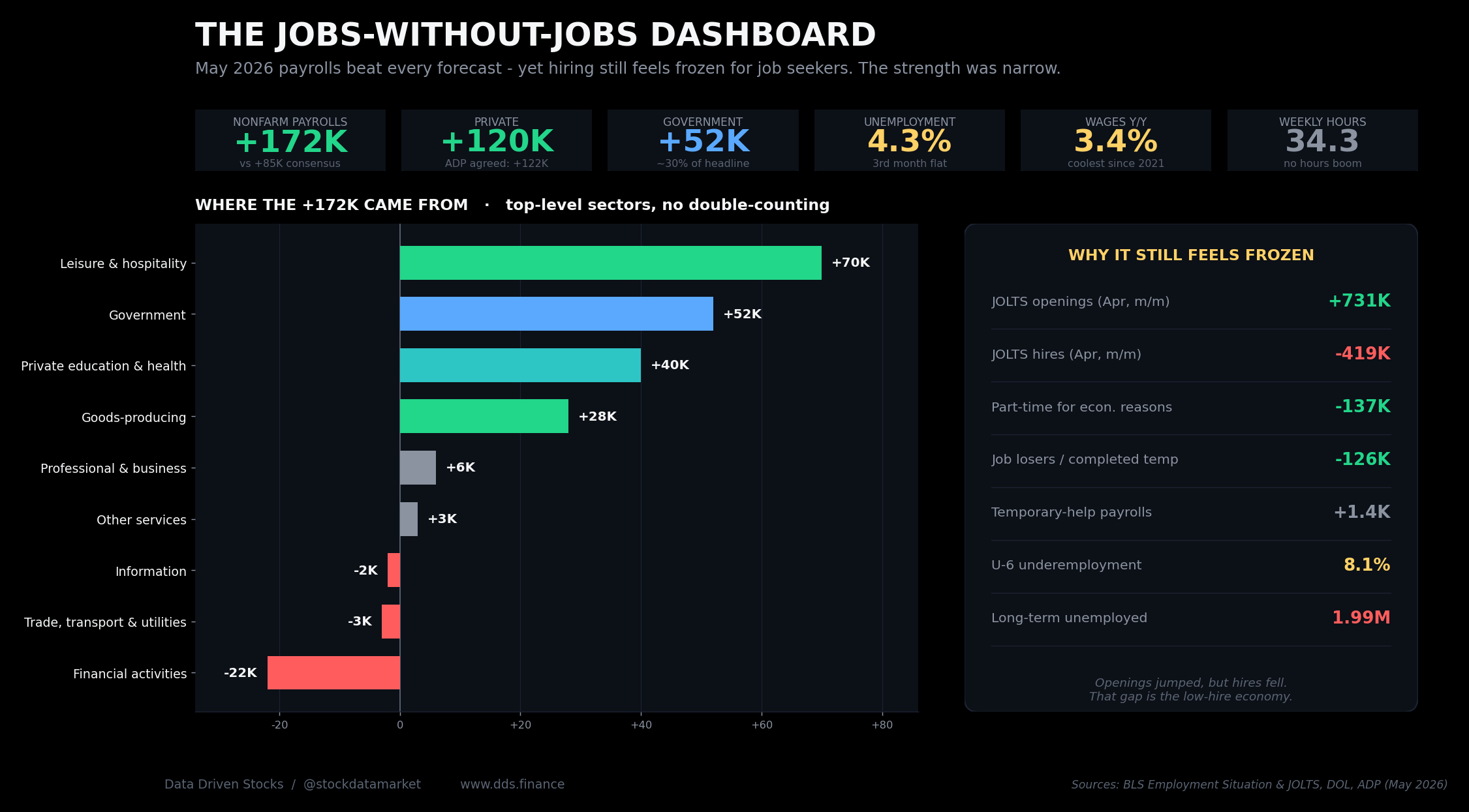
Nonfarm payrolls rose 172,000. Economists surveyed by Reuters had penciled in about 85,000, and the Dow Jones crowd was even lower at 80,000, so this was a beat of more than double the low end. Unemployment held at 4.3% for a third straight month. Wages rose 0.3% on the month and 3.4% over the year. The average workweek stayed at 34.3 hours. By every surface measure, this was a strong, resilient labor market that refused to roll over.
And yet, scroll any feed and you’ll find the same complaint you’ve heard for a year: there are no jobs. People with resumes out for months. New grads ghosted. Mid-career switchers stuck. Both things are true at the same time, and the gap between them is the entire story of this report. The payroll number can rip while the job hunt stays frozen, and once you understand why, you understand the 2026 labor market better than most of the hot takes.
So let’s actually dig in. Where did the 172,000 come from, who’s hiring, who’s cutting, what the revisions did to the picture, whether the World Cup quietly smuggled jobs into the number, and where this all goes through 2027.
The headline was real. The breadth was not.
This is the part people skip. A payroll beat does not mean every corner of the economy is hiring. It means enough big buckets expanded to outweigh the buckets that shrank. And in May, the buckets that expanded were a very specific, very recognizable trio.
Of the 172,000 jobs, 120,000 were private and 52,000 were government, which means roughly 30% of the entire month came from the public sector. Manufacturing chipped in a modest 7,000. The real muscle, though, came from three places: leisure and hospitality added 70,000, government added 52,000, and health care and social assistance added 47,200. Stack those up and you have basically explained the whole month before you’ve even reached the rest of the economy.
Now put the negatives next to them. Financial activities lost 22,000 jobs and is down 107,000 since its peak a year earlier, with the damage concentrated in insurance carriers and commercial banking. Information shed 2,000. Trade, transportation, and utilities slipped 3,000, dragged by a roughly 9,000 drop in air transportation that reportedly traced back to a single business closure. These are not small, sleepy categories. These are the white-collar and logistics engines that, in a genuinely broad boom, would be adding workers too. They weren’t.
That’s the tension in one image. Three sectors carried the month. Several others quietly subtracted. The arithmetic still landed at a healthy-looking 172,000, but the composition is what a job seeker actually lives in, and the composition was narrow.

It’s worth pausing on that private-sector number, because it’s the part that actually beat expectations. Private payrolls added 120,000, and since government hiring is largely budget-driven and anticipated, that private gain is the real engine of the upside surprise. But hold it up against history and the “beat” shrinks into perspective. Going back to 1939, private payrolls have grown by an average of about 105,000 a month, so May landed only modestly above the long-run norm. This is the same series that cratered by an almost unimaginable 19.55 million jobs in a single month in April 2020 and then snapped back by a record 4.61 million that June - the two most violent months in nearly nine decades of data. Set against that, a 120,000 print is not a boom. It’s a firm, ordinary month, which is exactly the tone of the entire report.

So what kind of jobs were these - full-time, part-time, or temporary?
The next question is what kind of work that 120,000 actually represents. Solid full-time roles, or the disposable, gig-style jobs that pad a headline and vanish? The answer is revealing.
Start with the cleanest test. If this were a staffing-agency surge - the statistical sugar that shows up and melts away - temporary-help payrolls would be climbing. They rose just 1,400. So this was not a temp boom.
The household survey, which counts people rather than jobs, tells a subtler story. Full-time employment actually slipped by about 79,000 in May, while part-time employment jumped by 266,000. On the surface that looks like a quiet shift toward part-time work. But the involuntary part-time count - people stuck in part-time jobs because they can’t find full-time work - fell by 137,000. So the move toward part-time was largely voluntary, and it landed exactly where you’d expect: in the hourly, shift-based service jobs that drove the month. The two surveys don’t always agree month to month, and the aggregate workweek held steady at 34.3 hours, so this isn’t a clean signal of a deteriorating job mix. But it fits the texture of the gains - a lot of restaurant, bar, hotel, and care-shift work, which skews hourly and part-time, and not much of the salaried, career-track hiring people are actually chasing. And as the World Cup exhibit later in this piece shows, a large slice of that hospitality hiring - on the order of the 56,000 above-trend surge - looks tied to one-off tournament anticipation rather than durable demand.
The table below lays out the entire private beat by sector: the work itself, the job quality, the AI exposure, and the World Cup link.

Service jobs, public jobs, and care jobs - the three engines
Break the engines down and the picture gets even clearer.
Leisure and hospitality is the loudest one. Inside that 70,000, food services and drinking places alone added 48,000, accommodation added about 10,600, and the most event-sensitive line in the entire report - performing arts, spectator sports, and related industries - added just 6,700. So the leisure surge was overwhelmingly restaurants, bars, and hotels. High-turnover, mostly hourly, often the first jobs to come back when consumers keep spending. Real jobs, but rarely the kind a frustrated white-collar applicant is hunting for.
Government is the second engine, and it’s almost entirely local. Local government added 55,000, with municipal payrolls outside of education up 43,500 and local education up 12,100, while state government actually fell 4,000 and the federal government barely moved at plus 1,000. Public hiring runs on budgets and staffing plans, not on whether private job seekers feel optimistic. When cities staff up administration, safety, transit, and recreation, the payroll number rises regardless of the private-sector mood.
The third engine is the care economy, and it’s the most structural of the three. Health care and social assistance added 47,200, with health care itself up 35,200. Inside that, ambulatory care services added 25,700, home health care alone added 10,900, hospitals added 6,000, and social assistance kicked in another 12,000. This is demographic demand. An aging population needs more care every single year, almost regardless of the business cycle, which is why health care has been one of the most reliable job creators of the entire post-pandemic era.
Here’s the uncomfortable takeaway. The jobs were real. They just weren’t the jobs that make the labor market feel easy. They were heavily service, heavily public, and heavily care-economy. A payroll print can be carried by exactly those categories while the durable, full-time, career-track hiring that people are actually chasing stays scarce.
It wasn’t a temp boom - and not the World Cup story you’d expect
Two theories went viral the moment the number printed. The first: it’s all temp jobs, statistical sugar that vanishes next month. The second, given the timing: FIFA and the World Cup juiced the number with one-off event hiring. Both are tidy. Both are mostly wrong, and the data says so without much ambiguity.
Start with temp work. The cleanest payroll proxy for temp-agency labor is temporary help services, and that line added a grand total of 1,400 jobs in May. If May had been powered by a wave of short-term staffing, that number would be screaming. Instead it barely registered. The broader employment-services category added only 3,600. This was not a temp-agency month.
Now the World Cup. Yes, World Cup hiring exists - that part is true. FIFA posted fixed-term tournament roles, Miami’s host committee listed project-based jobs running through July 2026, Dallas had short-duration arrivals-and-departures positions stretching into mid-July, and Reuters reported that more than 2,000 mostly concessions-related workers at SoFi Stadium were tangled in a labor dispute right before kickoff. Local event work is genuinely happening. But local event work is not a national payroll explanation, for two stubborn reasons. First, the May payroll survey counts the pay period including the 12th of the month, and the tournament kicked off in June, so most tournament hiring sits outside the May reference window. Second, the single most sports-sensitive payroll line in the whole report - performing arts and spectator sports - added only 6,700. That’s tiny next to 172,000, and it’s dwarfed by food service, local government, and health care.
If the World Cup leaves a clean statistical fingerprint, it should show up later, in June and July, in host-city hospitality, transport, public safety, venue operations, and food service. The May national number was mostly ordinary hospitality, municipal payrolls, and care-economy hiring. The honest one-liner: World Cup hiring was real but local, and the simple “stadiums staffed up” story does not explain a 172,000 national print. Whether even that “ordinary hospitality” is as ordinary as it looks, though, is exactly what the next section pulls apart.

Going deeper: where the three engines really came from - and whether they last
That’s the surface answer. But the real question worth chasing is the one most coverage skips: were these jobs a one-off, or are they built to last? Because “hospitality, local government, and health care” sounds like a tidy phrase until you actually pull each engine apart and ask where the work comes from, what kind of work it is, and whether it survives the summer. So let’s do exactly that.
First, a myth to retire. The 172,000 figure was not a record - the economy was adding more than half a million jobs a month back in 2021. What was unusual was the concentration, and the size of two specific gains relative to their own recent pace. So the right first question isn’t “was the month big,” it’s “which engines actually broke from trend.”
The answer is sharp. Leisure and hospitality added about five times its average monthly gain of the prior year, food services more than three times, and local government a stunning five-and-a-half times its recent pace. Health care, by contrast, came in at roughly nine-tenths of its normal monthly gain. Read that again, because it reframes everything: health care did not spike. It simply showed up and did what it always does. The genuine standouts - the gains that made this month look unusual - were hospitality and local government.

Now zoom into what kind of work these actually were. Inside leisure and hospitality, restaurants and bars did most of it at 48,000, with hotels adding another 10,600 and the entire arts, entertainment, and recreation bucket adding 11,700 - of which the genuinely sports-specific line, performing arts and spectator sports, was just 6,700. Inside government, the muscle was local government outside of education at 43,500, the kind of municipal payroll that covers administration, public safety, transit, parks, and sanitation, with another 12,100 in local public education, a token 1,000 in federal, and a 4,000 decline in state. Inside the care economy, the gains were ambulatory health care at 25,700 - home health care alone was 10,900 - plus 12,000 in social assistance, 6,000 in hospitals, and 3,500 in nursing and residential care. These are the textures that matter, because they tell you whether you’re looking at durable jobs or disposable ones.

Engine one - local government is not an event, it’s a multi-year boom
This is the gain most people misread, so it deserves the most attention. A 55,000 jump in local government in a single month looks suspicious, maybe even event-related. It isn’t. It’s the latest installment of a hiring run that’s been building for three years.
Here’s the backstory. State and local government shed roughly 1.5 million jobs in the first months of the pandemic as in-person services shut down and governments braced for a revenue collapse that never came. Instead, federal aid and resilient tax receipts left them in their strongest budget position in decades. Localities didn’t claw all the way back to their pre-pandemic level until late 2023 - and then they kept going. Since the start of 2023, state and local government has added more than a million jobs, and according to analysis by the Pew Charitable Trusts, public-sector employment growth has outpaced the private sector for the first time since the onset of the Great Recession in 2007. There’s still a backlog: unions and the data both describe far more public vacancies than hires, which is precisely why this hiring keeps showing up month after month.
So when local government adds 43,500 jobs outside education in May, that is not a tournament hiring a stadium crew. These are permanent municipal roles, and the category as a whole now sits well above its old peak. The one honest caveat is the size: a 55,000 print at five-and-a-half times the recent trend is lumpy, and a chunk of it will likely give back in coming months simply because monthly hiring is noisy. But the jobs themselves are durable, not disposable - and they tend to be lower-paying public-service roles, which is part of why a strong headline can coexist with soft wage pressure.

Engine two - hospitality is where the World Cup actually shows up
Here’s the twist, and it’s worth being honest about because it sharpens the earlier point. The direct sports-staffing line was tiny - performing arts and spectator sports added only 6,700, and temp agencies barely moved. So this was not a “stadium hired a bunch of people” month. But that’s not the channel that mattered. The World Cup shows up indirectly, through restaurants and bars staffing up before the influx.
The evidence for that is fairly strong. The leisure and hospitality gain of 70,000 was the biggest in roughly three years, and it ran about five times the sector’s prior-year pace. Bank of America described the move as an early sign of “World Cup fever.” Bloomberg framed the surge explicitly as US and Canadian hospitality businesses gearing up for a tournament that kicks off June 11. The chief economist at the National Restaurant Association tied part of the bump to the upcoming travel season, the World Cup included. And the anecdotes line up - a New York pub owner told reporters he’d hired seven extra bartenders ahead of the tournament. Crucially, none of this contradicts the survey-timing point from earlier. The payroll survey counts the pay period including the 12th, which is before kickoff, but businesses hire to be ready in advance, so anticipatory staffing lands in exactly that window.
If you want the single clearest exhibit for the World Cup effect, it’s this: strip out the portion of the hospitality gain that matches the sector’s normal monthly pace, and what’s left is a roughly 56,000-job surge in leisure and hospitality - about 34,000 of it in restaurants and bars alone - that has no ordinary explanation and lines up precisely with the run-up to the tournament. That above-trend lump is the part of the headline that was, in effect, quietly imported by the calendar.

That makes hospitality the part of the report with the clearest one-time character. The restaurant base itself is durable and has fully recovered its pandemic losses. But the size of the May lift looks like it borrowed demand from a specific event plus the normal summer ramp, and that’s the piece most at risk of fading. It’s also the piece most exposed to a wobbling consumer. With energy prices elevated, headline inflation running near 3.8%, and real household incomes reported lower for three straight months, discretionary dining is exactly the kind of spending that gets cut first - and hourly hospitality jobs are the first to go when it does.
Engine three - health care is the one that isn’t a story
The quietest engine is the most important one for the long run, precisely because it’s boring. Health care and social assistance added 47,200, but as we saw, that was slightly below its own recent trend. There’s no event here, no anticipation effect, no policy quirk. It’s demographic gravity - an aging population that needs more ambulatory care, more home health aides, more hospital staff, and more social assistance every single year. This engine has been the steadiest job creator of the entire post-pandemic era, even as its monthly pace has cooled a little from roughly 74,000 a month in 2024 to about 57,000 in 2025. If you want to know what’s still hiring in a frozen market, this is it. It just doesn’t make headlines because it never stops.
The verdict - mostly durable, with one clear one-time risk
So, were these one-time event jobs? Mostly no. The care-economy gains are structural, the municipal gains are permanent roles inside a documented multi-year boom, and the genuinely event-driven, disposable lines - sports staffing and temp agencies - barely registered. The honest exception is the hospitality surge, where a durable restaurant base picked up a real but probably temporary lift from World Cup anticipation and the summer travel season. That’s the piece most likely to fade, and the piece to watch as the tournament ends and the consumer tightens.
The cleaner way to say it: the jobs in this report were largely real and largely durable, but the unusual size of the month was inflated by lumpy local-government hiring that will smooth out and a hospitality bump that may not repeat. Strong month, narrower than it looks, and partly borrowed from the calendar.

The low-hire, low-fire economy: why openings can jump while hiring falls
Here’s where the report goes from interesting to genuinely revealing. The same week, the JOLTS data dropped, and it contained the single best explanation for the “no jobs” feeling that the headline can’t capture.
Job openings jumped to 7.618 million in April, up 731,000 from March, pushing vacancies to near a two-year high. On its own, that looks like a hiring boom waiting to happen. Except hires went the other way. Actual hires fell to 5.116 million, down 419,000. Total separations fell to 4.978 million. Quits fell to 2.977 million. So employers posted a lot more vacancies, hired fewer people, and workers got less confident about jumping ship.
It gets sharper when you look under the hood. Almost the entire openings jump came from one sector - professional and business services, where openings leapt from about 1.05 million to 1.72 million, a move so concentrated that some economists openly wondered whether it was a noisy print. Meanwhile, the industries you’d expect to be scrambling for workers were doing the opposite. In accommodation and food services, openings actually fell from 753,000 to 679,000, and hires fell from 855,000 to 803,000. There was no national stampede for service workers in the lead-up to May. There was a single-sector spike in postings that did not translate into people actually starting jobs.
This is what economists at the Richmond Fed have been calling a low-hiring, low-firing, low-quits equilibrium. Layoffs stay low, so if you have a job, it feels stable. But hiring also stays low, so if you don’t have the job you want, it feels like a wall. The payroll number is the net of roughly five million hires and five million separations every month, and when both sides slow down together, the headline can still be positive while the lived experience of job hunting gets worse. Stable and frozen are not opposites. In 2026, they’re the same market viewed from two different seats.

To make the two-seat problem concrete, here’s the same idea as a schema. One track counts jobs added to employer books. The other tracks whether those vacancies actually turn into someone starting work. The missing piece between them is hiring churn, and that’s exactly the piece that broke.

The household survey: not the involuntary part-time horror story either
If the payroll survey counts jobs, the household survey counts people, and it’s where the unemployment rate, participation, and the broader slack measures live. The meme version says May was secretly a surge of people forced into part-time work. The household numbers don’t back that up.
People employed part time for economic reasons - the involuntary part-timers - actually fell by 137,000 to 4.805 million. The people who said they could only find part-time work fell by 59,000. Job losers and people who completed temporary jobs fell by 126,000 to 3.385 million, which is the opposite of what you’d see if the month were a churn of short-lived gigs ending and dumping people back into unemployment. The broad U-6 underemployment rate even eased a touch, to 8.1% from 8.2%. On the most worrying slack measures, May improved.
But - and this is the honest counterweight - the slack did not vanish. U-6 at 8.1% is still above the 7.8% reading of a year earlier. The number of long-term unemployed, people out of work 27 weeks or more, rose to 1.988 million and now accounts for 27.5% of all unemployed people, up by 524,000 over the year. Discouraged workers ticked up. Participation held at a soft 61.8%, still below the 63.1% it averaged in 2019. So the month got better on the margin while the year-over-year picture quietly got a little worse for the people stuck at the bottom of the ladder. That’s not a contradiction. That’s a labor market that’s stable on top and grinding underneath.
And that 27.5% is not a blip - it’s a reversal. Step back and the share of the unemployed stuck in long-term joblessness had been grinding lower since the 2021 spike, bottoming near 18% in early 2023. It has climbed steadily ever since, and at 27.5% it’s now the highest of this cycle, up from about 20% a year ago. This is the low-hire economy showing up in the number that matters most to a job seeker: not whether people are being laid off, but how long it takes to climb back once they are. Few are being fired, but the ones who do lose a job are getting stuck.

One genuinely encouraging footnote: prime-age participation, the 25-to-54 crowd, sat at 83.9% in May, slightly above the 83.6% it averaged in both 2024 and 2025. A lot of the weakness in the overall participation rate is demographics - an aging population retiring out - rather than working-age people giving up. The core of the workforce is still showing up.

The revisions changed the story - twice
You cannot understand this report without understanding what revisions did to the backdrop, because the jobs narrative got rewritten twice in opposite directions.
The first rewrite was friendly. In the May release, the government revised the prior two months up by a combined 93,000, bringing March to 214,000 and April to 179,000. That’s a big deal. It means May didn’t arrive in isolation - the entire spring run looked sturdier after the fact. Plug in the latest figures for the year and payrolls are up roughly 569,000 over January through May, and the last three months averaged about 188,000 a month, a pace that looks far more like the pre-2025 normal than the stall that came before it.
The second rewrite was brutal, and it happened earlier in the year. With the annual benchmark - the process where payroll counts get re-anchored to near-complete tax records - the government cut the March 2025 level of total nonfarm payrolls by 898,000 on a seasonally adjusted basis, about 0.6%. Most of that was private payrolls, down 864,000. The preliminary estimate flagged an even larger hole near 911,000. For context, the average absolute benchmark revision over the prior decade was around 0.2%, so this was unusually large. Stripped down, it meant 2025 was even weaker than anyone realized at the time. The official line was blunt: payroll employment changed little in 2025, averaging just 15,000 a month.
Put the two rewrites together and you get the real frame. The market thought 2025 was soft. Then the benchmark said it was softer. Then spring 2026 bounced. That’s why this report carries weight - it isn’t just a strong month, it’s a rebound off a base that turned out to be much weaker than the real-time data suggested.

The long view: how American job creation actually got here
Zoom all the way out and the trend tells you everything the monthly noise hides. The trend pace of hiring - the smoothed, twelve-month average of monthly payroll gains - ran hot in 2022 at several hundred thousand jobs a month as the economy clawed back from the pandemic. From there it was a long, steady deceleration: cooler through 2023, cooler again through 2024, until 2025 flatlined into that roughly 15,000-a-month stall. Spring 2026 is the first stretch in a while where the trend has turned back up, with that three-month pace near 188,000.
So the question for the back half of 2026 isn’t whether the labor market is strong. It’s whether this is a genuine re-acceleration or a head-fake bounce off an artificially low base.

Unemployment tells the same story from a different angle. By the standards of the last quarter-century, 4.3% is low - far below the 10% of the financial crisis and the 14.8% spike of the 2020 shutdown, and not far off the 3.4% lows of 2023. But the direction matters. The jobless rate has drifted up into a 4.3% to 4.5% band since mid-2025 and stayed there, while broad underemployment crept to 8.1%. This is not a collapse. It’s a gentle loosening - the kind that’s easy to ignore in the headline number and impossible to ignore if you’re the one still looking.

What’s actually driving this - macro, AI, and the geopolitical backdrop
A jobs report never floats free of the rest of the economy, and the forces around this one all point the same direction: firm, but not hot.
Wages are cooling, not accelerating. The 3.4% annual pace of average hourly earnings is the slowest in years, and the Atlanta Fed’s wage tracker eased to 3.6% in April from 3.9% in March. That’s the profile of a labor market with enough demand to keep creating jobs but not enough pressure to reignite a wage-price spiral. On the cost side, though, there’s a wrinkle: first-quarter productivity was revised down to just 0.3% growth, and unit labor costs landed at 1.8%. Soft productivity means even modest wage growth still nudges labor costs higher, which keeps the inflation conversation alive even as wage growth itself fades.
That’s why the market read this report as hawkish. After the number, the two-year Treasury yield climbed toward 4.15%, the ten-year pushed to around 4.54%, the dollar firmed, equities opened softer, and the implied odds of a December rate hike jumped from roughly 48% to 65% in market pricing. The logic is straightforward. A labor market that keeps adding jobs takes the pressure off the Fed to ease, and if anything tilts the next move toward tightening. As one strategist framed it, for policymakers the binding constraint right now is inflation, not employment, and a firmer jobs picture only reinforces that.
There’s a structural story underneath the cyclical one, too. The soft headline participation rate is partly a demographic effect - an aging population retiring out - which is exactly why prime-age participation can stay healthy while the overall rate looks weak. Immigration and labor-supply composition feed into the same dynamic, shaping how many workers are even available to be counted. And the sectors carrying the job gains - care, local government, hospitality - are the ones least sensitive to the trade and policy turbulence that dominates the headlines, which is part of why the labor market has been able to grind forward even as the geopolitical backdrop stays noisy. The jobs being created are, in a sense, the most domestic and least globally exposed jobs in the economy.
And there’s one more structural force worth naming, because it shows up in this report mostly by its absence: artificial intelligence. Sort the private gains by how exposed each sector is to automation and the pattern is hard to miss. Every job gain came from in-person, hands-on work a model can’t easily do - hospitality, health care, construction. The white-collar, digital sectors most exposed to AI - information, finance, and professional services - collectively shed 18,000 jobs. That mirrors the macro story of the past two years in miniature. White-collar unemployment has risen each year since 2023 while blue-collar joblessness has held flat or fallen, according to BLS data compiled by CNBC. Goldman Sachs has estimated AI is already shaving roughly 16,000 jobs a month off US employment. Big Tech’s hiring of new graduates has dropped by about half from pre-pandemic levels, per the venture firm SignalFire, and Oxford Economics finds recent graduates - just 5% of the workforce - have driven an outsized share of the rise in unemployment since mid-2023. None of this proves AI dictated May’s specific sector splits, and some of what gets blamed on automation is ordinary cost-cutting in disguise. But the direction is unmistakable: the jobs still being created are increasingly the ones a model can’t do.

Where this goes: three paths into 2027
Forecasting the labor market a year and a half out is humility-inducing work, so treat what follows as scenarios, not promises. Anchor on what we actually know: the three-month pace is near 188,000, the trend has turned up off a weak base, layoffs are low, and hiring churn is still soft.
In the base case, the most likely one, the re-acceleration partly fades into normalization. The low-hire, low-fire equilibrium persists, payroll growth settles back into a roughly 110,000-to-130,000 monthly pace through 2027, and unemployment hovers in the 4.3% to 4.5% band it’s been stuck in. Boring, durable, and consistent with cooling wages and an economy that’s neither booming nor breaking.
In the bull case, the spring momentum holds. Private hiring keeps converging with the kind of strength ADP flagged, the openings eventually translate into real hires, and payrolls hold a 160,000-plus pace while unemployment edges back toward the low 4s. This is the “turning the corner” scenario, and it gets more plausible if the Fed stays patient and consumer spending holds.
In the bear case, May was the head-fake. The professional-and-business-services openings spike proves noisy, hiring stays frozen, the temporary spring lift fades, and payroll growth drifts back toward the 2025 stall in the 40,000-to-60,000 range. Unemployment grinds up toward 4.8% or 4.9% as the low-hire economy slowly stops absorbing new entrants. Long-term unemployment, already rising, gets worse first.
The single most important variable across all three is the one this whole report kept pointing at: hiring churn. Not openings, not layoffs - hires. The day vacancies start converting into actual jobs again is the day the “no jobs” feeling finally catches up to the headline. Until then, expect more months that look strong on top and feel frozen underneath.

Bottom line
The May 2026 jobs report was a real beat off a genuinely weak base, and it deserves to be taken seriously. But it was carried by three sectors - hospitality, local government, and health care - while finance and other white-collar corners quietly shrank. It was not a temp boom, and the direct sports-staffing was a rounding error - though, as we saw, the World Cup almost certainly lifted the hospitality piece through the side door, and that lift may not last. Strip out the lumpy local-government print and the event-driven hospitality bump and you’re left with a steadier, narrower core. And all of it sat on top of a JOLTS report showing the defining feature of this entire era: more openings, fewer hires, lower quits.
That’s how you get a strong number and a frozen feeling in the same week. Payrolls count jobs. Job seekers feel hires. Until those two reconnect, the headline and the vibe are going to keep telling different stories - and both of them will be right.
Sources
U.S. Bureau of Labor Statistics, Employment Situation Summary, May 2026 - https://www.bls.gov/news.release/empsit.nr0.htm
U.S. Bureau of Labor Statistics, Table B-1, Employees on nonfarm payrolls by industry - https://www.bls.gov/news.release/empsit.t17.htm
U.S. Bureau of Labor Statistics, Summary Table A, Household data - https://www.bls.gov/news.release/empsit.a.htm
U.S. Bureau of Labor Statistics, Table A-15, Alternative measures of labor underutilization - https://www.bls.gov/news.release/empsit.t15.htm
U.S. Bureau of Labor Statistics, Job Openings and Labor Turnover Survey (JOLTS), Table A - https://www.bls.gov/news.release/jolts.a.htm
U.S. Bureau of Labor Statistics, CES National Benchmark Article - https://www.bls.gov/web/empsit/cesbmart.htm
U.S. Bureau of Labor Statistics, Productivity and Costs, Q1 2026 revised - https://www.bls.gov/news.release/pdf/prod2.pdf
U.S. Department of Labor, Weekly Unemployment Insurance Claims - https://www.dol.gov/ui/data.pdf
ADP National Employment Report, May 2026 - https://mediacenter.adp.com/2026-06-03-ADP-National-Employment-Report-Private-Sector-Employment-Increased-by-122%2C000-Jobs-in-May-Annual-Pay-was-Up-4-4
Federal Reserve Bank of St. Louis, “The Effects of a Low-Fire, Low-Hire Economy on Workers” - https://www.stlouisfed.org/on-the-economy/2026/mar/effects-low-fire-low-hire-economy-workers
Federal Reserve Bank of Richmond, “A JOLTing Labor Market Situation?” - https://www.richmondfed.org/research/national_economy/macro_minute/2026/jolting_labor_market_situation
Federal Reserve Bank of Dallas, “Climbing the employment ladder tough when bottom rung is broken” - https://www.dallasfed.org/research/economics/2026/0526
Federal Reserve Bank of Atlanta, Wage Growth Tracker - https://www.atlantafed.org/chcs/wage-growth-tracker
Federal Reserve Economic Data (FRED), Total Nonfarm Payrolls (PAYEMS) - https://fred.stlouisfed.org/series/PAYEMS
Federal Reserve Economic Data (FRED), Unemployment Rate (UNRATE) - https://fred.stlouisfed.org/series/UNRATE
Federal Reserve Economic Data (FRED), U-6 Underemployment Rate (U6RATE) - https://fred.stlouisfed.org/series/U6RATE
Federal Reserve Economic Data (FRED), Labor Force Participation Rate (CIVPART) - https://fred.stlouisfed.org/series/CIVPART
Reuters, “Strong May jobs number sends yields, rate expectations higher” - https://www.reuters.com/business/view-strong-may-jobs-number-sends-yields-rate-expectations-higher-2026-06-05/
Reuters, “US job openings jump to near two-year high in April” - https://www.reuters.com/business/us-job-openings-jump-near-two-year-high-april-2026-06-02/
Bloomberg, “US Adds 172,000 Jobs in May, Beating All Economists’ Estimates” - https://www.bloomberg.com/news/articles/2026-06-05/us-adds-172-000-jobs-in-may-beating-all-economists-estimates
Bloomberg, “World Cup Preparations Boost US, Canada Job Growth in Hospitality Sector” - https://www.bloomberg.com/news/articles/2026-06-05/world-cup-likely-gave-a-lift-to-blowout-us-canada-jobs-numbers
Skift, “Leisure and Hospitality Leads U.S. Job Growth on World Cup Boost” - https://skift.com/2026/06/05/hospitality-leisure-job-gains-may-2026/
Marketplace, “Hospitality industry added 70,000 jobs in May. Did the World Cup help?” - https://www.marketplace.org/story/2026/06/05/did-world-cup-preparations-boost-hospitality-hiring
Newsweek, “Latest jobs report: Charting the top hiring and losing industries” - https://www.newsweek.com/jobs-report-may-2026-chart-winning-losing-industries-12037753
The Pew Charitable Trusts, “Slowdown in Private-Sector Jobs a Boon for State and Local Hiring” - https://www.pew.org/en/research-and-analysis/articles/2025/03/10/slowdown-in-private-sector-jobs-a-boon-for-state-and-local-hiring
Governing, “Slowdown in Private-Sector Jobs a Boon for State and Local Hiring” - https://www.governing.com/workforce/slowdown-in-private-sector-jobs-a-boon-for-state-and-local-hiring
AFSCME, “Public sector job growth is increasing, but many vacancies still remain” - https://www.afscme.org/blog/public-sector-job-growth-is-increasing-but-many-vacancies-still-remain
Federal Reserve Board, “The Restrained Recovery of State and Local Government Payrolls from the Pandemic Recession” - https://www.federalreserve.gov/econres/notes/feds-notes/the-restrained-recovery-of-state-and-local-government-payrolls-from-the-pandemic-recession-20230804.html
Federal Reserve Economic Data (FRED), Leisure & Hospitality, Local Government, Health Care employment series - https://fred.stlouisfed.org/
CNBC, “U.S. payrolls rose by 172,000 in May, much more than expected” - https://www.cnbc.com/2026/06/05/jobs-report-may-2026.html
CNBC, “The AI economy is rewriting the American Dream - and blue-collar workers are poised to win” - https://www.cnbc.com/2026/05/19/ai-hiring-slowdown-skilled-trade-workers.html
Yale Insights, “The Real Job Destruction from AI Is Hitting Before Careers Can Start” (Goldman Sachs estimate) - https://insights.som.yale.edu/insights/the-real-job-destruction-from-ai-is-hitting-before-careers-can-start
SignalFire and Oxford Economics, on entry-level and recent-graduate hiring (via NewsNation) - https://www.yahoo.com/news/ai-disrupting-entry-level-job-114344606.html
Trading Economics, United States Non Farm Payrolls - https://tradingeconomics.com/united-states/non-farm-payrolls
Reuters, “SoFi Stadium workers authorize strike a week out from World Cup” - https://www.reuters.com/sports/soccer/sofi-stadium-workers-authorize-strike-week-out-world-cup--flm-2026-06-06/


