CoreWeave Just Reported Its First Quarter as a Hyperscaler. The Numbers Are Bigger Than Anyone Expected.
$2.08B revenue, a $99.4B backlog, $7.7B of capex in 90 days, and a $536M interest bill - all in a single quarter ended March 31, 2026.

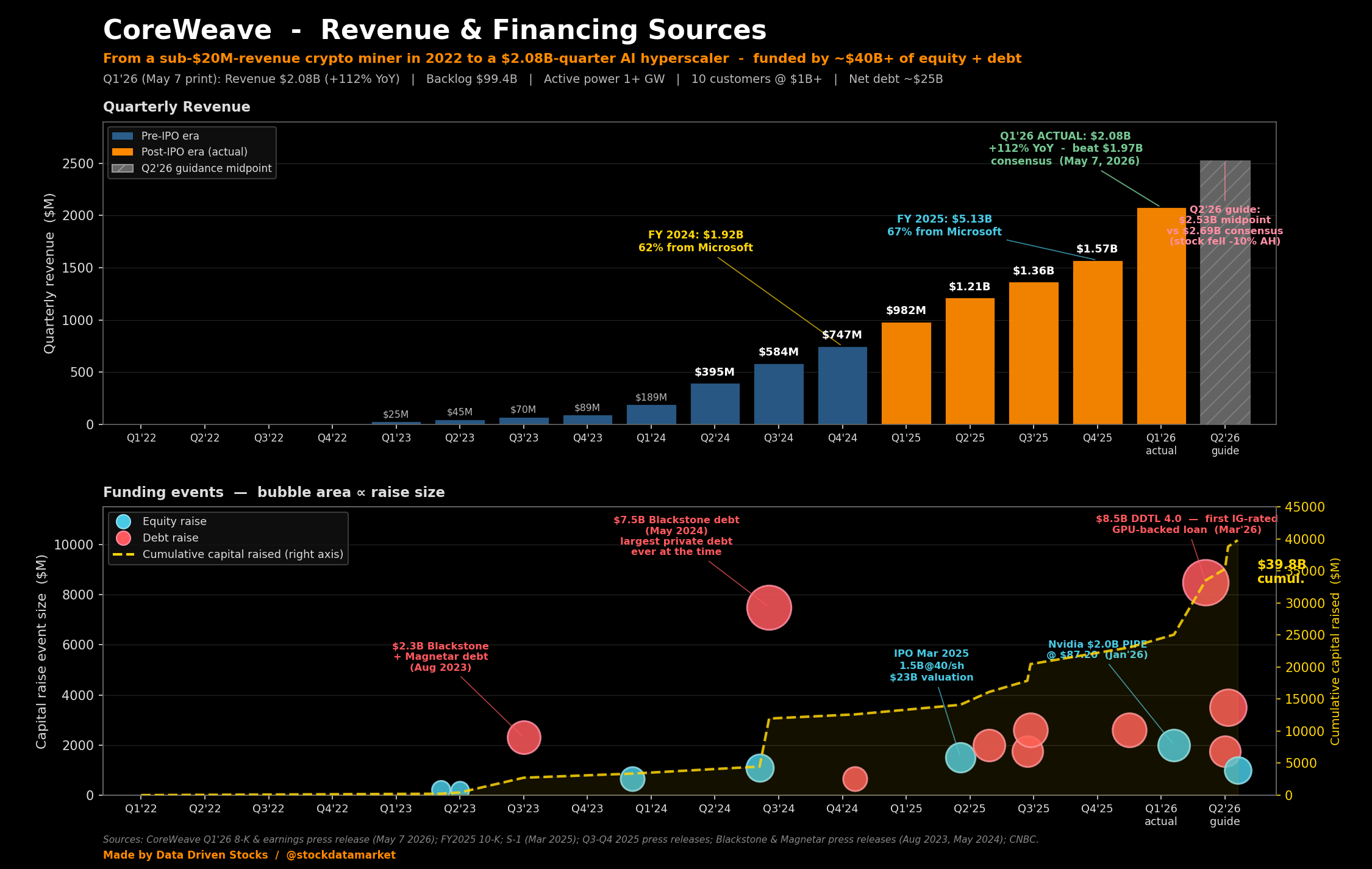
CoreWeave reported first-quarter 2026 results after the close on May 7, 2026. The headline numbers were the cleanest beat-and-miss combination Wall Street has seen from the company since the IPO. Revenue of $2.078 billion, up 112% year-over-year and ahead of the $1.97 billion LSEG consensus. A revenue backlog of $99.4 billion - up from $66.8 billion at year-end 2025, and up 284% year-over-year. Active power crossed 1 gigawatt for the first time. Ten customers are now committed to spend at least $1 billion each on the platform.
Then came the Q2 guidance. Midpoint $2.53 billion versus a $2.69 billion consensus. The stock dropped 10% after-hours.
This is the cleanest live test yet of whether CoreWeave’s economics work. The Q1 print confirmed that backlog conversion is accelerating. The Q2 guide signaled that, even at this scale, the timing of new-cluster deployments still gates near-term revenue. And in between, the company spent $7.7 billion on capex in 90 days while booking $536 million of interest expense in the same period. Below is what the data actually says.
What changed since February
When CoreWeave reported Q4 2025 in February, the picture looked like this. FY 2025 revenue $5.13 billion. Backlog $66.8 billion. Active power 850 megawatts. Microsoft 67% of FY 2025 revenue. Net debt about $21.6 billion. Q4 interest expense $388 million. Full-year 2026 revenue guidance $12-13 billion, capex $30-35 billion.
Three months later, with Q1 2026 in the book, the picture is this. Q1 revenue $2.078 billion (+112% YoY). Backlog $99.4 billion (+49% QoQ, +284% YoY). Active power above 1 GW. Total contracted power 3.5 GW (up 400 MW QoQ). Ten customers each at $1B+ of contracted spend. Net debt about $25 billion. Q1 interest expense $536 million. FY 2026 revenue guidance maintained at $12-13 billion. FY 2026 capex range raised to $31-35 billion (the low end moved up because of component prices, per CFO Nitin Agrawal). 2027 exit annualized run rate reaffirmed at over $30 billion. S&P upgraded the credit outlook from stable to positive on the print.
Two of those data points are the bull case in plain numbers. The backlog has grown by $32.6 billion in 90 days. Active power doubled relative to the original IPO-era footprint. Two of those data points are the bear case. The stock fell 10% after-hours because Q2 came in $160 million light versus consensus, and capex got bigger - again - while Q1 net loss widened to $740 million.

The Q1 print, line by line
Revenue $2.078 billion, +112% YoY versus $982 million in Q1 2025. Operating expenses $2.222 billion - meaning GAAP operating income was already negative on the quarter before any below-the-line items. Technology and infrastructure costs jumped 127% to $1.27 billion. Sales and marketing more than sextupled to $69 million. Adjusted EBITDA came in at $1.157 billion at a 56% margin - showing the underlying operating engine, before depreciation and interest, is still highly cash-generative. Adjusted net loss was $589 million; GAAP net loss was $740 million.
The single largest non-operating line on the income statement was interest expense, net of $536 million. That is up from $388 million in Q4 2025 and $264 million in Q1 2025. Q2 2026 guidance pegs the same line at $510-590 million.
Cash flow from operations was strong at $2.984 billion. The company used $7.708 billion in investing activities, of which $7.695 billion was capex on property and equipment. Cash and equivalents at quarter end stood at $2.24 billion. Property and equipment on the balance sheet rose to $36.424 billion - more than the company’s pre-IPO valuation just thirteen months earlier.

The interest expense line is what flips the operating story. Adjusted EBITDA at 56% margin says CoreWeave is profitable on a cash basis at the operating level. The $536 million quarterly interest charge says that 25.8 cents of every revenue dollar is going to bondholders and term-loan lenders before depreciation, capex, taxes, or any reinvestment in the business. That ratio stayed roughly flat from Q4 2025 (24.7%) to Q1 2026 (25.8%), but on a much bigger base. Each successive debt facility - the $8.5 billion DDTL 4.0 closed during Q1 2026 chief among them - is investment-grade rated and priced at a lower coupon than the high-yield notes outstanding, which is why the cost-of-capital trajectory does not get linearly worse despite the absolute dollar growth.
CapEx is the real headline
Revenue scaled 112% YoY. CapEx scaled even faster. The single Q1 2026 capex number - $7.695 billion - is more than three times CoreWeave’s estimated full-year 2024 capex, more than the entire IPO raise, and roughly half of all FY 2025 capex in a single quarter.

This is the line item that either justifies the entire investment thesis or sinks it. If $31-35 billion of 2026 capex translates over twelve to twenty-four months into utilized GPU capacity that converts to billable revenue, then the backlog (now $99.4 billion) starts coming down the income statement and the operating leverage shows up. If supply-chain delays, commissioning issues, or customer renegotiations slow that conversion - a risk CoreWeave already had to acknowledge once at Q3 2025 when third-party data-center developer delays forced a small revenue guide-down - then the company is spending faster than the revenue catches up, and the gap is plugged by more debt.
CFO Nitin Agrawal addressed the capex range increase directly on the call. The bottom of the range moved from $30B to $31B because of component prices. Per Agrawal: “It’s an issue, it’s a problem, but we have an incredible capacity to navigate the supply chain.” The full quote is the kind of statement that sounds confident in isolation and looks risky when it is restated as “the cost of building the asset base just went up by at least $1 billion in three months and we are not changing the revenue forecast.”
How the funding stack now looks
CoreWeave disclosed on the call that it has raised more than $20 billion of debt and equity in 2026 to date. That includes the $8.5 billion DDTL 4.0 facility - which closed during Q1 - and the $2.0 billion equity investment from Nvidia at $87.20 per share that was finalized in the same quarter.

The structural significance of DDTL 4.0 cannot be overstated. Rated A3 by Moody’s and A(low) by DBRS, with a SOFR + 2.25% floating tranche and a fixed tranche at roughly 5.9%, it is the first investment-grade-rated GPU-backed loan in market history. The non-recourse structure - except for limited customary carve-out obligations - means the lenders are taking project-level risk on the underlying GPU clusters and customer contracts, not corporate risk on CoreWeave itself. That structure had not previously existed at IG ratings. The fact that S&P then upgraded its outlook on CoreWeave’s corporate credit from stable to positive on the same day as Q1 earnings is the natural follow-on - the market is now pricing CoreWeave’s debt closer to a regulated utility than to a venture-backed neocloud.
The four customer wins announced in the Q1 release shape the next four quarters. A multi-year agreement with Anthropic to support Claude development and deployment. Expansions with Cohere, Jane Street, and Mistral. New work with Adaption Labs, Advaita Bio, Hudson River Trading, Perplexity, and World Labs. CoreWeave was also named one of the first Nvidia Exemplar Cloud providers for inference on GB200 NVL72 systems. And it announced “Flexible Capacity Plans” - Flex Reservations and Spot pricing - clearly aimed at the inference market that is now the largest growing piece of demand.
The customer book is finally diversifying
This is the area where the Q1 2026 print probably mattered the most for the long-run story. CEO Mike Intrator told analysts on the call that ten customers are now committed to spend at least $1 billion each. In 2024, two customers accounted for 77% of revenue. In FY 2025, Microsoft alone was 67%. The contracted backlog tells a different story.

The $99.4 billion backlog has a different shape than the $5.13 billion of recognized FY 2025 revenue. Microsoft was 67% of recognized 2025 revenue. Microsoft is a much smaller share of the backlog. Meta and OpenAI between them are now over half. As those contracts ramp through 2026 and 2027, the customer concentration ratio that worried the IPO market in March 2025 should mechanically come down - even if Microsoft itself does not reduce its absolute spend.
The risk that did not go away is that hyperscaler concentration was always two-sided. Microsoft was 67% of CoreWeave’s revenue. CoreWeave is a single-digit percentage of Microsoft’s compute spend. If Meta becomes 35% of CoreWeave’s revenue and OpenAI becomes 22% of CoreWeave’s revenue, the customer count moves up but each individual relationship is still capable of moving the company.
Q2 guidance and why the stock dropped 10%
The number that triggered the after-hours sell-off was Q2 revenue guidance of $2.45-2.60 billion. The midpoint of $2.53 billion was $160 million below the LSEG consensus of $2.69 billion. The Q1 beat - $2.078 billion versus $1.97 billion - was a $108 million surprise. The Q2 miss is bigger than the Q1 beat.
The mechanism is the same one that produced the Q3 2025 guide-down. CoreWeave is dependent on third-party developers to deliver data-center capacity on schedule, and on the underlying supply chain (cooling, power, networking gear) to deliver components on schedule. Mike Intrator told Reuters during the Q1 earnings cycle that Q1 would be “the lowest margin point of 2026, with recovery expected as newly deployed clusters reach full utilisation.” That sentence is bullish in 2027 and concerning in Q2 2026. The market priced the latter on the night.
Importantly, the company maintained its full-year 2026 revenue range of $12-13 billion. Mathematically that requires Q3 plus Q4 to come in at roughly $7.5 billion combined to hit the midpoint - or about $3.7 billion per quarter at the midpoint, implying 47% sequential growth from Q2’s guided midpoint. That is plausible given the backlog and the active-power doubling targeted for the second half. It is also a step-up that will get scrutinized at every interim catalyst between now and Q3 results.
What the call actually told us
The Q1 2026 call effectively confirmed three things and left one open question.
Confirmed: the backlog growth is real, accelerating, and shifting away from Microsoft. Going from $66.8B at year-end to $99.4B in 90 days, with ten customers each contracted at $1B+, with Meta upsizing to $35.2B and Anthropic signing a multi-year agreement, is not a slow rebalance - it is a structural one.
Confirmed: the capital structure is moving toward investment grade. DDTL 4.0 priced at a much lower coupon than the 9.000-9.750% Senior Notes that dominated the post-IPO debt sprint, and S&P’s outlook upgrade on the print is the public-market endorsement of the same trend. The cost of marginal debt for CoreWeave in May 2026 is materially lower than it was even six months ago.
Confirmed: scale is real, and the operating engine works at this scale. Adjusted EBITDA of $1.157 billion at 56% margin is not a rounding error - it is bigger in absolute dollars than the company’s entire 2024 revenue. The “fastest cloud in history to reach $5B” headline from February has been followed by a “fastest cloud in history to reach $2B in a quarter” headline in May.
Open question: whether the timing of revenue recognition can keep up with the capex curve. Q2 guidance below consensus is the second time in three quarters that this question has surfaced. Each time, the answer has been “supply chain timing, total contract value unchanged, revenue shifts right.” Each time, the stock has reacted. If Q2 prints in the middle of the guided range, the discussion at Q3 earnings becomes whether back-half acceleration is realistic. If Q2 surprises to the upside, the entire skepticism dissolves. If Q2 misses, the conversation about when GPU capex actually starts producing recognized GAAP revenue becomes much sharper.
What this means for the rest of the AI infrastructure complex
CoreWeave is the most heavily watched neocloud because it is the most public, the most transparent, and the most leveraged. Its capital stack is the template that other neoclouds and hyperscaler-adjacent operators are now using. Meta itself just signed a $29 billion finance package for a single Louisiana data center. Oracle raised $18 billion of debt to support OpenAI infrastructure. Investment-grade GPU-backed loans, which did not exist as a category two years ago, are now an established asset class.
The question that the May 7 print actually answered is whether the demand side of this trade is real. The answer was unambiguous: $99.4 billion of backlog from ten counterparties, mostly investment-grade credits, mostly take-or-pay. That is more demand visibility than CoreWeave - or any neocloud - had at any point in its history. The question that the May 7 print did not answer is whether the supply side can be delivered fast enough to match the demand visibility. That is the question the next two quarters will resolve.
For now, the cumulative capital line on the hero chart - the yellow dashed curve that climbed through $39.8 billion by April 2026 - keeps rising. CoreWeave disclosed roughly $20 billion more raised in 2026 alone. The asset base on the balance sheet sits at $36.4 billion of property and equipment. Active power crossed 1 GW. The backlog crossed $99 billion. And the company maintained guidance that translates the contracted backlog into recognized revenue.
That is what May 7, 2026 actually said: scale is real, demand is real, the cost of capital is improving, and the operating engine works. The remaining variable is timing. The market priced timing risk on the night. The next four quarters will tell us whether it priced it correctly.
Sources
[1] CoreWeave, “CoreWeave Reports Strong First Quarter 2026 Results,” press release, May 7, 2026. https://investors.coreweave.com/
[2] CoreWeave, Inc., Form 8-K filed May 7, 2026, with first-quarter 2026 financial results. SEC EDGAR.
[3] Jonathan Vanian, “CoreWeave (CRWV) Q1 earnings report 2026,” CNBC, May 7, 2026. https://www.cnbc.com/2026/05/07/coreweave-crwv-q1-earnings-report-2026.html
[4] CoreWeave, Q1 2026 Earnings Presentation, May 7, 2026. https://investors.coreweave.com/financials/quarterly-results/
[5] StockTitan, “CoreWeave Q1 Revenue Doubles, Backlog Hits $99.4B,” May 7, 2026. https://www.stocktitan.net/news/CRWV/
[6] StockTitan, “CoreWeave Q1 2026 AI cloud revenue surges (CRWV 8-K Filing),” May 7, 2026. https://www.stocktitan.net/sec-filings/CRWV/8-k-core-weave-inc-reports-material-event-b15570312e6c.html
[7] Benzinga, “CoreWeave Reports ‘Strongest’ Bookings In Company History, Shares Move Higher After Q1 Earnings,” May 7, 2026. https://www.benzinga.com/markets/earnings/26/05/52392338/coreweave-reports-strongest-bookings-in-company-history-shares-move-higher-after-q1-earnings
[8] Sherwood News, “CoreWeave reports modestly better-than-expected Q1 results, revenue backlog nearing $100 billion,” May 7, 2026. https://sherwood.news/markets/coreweave-q1-earnings-2026-ai-boom-neocloud/
[9] CoreWeave, Inc., Form 10-K for fiscal year ended December 31, 2025, filed with SEC. https://www.sec.gov/
[10] CoreWeave, Inc., Form S-1 Registration Statement, filed March 3, 2025. https://www.sec.gov/
[11] CoreWeave, “CoreWeave Reports Strong Fourth Quarter and Fiscal Year 2025 Results,” press release, February 26, 2026. https://investors.coreweave.com/news/news-details/2026/CoreWeave-Reports-Strong-Fourth-Quarter-and-Fiscal-Year-2025-Results/
[12] CoreWeave, “CoreWeave Reports Strong Third Quarter 2025 Results,” press release, November 10, 2025. https://investors.coreweave.com/news/news-details/2025/CoreWeave-Reports-Strong-Third-Quarter-2025-Results/
[13] CoreWeave 8-K filings for Q1 2025, Q2 2025, Q3 2025, Q4 2025 earnings press releases, SEC EDGAR. https://www.sec.gov/cgi-bin/browse-edgar?action=getcompany&CIK=0001769628
[14] CoreWeave, “CoreWeave Announces Pricing of Initial Public Offering,” press release, March 27, 2025. https://www.coreweave.com/news/coreweave-announces-pricing-of-initial-public-offering
[15] Blackstone, “CoreWeave Secures $7.5 Billion Debt Financing Facility led by Blackstone and Magnetar,” press release, May 17, 2024. https://www.blackstone.com/news/press/coreweave-secures-7-5-billion-debt-financing-facility-led-by-blackstone-and-magnetar/
[16] Blackstone, “CoreWeave Secures $2.3 Billion Debt Financing Facility led by Magnetar Capital and Blackstone,” press release, August 3, 2023. https://www.blackstone.com/news/press/coreweave-secures-2-3-billion-debt-financing-facility-led-by-magnetar-capital-and-blackstone-to-meet-surging-demand-and-ongoing-expansion-of-specialized-cloud-infrastructure-to-power-ai/
[17] Sacra, “CoreWeave revenue, valuation & funding.” https://sacra.com/c/coreweave/
[18] TipRanks, “CoreWeave Last-Minute Q1 Earnings Alert: Options Traders Expect an 18.7% Move in CRWV Stock,” May 7, 2026. https://www.tipranks.com/news/coreweave-will-report-q1-earnings-on-may-7-options-traders-expect-a-18-71-move-in-crwv-stock
[19] Annie Palmer, “CoreWeave stock closes up 12% after company lands $14 billion deal with Meta,” CNBC, September 30, 2025. https://www.cnbc.com/2025/09/30/coreweave-meta-deal-ai.html
[20] Bloomberg News, “CoreWeave Inks $14 Billion Meta Deal, Highlighting AI Demand,” September 30, 2025. https://www.bloomberg.com/news/articles/2025-09-30/coreweave-inks-14-billion-meta-deal-in-latest-sign-of-ai-demand
[21] ZeroHedge, “CoreWeave Expands Meta AI Deal To $21 Billion, Issues $4.25 Billion In New Convertible & Junk Debt,” April 2026.
[22] Tickeron, “CoreWeave (CRWV): Q1 2026 Earnings Preview Amid Surging AI Demand,” May 6, 2026. https://tickeron.com/blogs/coreweave-crwv-q1-2026-earnings-preview-amid-surging-ai-demand-13231/
[23] Startup Fortune, “CoreWeave’s Q1 earnings are a live test of whether GPU cloud economics can survive the debt they created,” May 7, 2026. https://startupfortune.com/coreweaves-q1-earnings-are-a-live-test-of-whether-gpu-cloud-economics-can-survive-the-debt-they-created/
[24] Sebastian Moss, “CoreWeave Q3 earnings show revenue backlog doubled to $55.6bn,” Data Center Dynamics, February 11, 2026. https://www.datacenterdynamics.com/en/news/coreweave-q3-earnings-show-revenue-backlog-doubled-to-556bn/
[25] Levelheaded Investing, “CoreWeave (CRWV) Q3 2025: When The Interest Bill Becomes the Story,” December 30, 2025. https://www.levelheadedinvesting.com/p/coreweave-crwv-q3-2025-when-the-interest-bill-becomes-the-story
[26] Sharon Goldman and Christiaan Hetzner, “CoreWeave earnings: Data-center operator posts $56 billion in contracted future revenue,” Fortune, November 10, 2025. https://fortune.com/2025/11/10/coreweave-earnings-infrastructure-debt-ai-bubble/
[27] Yahoo Finance / Macrotrends, “CoreWeave Revenue 2024-2025 (CRWV).” https://www.macrotrends.net/stocks/charts/CRWV/coreweave/revenue
[28] MarketScreener, “CoreWeave: First Quarter 2026 Q1’26 Earnings Presentation,” May 7, 2026. https://www.marketscreener.com/news/coreweave-first-quarter-2026-q1a-25-earnings-presentation-ce7f5bdada8bf724
[29] Futurum Group, “CoreWeave Q4 FY 2025 Results Highlight Backlog Growth And Capacity Expansion,” March 3, 2026. https://futurumgroup.com/insights/coreweave-q4-fy-2025-results-highlight-backlog-growth-and-capacity-expansion/
Note: All Q1 2026 financial figures sourced directly from CoreWeave’s May 7, 2026 earnings press release and accompanying 8-K filing on SEC EDGAR. Q2 2026 and FY 2026 guidance figures are official company guidance as stated by CFO Nitin Agrawal on the May 7, 2026 earnings conference call. Stock-price reactions sourced from CNBC and Sherwood News May 7, 2026 reporting. Nothing here is investment advice.