
America’s Job Engine Is Quietly Stalling: Inside the April 2026 Payroll Report Wall Street Is Sleepwalking Past
America’s Job Engine Is Quietly Stalling: Inside the April 2026 Payroll Report Wall Street Is Sleepwalking Past. So the job reports are as always rigged

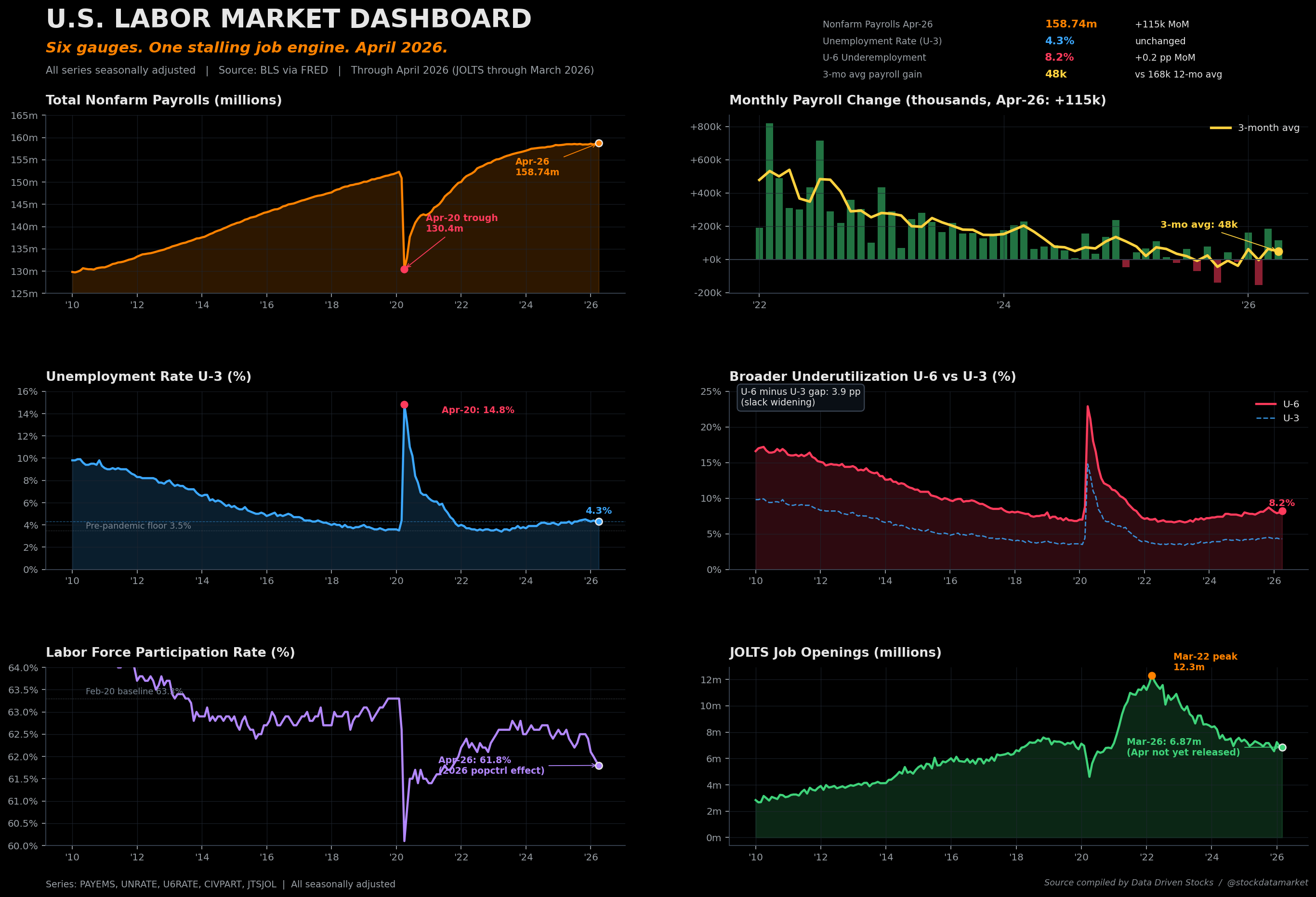
The headline bought time. The internals did not.
On May 8, 2026, the Bureau of Labor Statistics dropped a number that, on the surface, was not supposed to scare anyone. Total nonfarm payrolls rose by 115,000 in April. The Dow Jones consensus had pencilled in 55,000. Stocks ticked higher. Treasury yields drifted lower. The talking-point machine spun up, and within an hour everyone had moved on to the next data point.
That is the version Wall Street wrote up. The actual report is a more uncomfortable read.
The three-month average payroll gain has slowed to 48,000. Federal government employment continued to decline. Information employment is down 11.0% from its November 2022 peak. The household survey says employment fell by 226,000 in April. The number of Americans working part time because they cannot find full-time work jumped by 445,000 in a single month, to 4.9 million. The U-6 underemployment rate climbed to 8.2%, which is 1.2 percentage points above its February 2020 baseline. Labor force participation slipped again, to 61.8%, the lowest reading since October 2021.
The April report did not break the labor market. It confirmed something subtler and arguably more important. The U.S. job engine is not collapsing. It is freezing. And the longer it sits frozen, the larger the eventual unfreezing has to be.
The +115k headline by sector
The +115k figure does not come from broad-based hiring. It comes from three sectors carrying everyone else.
Health care and social assistance added 53,900 jobs, of which 37,300 was health care and 16,600 was social assistance. That is essentially the same number this sector has added every single month for the past year and a half. Transportation and warehousing added 30,300, almost entirely from couriers and messengers. Retail trade added 21,800, with warehouse clubs and supercenters doing most of the lifting. Construction chipped in 9,000.
Add those four together and you get 115,000. That is the entire headline gain. The rest of the economy is roughly net flat, with notable drags from professional and business services (-18k), information (-13k), financial activities (-11k), and government (-8k).

For a more visual feel of how the +115k assembles itself one sector at a time, the animated waterfall below walks through it.

This is what economists mean by “narrow breadth.” The Atlanta Fed’s diffusion-style measures and BLS’s own one-month diffusion index have been hovering near 50 for months, which is the threshold where roughly half of industries are growing and half are shrinking. A healthy expansion typically runs at 60 to 65. April’s print is consistent with that recent narrow regime.
Two surveys, two stories
The single most important thing to understand about the April release is that it contained two contradictory verdicts on the same labor market. The establishment survey said the U.S. economy added 115,000 jobs. The household survey said the U.S. economy lost 226,000 employed persons. These are not noise around each other. They are pointing in opposite directions.

The two surveys disagree because they are measuring different things. The establishment survey, also called CES, samples about 119,000 businesses and government agencies covering 622,000 worksites and counts payroll jobs. If you hold two jobs you are counted twice. Furloughed federal workers who received pay during the partial government shutdown are still counted. The 90% confidence interval on the monthly change is roughly ±122,000 jobs.
The household survey, also called CPS, samples about 60,000 households and counts employed persons. One person, one count, no matter how many jobs they hold. Self-employed and unpaid family workers are included. The 90% confidence interval on monthly change in unemployment is roughly ±425,000 persons and ±0.3 percentage points on the unemployment rate. That is a much wider band, which is one reason single-month CPS moves should not be over-read.
But April’s CPS print is also entangled with a methodological break. With the January 2026 release, BLS applied updated population controls to the CPS, and that adjustment alone lowered the labor-force participation rate by 0.4 percentage point and the employment-population ratio by 0.5 percentage point. Historical CPS data before 2026 were not back-revised. So a meaningful piece of what looks like a year-over-year deterioration in the household survey is a comparability break, not new economic damage.
The schema below lays out the structural differences side by side.

The unbroken federal drag
Roughly half of every recent jobs report’s downside surprise has come from the same place: federal government payrolls. And it is not subtle.
Federal employment peaked in October 2024 at about 3.013 million. By April 2026 it had fallen to roughly 2.665 million. That is a decline of about 348,000 jobs, or close to 11.5% of the federal workforce, in eighteen months. BLS’s own March 2026 release stated the figure at -355,000 since the October 2024 peak, or -11.8%. Pick whichever vintage you prefer; the point is that this is the biggest sustained reduction in federal employment in the modern data series.

The mechanism is well documented. The “deferred resignation offer” rolled out in early 2025 paid federal employees to separate later in the year, and that cohort came off payroll in October 2025, producing the spectacular -162k single-month reading the BLS itself called out. Reductions in force at multiple agencies followed. A government shutdown produced furlough complications that BLS partially papered over via its standard rule, which counts furloughed federal employees as employed if they worked or received pay during the pay period containing the 12th of the month. The official April number was federal -9k, on top of -15k in March, -37k in January, -11k in December 2025, and so on.
State and local government are doing something completely different. Indexed to February 2020, state employment is at 103.1 and local is at 103.3. Both are still climbing. Federal sits at 93.3, well below its pre-pandemic level. The government sector in aggregate is a public-sector tale of two cities.

This matters for forecasting. If federal employment had merely held steady from its peak, the April headline would have been roughly +124k, the three-month average would be near 70k instead of 48k, and the conversation about “labor market stalling” would be muted. The slowdown is not entirely a private-sector phenomenon. A meaningful slice of it is the federal workforce reduction working its way through the data.
The hidden underemployment story
The April unemployment rate held at 4.3%. The narrative around stable U-3 misses what was happening underneath. The number of Americans working part time for economic reasons (often called slack work) jumped 445,000 in a single month, to 4.94 million. That is the largest one-month increase outside of pandemic distortions in recent memory. These are people who would prefer full-time work and cannot find it. They are still counted as employed in U-3, which is why the headline rate looked unchanged. They show up in U-6.
U-6 climbed from 8.0% in March to 8.2% in April. The U-6 minus U-3 spread, which is a clean read on slack at the margin of the workforce, widened to 3.9 percentage points. That is the highest reading outside of crisis periods in the past several years.

The April rise is not a clean signal yet. Slack work is volatile month to month. But combined with the LFPR slip, the household-employment decline, and the rising long-jobless count (people jobless less than five weeks rose by 358,000 to 2.5 million), it suggests that pressure on hours and on the quality of available employment is building, even as the headline rate holds. The labor market can deteriorate in two ways: through outright job losses, or through a slow erosion of the kind of jobs available. The April report is the latter.
Revisions: monthly noise on top of an annual hammer
There is a structural problem with how analysts have been processing payroll data this year, and it is the revision regime.
Take April’s release first. February 2026 was revised down 23,000, from -133k to -156k. March 2026 was revised up 7,000, from +178k to +185k. Net: February-March combined are 16,000 lower than previously reported. That is small.
Now zoom out. In the November 2025 release, BLS revised August down -22k and September down -11k. In the December release (delayed to January 9 because of the shutdown), October went from -105k to -173k, and November moved from +64k to +56k. In the January 2026 release, the annual benchmark recalculation was applied. And that is where it stops being noise.

The 2025 benchmark cycle reduced the seasonally adjusted March 2025 nonfarm employment level by 898,000. The not-seasonally-adjusted cut was 862,000. That benchmark revision was 7.5 times the size of the prior decade’s average absolute benchmark revision of 0.2%. The cumulative result was that 2025 payroll growth, which had been originally tracked at +584k for the full year, was retroactively cut to +181k. That is a -403,000 haircut to the labor market’s perceived strength last year, applied months after Wall Street and the Fed had built their priors on the original numbers.
The mechanism behind that cut is reasonably well understood. The CES survey is sample-based and corrected once a year against the Quarterly Census of Employment and Wages (QCEW), which uses near-universe unemployment-insurance tax records. Two factors drove the gap. First, businesses in the CES sample reported less employment to QCEW than they reported to CES (response error). Second, the post-2020 birth-death model overshot. BLS now starts incorporating current sample information each month into the birth-death framework, beginning with the January 2026 release, in an attempt to reduce future overestimates.
What this means for analysts is awkward. Every monthly print published in 2025 was, with hindsight, too optimistic by about 50-75k jobs per month on average. The April 2026 print of +115k, then, should be read with a quiet mental adjustment: the post-benchmark vintage of this number, when it arrives in February 2027, is more likely to be lower than higher. That does not mean the April print was wrong. It means the system has a known direction-of-error that you can plan around.
JOLTS: the labor market is freezing in place
JOLTS is the cleanest read on demand for workers. The latest available reading is March 2026, because April’s JOLTS is not due until June 2, 2026. In March, total job openings stood at 6.866 million, down 56k from February and down 86k from a year earlier. The openings rate fell to 4.1%.
That is not a dramatic vacancy collapse. It is a vacancy normalization. Compared to the March 2022 peak of 12.30 million openings, the U.S. economy has shed roughly 5.4 million job vacancies. Compared to a pre-pandemic 2019 baseline near 7.0 million, openings are now slightly below that level. Demand for workers has cooled all the way back through the post-COVID excess and is starting to pierce into the soft side of normal.

What is striking is what happened to the flows. Hires are running near 5.55m a month, well below the 6.0-6.5m range that prevailed in 2022. Quits have collapsed from a peak above 4.4m to 3.17m. Layoffs have actually stayed low at 1.87m. This is the textbook low-hire / low-fire pattern that economists associate with frozen labor markets. Employers are not aggressively cutting, but they are not aggressively hiring either. Workers have stopped quitting voluntarily because they perceive the outside option as worse than where they are. Federal Reserve Bank of Chicago President Austan Goolsbee summarized the regime in a CNBC interview after the April print as a labor market that has been “pretty much stable for a year, year and a half.” Stable is correct. Stable is not the same thing as good.
What is actually driving this
Five forces are converging on the U.S. labor market simultaneously, and each of them deserves to be priced into the forecast.
The first is monetary policy still working through the system. The Fed’s policy rate, after a tightening cycle that peaked in 2023, has come down only modestly. Real rates remain elevated relative to the post-2008 era. Interest-sensitive sectors, particularly housing, manufacturing, and parts of professional services, have absorbed the brunt of that. Information employment being down 11% from its 2022 peak is the canonical example. Cheap-money tech hiring expansion of 2021-2022 has been unwound, and the unwind is still happening in motion picture, sound recording, data processing, and web hosting subsectors.
The second is federal workforce reduction as fiscal policy. The 348-355k decline in federal employment since October 2024 is not a labor-market accident; it is a deliberate executive-branch policy choice to shrink the federal civilian workforce. That policy creates direct payroll subtraction every month and indirect drags on federal contractor employment within professional and business services, which has been bleeding jobs for almost a year.
The third is the AI-and-automation displacement story, which is real but harder to isolate cleanly in the macro data. The hiring slowdown in white-collar adjacent categories (information, professional and business services, financial activities) is consistent with firms being more cautious about adding mid-level knowledge workers when generative AI tools can absorb a meaningful slice of the workload. The unemployment rate for young workers aged 16-24 is now at 9.5% per the Economic Policy Institute’s analysis of the April release, which is 5.2 percentage points above the headline 4.3%. Entry-level pathways are narrowing.
The fourth is immigration enforcement and the labor-supply side. Reduced inflows of working-age immigrants in 2025-2026 mechanically reduce both the labor force and employment. Some of the LFPR weakness may reflect this on the supply side rather than discouraged-worker dynamics on the demand side. BLS’s 2026 population controls partially capture the level shift but not the flow.
The fifth is the geopolitical overhang. Tariff regimes, Middle East tensions, and the energy-price volatility that comes with both have made U.S. firms more conservative on capex and headcount commitments. That is consistent with the observed low-quit / low-hire JOLTS pattern. Brown Brothers Harriman’s chief investment strategist Scott Clemons described the report as “evidence of the underlying resilience of this economy and of this labor market, despite all of the slings and arrows of outrageous concerns about the Middle East and unemployment and inflation and the Fed.” Resilience is fair; reactive caution is also fair.
None of these is sufficient on its own to explain the slowdown. Together, they explain the regime: stable but soft, narrow but not collapsed, with downside risk concentrated in white-collar and federal-adjacent employment.
What the next twelve months probably look like
A simple AR(1) extrapolation, anchored to a breakeven rate of about 80k jobs per month and a terminal unemployment rate of 4.6%, fit on data from June 2022 forward, suggests the following. The 3-month average payroll gain drifts up gradually from 48k in April 2026 to about 71k by mid-2027, with an 80% confidence band running from -64k to +200k. The unemployment rate drifts up from 4.3% to about 4.4% by mid-2027 median, with an 80% band of 4.0% to 4.9%. These are not forecasts that say a recession is starting. They are forecasts that say slack is building slowly.

The next two data points to watch are obvious. JOLTS for April 2026 lands on June 2, 2026; the May 2026 Employment Situation lands on June 5, 2026. If June’s payroll print is below 50k and the federal drag continues, the conversation will shift from “stable but soft” to “actively softening.” If JOLTS openings break below 6.5 million, that will be the cleanest signal that vacancy demand has rolled over into outright contraction territory. Watch the part-time for economic reasons series too. If it does not retrace at least half of the 445k April spike, U-6 will keep climbing even with U-3 unchanged, and the slack story becomes the story.
A slowdown that does not show up cleanly in the unemployment rate but does show up in revisions, in U-6, in part-time-for-economic-reasons, and in JOLTS quits is the kind of slowdown markets price slowly and central banks miss for a few months at a time. The April 2026 employment report is consistent with that pattern. The labor market is not breaking. It is sitting on its hands. And the longer it sits, the bigger the eventual move.
Sources and primary references
Bureau of Labor Statistics, Employment Situation - April 2026, May 8, 2026 release. https://www.bls.gov/news.release/empsit.nr0.htm and the archived version at https://www.bls.gov/news.release/archives/empsit_05082026.htm.
Bureau of Labor Statistics, Employment Situation technical note. https://www.bls.gov/news.release/empsit.tn.htm
Bureau of Labor Statistics, Employment Situation Table A-1, A-15, B, B-1. https://www.bls.gov/news.release/empsit.t01.htm and https://www.bls.gov/news.release/empsit.t15.htm
Bureau of Labor Statistics, Job Openings and Labor Turnover Survey - March 2026, May 5, 2026 release. https://www.bls.gov/news.release/jolts.nr0.htm
Bureau of Labor Statistics, Current Employment Statistics National Benchmark Article, February 11, 2026. https://www.bls.gov/web/empsit/cesbmart.htm
Bureau of Labor Statistics, Employment Situation - November 2025, December 16, 2025 release (federal -162k October 2025 detail). https://www.bls.gov/news.release/archives/empsit_12162025.htm
Bureau of Labor Statistics, Total nonfarm payroll employment changed little in November 2025, The Economics Daily. https://www.bls.gov/opub/ted/2025/total-nonfarm-payroll-employment-changed-little-in-november-2025.htm
Bureau of Labor Statistics, Employment Situation Release Schedule. https://www.bls.gov/schedule/news_release/empsit.htm
Federal Reserve Economic Data (FRED), Federal Reserve Bank of St. Louis, series PAYEMS, USPRIV, USGOVT, UNRATE, U6RATE, CIVPART, EMRATIO, CE16OV, UNEMPLOY, CLF16OV, JTSJOL, JTSHIL, JTSQUL, JTSLDL, USEHS, USTRADE, USCONS, USINFO, USFIRE, USPBS, USTPU, USLAH, MANEMP, USMINE, CES9091000001, CES9092000001, CES9093000001, LNS12032194, AHETPI, CES0500000003. https://fred.stlouisfed.org
CNBC, Jobs report April 2026: U.S. payrolls increased 115,000 in April, more than expected; unemployment at 4.3%, May 8, 2026. https://www.cnbc.com/2026/05/08/jobs-report-april-2026.html
Economic Policy Institute, Jobs Day analysis - April 2026. https://www.epi.org/indicators/unemployment/
Wolf Street, Annual Benchmark Payroll Revisions: Nonfarm Job Creation for 12 Months to March Chopped by 911,000, September 9, 2025 (preliminary benchmark detail). https://wolfstreet.com/2025/09/09/annual-benchmark-payroll-revisions-nonfarm-job-creation-for-12-months-to-march-chopped-by-911000-to-1-45-million-jobs-created/
MMG Real Estate Advisors, The January 2026 Jobs Report and 2025 Benchmark Revisions: What Changed, Why It Changed, and How to Read the Surprise. https://mmgrea.com/january-2026-jobs-report-2025-benchmark-revisions/
Trading Economics, United States Non Farm Payrolls. https://tradingeconomics.com/united-states/non-farm-payrolls
Roth Staffing Companies, BLS: U.S. Economy Adds 115,000 Jobs in April 2026. https://www.rothstaffing.com/bls-u-s-economy-adds-115000-jobs-in-april-2026/
Compiled and analyzed by Data Driven Stocks / @stockdatamarket. All charts built from FRED time-series data; methodology and code available on request. This piece is research, not investment advice.

